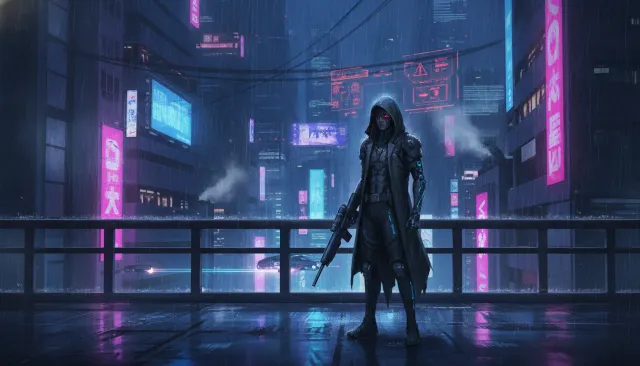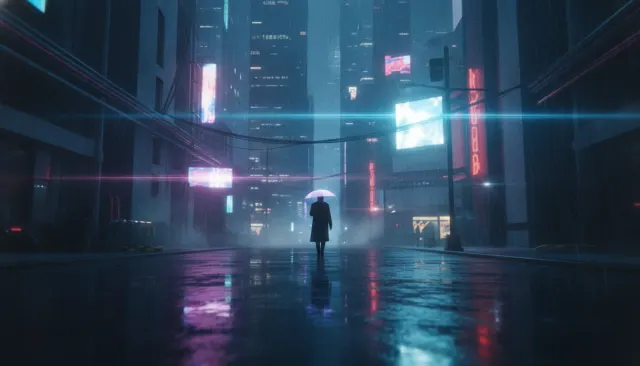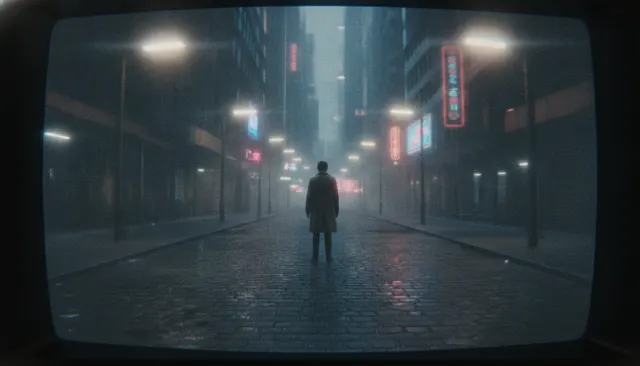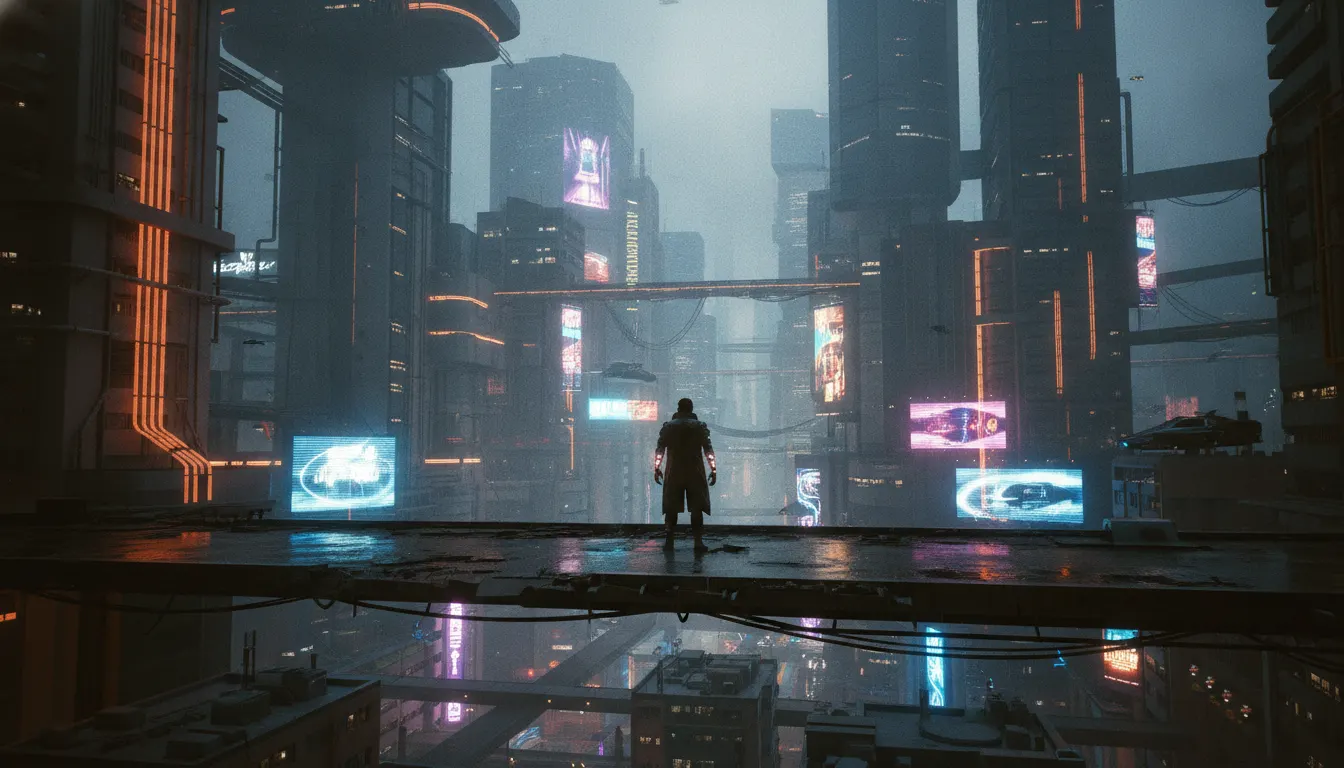
Cyberpunk 2077 (CD Projekt Red, 2020)
the defining reference
Cyberpunk 2077 CD Projekt Red neon-noir aesthetic. Night City vertical megastructure, holographic billboard saturation, RTX path-traced reflections.
The moves a human crew would use to get here. Cue applies them for you, and knowing their names is how you ask for a change.
~80% deep shadow to ~20% saturated neon color source
hot pink/magenta, cyan, electric orange-amber, acid yellow - not pastel
cool blue corporate high vs. warm amber/red street low
multiple overlapping illuminated signs at different scales and languages
traced or simulated global illumination bounce from colored neon sources into surrounding environment
Cyberpunk 2077 (CD Projekt Red, 2020) adapts Mike Pondsmith's Cyberpunk 2020 tabletop RPG universe (R. Talsorian Games, 1988) into a first-person open-world environment. The game's art director Kacper Niepokólczycki oversaw one of the largest and most ambitious stylized-realism environment designs in gaming history: Night City, a fictional coastal California megacity perpetually at night, drenched in neon, layered with corporate architecture above and favela infrastructure below.
Night City's visual identity is defined by extremely high-contrast neon color - hot pink, cyan, electric orange, acid yellow - set against very dark environment bases (wet asphalt, deep shadow, unlit concrete). This follows the Blade Runner (Ridley Scott, 1982) color vocabulary that William Gibson's Neuromancer (1984) codified as cyberpunk's visual language. The ratio is crucial: approximately 80% deep shadow and 20% hyper-saturated light. Too much neon and the darkness loses its oppressive weight.
The art direction encodes class hierarchy spatially. Corporate towers (Arasaka, Militech) are glass, steel, clean lighting, and cool blues. Street-level Pacifica and Heywood are warm amber/red sodium vapor, exposed cabling, vendor stalls, rust, and aging neon signs. The Badlands outside the city are brown dust, bleached color, and natural light - relief from the city's density. This vertical and geographic color stratification communicates world-building through art direction alone.
Character fashion and body modification design follows two opposing aesthetic poles. Corporate characters wear clean-lined formal wear with subtle enhancement (implants concealed). Street characters layer extreme visible body modification, grafted technology, neon-tattooed skin, and maximalist fashion mixing cultural references from Afro-Caribbean, Japanese, Mexican, and Eastern European sources. This maximalist street fashion language became influential in music video art direction post-2020.
The game used ray-traced reflections and global illumination to render neon light bouncing in wet surfaces, pooling in puddles, and refracting through rain. This technical ambition defined how cinematic night-city environments were rendered across games, film VFX, and commercial production.
the defining reference
originating cinematic cyberpunk color language
evolved neon palette by cinematographer Roger Deakins
literary origin of the aesthetic
anime parallel neon city at night
amber cyberpunk aesthetic predecessor
anime cyberpunk city visual precedent
A Look is not a filter. It is a set of stored decisions the pipeline reads before it makes a single frame, so two videos in the same Look actually match.