SUBGENRE ACTION DARKER · CONTEMPORARY · JAPAN
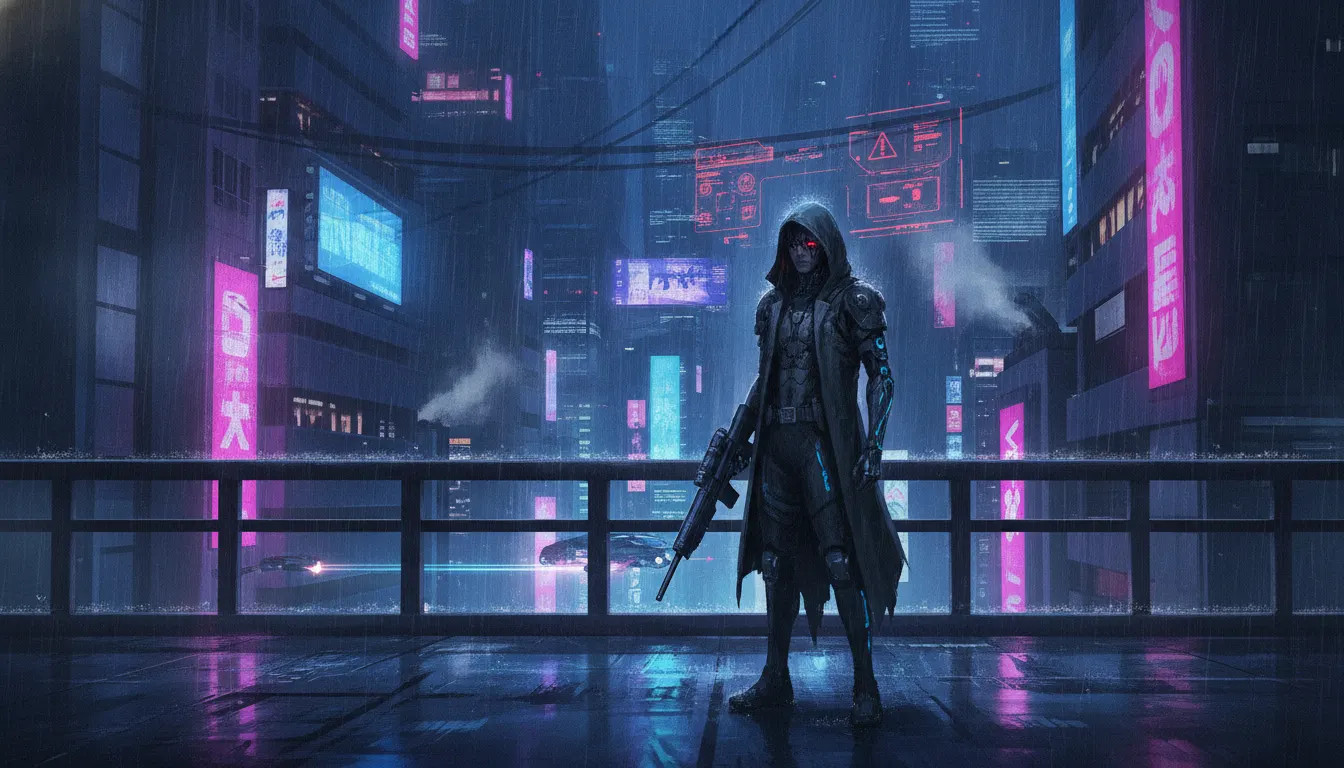
Cyberpunk Anime Akira Modern
Modern cyberpunk anime register inspired by Akira lineage (Cyberpunk Edgerunners, Psycho Pass, Ghost in the Shell SAC). Neon-rain Tokyo, augmented bodies, glitchy HUD overlays.
cyberpunkneongrittyaugmented
LUT cyberpunk-neon-rain
WHEN TO USE
- Tech, AI, or gaming content where cyberpunk visual language signals future-forward subject matter
- Urban nighttime content requiring neon-saturated, rain-soaked atmospheric aesthetic
- Content for audiences with overlap between anime fandom and tech/gaming culture - an extremely large demographic
- Brand campaigns for technology, gaming, or entertainment companies wanting cultural edge
- Music content for electronic, synthwave, or cyberpunk genre music
- Content exploring technology's relationship with humanity and identity
WHEN NOT TO USE
- Daytime or nature content where the night-and-neon palette is fundamentally mismatched
- Children's content where cyberpunk's violence, body horror, and social despair themes are inappropriate
- Pastoral, historical, or warm-register brand content
- Content requiring hopeful or optimistic emotional register where the dystopian aesthetic contradicts
SIGNATURE TECHNIQUES
How the look is made.
The moves a human crew would use to get here. Cue applies them for you, and knowing their names is how you ask for a change.
- 01Luminous
vs-dark contrast: neon signage and holograms against rain-soaked unlit concrete
- 02Vertical urban stratification
elevated corporate infrastructure over slum street level
- 03Otomo
style miniature-referenced city rendering: urban environment with apparent causal architectural history
- 04Body modification and implant visualization
glowing circuitry under skin, mechanical augmentation joints
- 05Rain as visual texture layer
falling rain catching neon reflections against dark street surfaces
- 06Holographic advertisement as environmental narrative
corporate brand saturation of public space
- 07Imaishi hyper
kinetic action animation: extreme speed smears, trauma visualization, body destruction
HISTORY & CONTEXT
Where it comes from.
Cyberpunk Anime: From Akira to Modern (1988-Present)
Cyberpunk as an anime aesthetic emerges from the 1982-1988 convergence of two streams: American cyberpunk fiction (William Gibson's Neuromancer, 1984; Philip K. Dick's adaptations) and Japanese urban anxiety about technology, economic excess, and social fragmentation during the 1980s bubble economy. Akira (Tokyo Movie Shinsha, director Katsuhiro Otomo, 1988) is the originating text, but the tradition runs through Ghost in the Shell (Production I.G, director Mamoru Oshii, 1995), Serial Experiments Lain (Triangle Staff, 1998), Texhnolyze (Madhouse, 2003), and into contemporary work like Cyberpunk: Edgerunners (Trigger, 2022).
Visual Architecture of Anime Cyberpunk
The anime cyberpunk visual vocabulary is built on a consistent set of contrasts: the luminous (neon signage, holographic advertisement, bioluminescent implants, data visualization) against the dark (rain-soaked streets, unlit concrete undercity, overcast sky that reflects neon rather than admitting daylight). Vertically stratified environments - elevated highways over slums, corporate towers over street-level poverty - make the social stratification of cyberpunk society architecturally legible.
Neo-Tokyo in Akira is rendered at 1/25th scale model photography precision, with Otomo's team building detailed miniatures of the urban environment before animating. The resulting city feels like a physically real place rather than a painted backdrop - individual advertising signs, traffic patterns, and urban infrastructure accumulate into a world with apparent causal history.
Ghost in the Shell and the Philosophical Thread
Ghost in the Shell (1995) added the philosophical dimension that distinguishes literary cyberpunk from action thriller: Major Kusanagi's identity crisis - whether a consciousness running on synthetic hardware constitutes a person - is externalized through visual strategies. Oshii's frequent still shots of the city, the underwater sequence, and the final network upload sequence use visual silence and environmental observation to create reflective space that action-oriented cyberpunk anime typically avoids.
Cyberpunk: Edgerunners (2022) and the Synthesis
Cyberpunk: Edgerunners (Trigger, director Hiroyuki Imaishi, 2022) represents the current state-of-the-art. Working within CD Projekt Red's Cyberpunk 2077 world, Trigger's production synthesized Imaishi's hyper-kinetic action animation style (Gurren Lagann, Kill la Kill) with Night City's art direction. The result extends the anime cyberpunk tradition into its fourth decade while incorporating contemporary concerns: corporate body modification, mental health under capitalism, the compressed timescales of the gig economy.
NOTABLE WORKS
Where you have seen it.
*Ghost in the Shell*, Production I.G, director Mamoru Oshii, 1995
*Ghost in the Shell: Stand Alone Complex*, Production I.G, director Kenji Kamiyama, 2002-2003
*Serial Experiments Lain*, Triangle Staff, director Ryutaro Nakamura, 1998
*Texhnolyze*, Madhouse, director Hiroshi Hamasaki, 2003
*Cyberpunk: Edgerunners*, Trigger, director Hiroyuki Imaishi, 2022
*Blame!*, Polygon Pictures, director Hiroyuki Seshita, 2017
THE RECIPE
The exact knobs
the renderer turns.
A Look is not a filter. It is a set of stored decisions the pipeline reads before it makes a single frame, so two videos in the same Look actually match.
SettingValue
GradeColour LUT applied to every frame
cyberpunk-neon-rainTransitionHow one shot becomes the next
hard cuts · 140ms · linearKen BurnsCamera move applied to stills
Slow push · 0.06 · centerTypographyDisplay / body / mono pairing
IBM Plex Mono · Inter · JetBrains MonoMusic moodWhat the bed under the voice sounds like
industrial-synth · dark-electronicPrompt suffixAppended to every shot prompt in this Look
modern cyberpunk anime, Akira Cyberpunk Edgerunners Psycho Pass Ghost in the Shell SAC style, neon-rain Tokyo, augmented bodies, glitchy HUD overlaysPALETTE
Primary
#FF2D5E
Secondary
#5BC0EB
Accent
#FFE066
Text/Light
#0A0A14
Text/Dark
#F4ECDC
BG 900
#0A0A10
BG 800
#15151F
RELATED LOOKS
Next to it on the shelf.
Your first cut
is on us.
+ New videoFree plan · no card · 1080p export