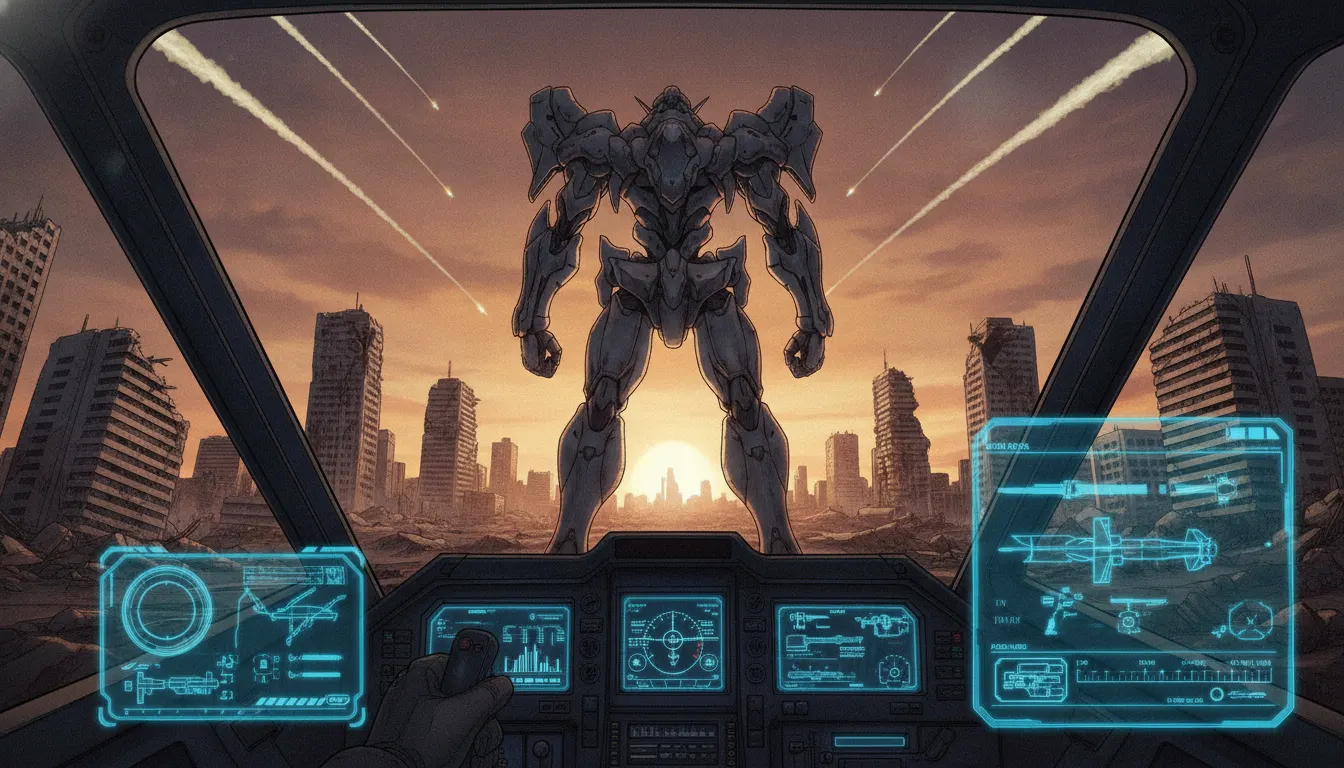
SUBGENRE MECHA · CONTEMPORARY · JAPAN
Gundam Mecha Detailed
Detailed mecha anime register (Gundam, Evangelion, Code Geass). Hand-drawn panel-line mech detail, cockpit HUD interiors, missile-trail spectacle.
militaristicmechanicaltacticalepic
LUT mecha-tactical
WHEN TO USE
- Mecha, military sci-fi, or space opera content requiring functional-plausibility mechanical design over fantasy exaggeration
- Content targeting Gundam's extremely large and passionate multi-generational fan base directly
- Brand campaigns for mechanical products, engineering, or precision manufacturing where the detailed-hardware aesthetic is relevant
- Model kit, hobby, or craftsmanship content referencing Gunpla as a cultural practice
- War drama content where the mecha serves as metaphor for industrial-scale conflict
- Content requiring the ability to age, weather, and customize a mechanical design for narrative purposes
WHEN NOT TO USE
- Fantasy or magic content where the industrial military aesthetic is tonally mismatched
- Children's content where the war drama themes and mechanical complexity are unsuitable (though SD Gundam exists for this purpose)
- Comedy content requiring expressive organic characters where mechanical rigidity limits emotional range
- Content requiring fast visual read at small size where panel line detail becomes noise
SIGNATURE TECHNIQUES
How the look is made.
The moves a human crew would use to get here. Cue applies them for you, and knowing their names is how you ask for a change.
- 01Rectangular industrial mobile suit forms suggesting functional military hardware over fantastical robot design
- 02V-fin antenna as unit identification shorthand across all Gundam-lineage designs
- 03Katoki Hajime panel lining
engraved surface details simulating access hatches, hull plating, maintenance panels
- 04In
universe military marking system: unit identification codes, caution labels, sensor calibration markings
- 05Color blocking as applied paint rather than intrinsic surface color - military vehicle paint convention
- 06Beam saber and beam rifle weapon design
energy weapon standardization across the franchise
- 07Gunpla weathering and battle damage
scratched paint, oil stain panel washing, chipping effects
HISTORY & CONTEXT
Where it comes from.
Gundam and the Detailed Mecha Aesthetic
Mobile Suit Gundam (Sunrise, director Yoshiyuki Tomino, 1979-1980) originated one of the most commercially durable franchises in Japanese media history and established the aesthetic vocabulary for "real robot" mecha anime - a genre distinction from "super robot" shows (Mazinger Z, Getter Robo) where mechanical designs prioritize functional plausibility over fantastical exaggeration. Across forty-five years of franchise extensions, the Gundam visual system has maintained consistent mechanical design principles while evolving through multiple artists and production eras.
Kunio Okawara and the Original Gundam Design System
Mechanical designer Kunio Okawara created the original RX-78-2 Gundam design - and the vocabulary it established. Rather than the rounded, creature-like forms of Mazinger or the sleek aerodynamic profiles of Macross Valkyries, the original Gundam is a rectangular, industrial-looking bipedal machine. It has a V-fin antenna (standard military hardware iconography), a mono-eye sensor that expresses emotion by moving position, and color blocking that reads as applied military paint rather than intrinsic surface color. The design principle is that a mobile suit is ground-based military hardware that happens to be human-scaled - every panel, joint, and thruster suggests functional purpose.
Katoki Hajime and the Ver.Ka Line
Mechanical designer Katoki Hajime, working on Gundam 0083 (Sunrise, 1991-1992), Gundam Wing (Sunrise, 1995-1996), and the "Master Grade Ver.Ka" model kit line (Bandai, 2000-present), represents the franchise's most detailed and influential design contribution. Katoki's approach adds panel lines - engraved surface details suggesting access hatches, hull plating, and maintenance panels - that give mobile suits the visual density of full-scale military hardware. His units also carry unit identification markings, caution labels, and sensor calibration marks that function as in-universe signage. The result reads as authentic military equipment from a parallel world rather than a cartoon robot.
Model Kit Culture and the Gunpla Aesthetic
Bandai's Gunpla (Gundam plastic model) kits, available continuously since 1980, are the primary commercial engine of the franchise and the medium through which the Gundam mechanical aesthetic reaches the widest audience. The evolution of kit quality - from 1/144 snap-fit basics to 1/100 Master Grade with interior cockpit detail and LED accommodation - parallels the evolution of the mechanical design language. Gunpla building culture (nippers, panel lining, top coat, weathering) has created a secondary aesthetic tradition of battle-damaged, weathered, and customized mobile suit finishes.
NOTABLE WORKS
Where you have seen it.
*Mobile Suit Zeta Gundam*, Sunrise, director Yoshiyuki Tomino, 1985-1986
*Gundam 0083: Stardust Memory* OVA, Sunrise, 1991-1992 (Katoki Hajime mechanical design debut)
*Mobile Suit Gundam Wing*, Sunrise, 1995-1996 (Katoki designs Wing Gundam Zero Custom)
*Mobile Suit Gundam: Iron-Blooded Orphans*, Sunrise, director Tatsuyuki Nagai, 2015-2017
*Mobile Suit Gundam: The Witch from Mercury*, Sunrise, director Hiroshi Kobayashi, 2022-2023
Kunio Okawara and Katoki Hajime, mechanical designers, defining Gundam visual vocabulary
THE RECIPE
The exact knobs
the renderer turns.
A Look is not a filter. It is a set of stored decisions the pipeline reads before it makes a single frame, so two videos in the same Look actually match.
SettingValue
GradeColour LUT applied to every frame
mecha-tacticalTransitionHow one shot becomes the next
hard cuts · 160ms · linearKen BurnsCamera move applied to stills
Slow push · 0.07 · centerTypographyDisplay / body / mono pairing
Orbitron · Inter · JetBrains MonoMusic moodWhat the bed under the voice sounds like
orchestral-militaristic · driving-rockPrompt suffixAppended to every shot prompt in this Look
Gundam Evangelion Code Geass mecha anime, detailed panel-line mech shading, cockpit HUD interior, missile trails, hand-drawn mechPALETTE
Primary
#2A4D7A
Secondary
#E0E2E5
Accent
#E03E3E
Text/Light
#0F1622
Text/Dark
#E8EEF5
BG 900
#0A1018
BG 800
#16223A
RELATED LOOKS
Next to it on the shelf.


Your first cut
is on us.
+ New videoFree plan · no card · 1080p export