South Park Season 1
Trey Parker + Matt Stone / Comedy Central · 1997
Original season establishing the paper-cutout digital aesthetic - 'Cartman Gets an Anal Probe', 'Weight Gain 4000'
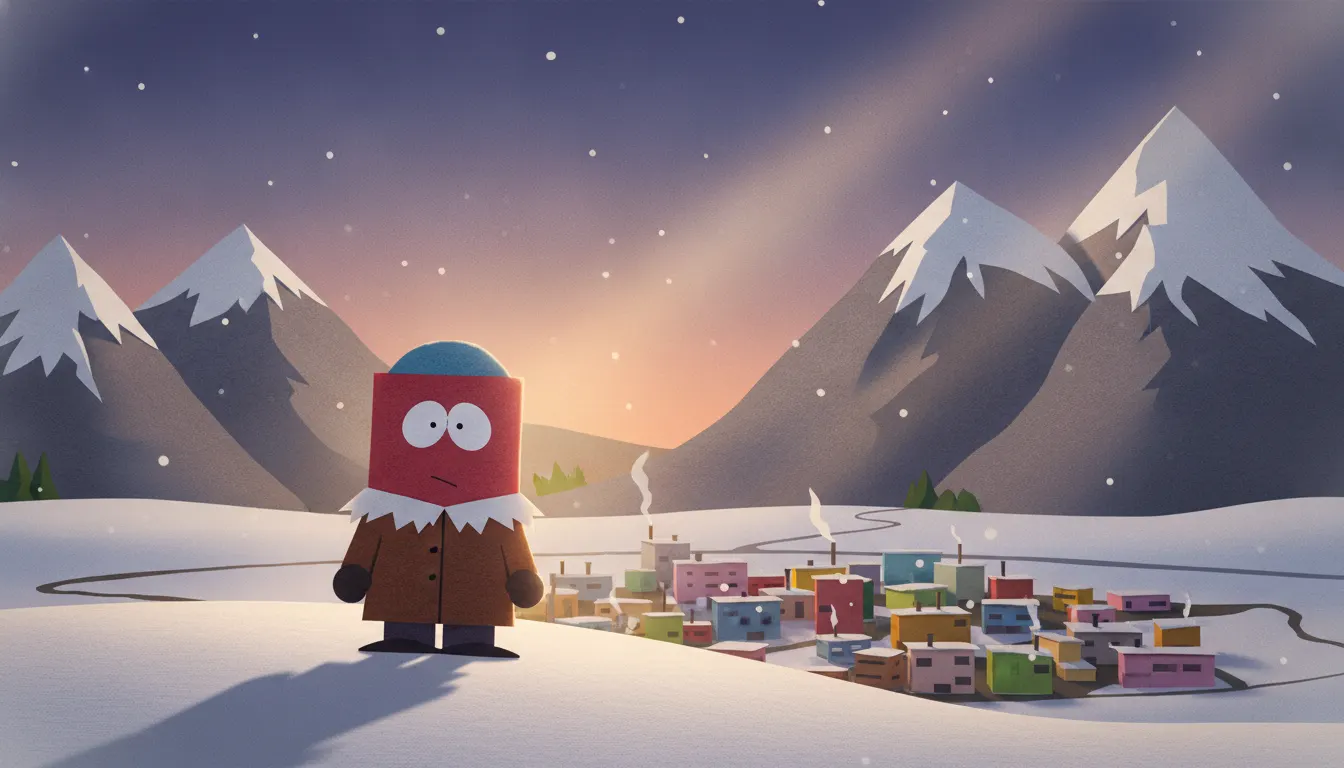
Trey Parker and Matt Stone crude construction-paper cutout look. Simple geometric shapes, beady eyes, snowy Colorado mountain town.
The moves a human crew would use to get here. Cue applies them for you, and knowing their names is how you ask for a change.
Characters move as unified rigid units rather than articulated figures - rotating rather than walking, sliding rather than stepping, simulating cardboard figure animation
Dialogue delivered with simple open/closed mouth switching, matching the physical limitations of cardboard puppet animation rather than realistic lip-sync
Kenny's orange parka concealing all facial features creating a character identifiable only by color and outline - a design that became a meme format
South Park's Colorado mountain backdrop rendered as flat, minimal color-fills with white snow ground and simple building forms
The simple aesthetic enables completion in ~6 days - episodes can address breaking news events with satirical commentary within a week of the actual event
Cartman, Kyle, Stan, Kenny in horizontal line compositions - the standard South Park compositional grammar encoding the group dynamic visually
Parent and teacher characters use the same cutout puppet design as children but with adult proportions, maintaining the flat-world visual consistency
South Park premiered on Comedy Central on August 13, 1997, created by Trey Parker and Matt Stone. Originally produced by Colorado-based Parker/Stone studio (which became South Park Studios, now South Park Digital Studios), the show has run for 27 seasons as of 2024 - one of cable television's longest-running animated series. The series streams on Paramount+ and HBO Max.
Parker and Stone's 1995 short The Spirit of Christmas: Jesus vs. Frosty and its 1995 follow-up Jesus vs. Santa (sometimes called The Spirit of Christmas: Jesus vs. Santa) were produced in literal paper cutout animation - cardboard figures photographed frame-by-frame, moving stiffly with rigid joints. When Comedy Central commissioned the series in 1997, the creators translated this rough cutout look into digital animation using PowerAnimator (later Maya), deliberately simulating the stiff, jointed quality of physical paper puppets.
The deliberate decision to maintain aesthetic crudeness as Comedy Central's animation technology improved is central to the show's identity. Characters have limited arm articulation, mouths that operate on a simple open/close principle, and movement that suggests cardboard figures on sticks. This constraint-as-choice mirrors Ren and Stimpy's anti-polish philosophy in a different direction.
The main characters - Eric Cartman (red jacket, round body), Kyle Broflovski (green hat, Jewish identity), Stan Marsh (blue/red pompom hat), and Kenny McCormick (orange parka that obscures his mouth and face) - are among the most recognizable character designs in animation. Their paper-puppet stiffness is inseparable from their identity: they wobble, they rotate as units, their coats swallow their anatomy.
The town of South Park, Colorado - with its snow-covered mountain background, elementary school, Cartman's house, Stark's Pond - uses deliberately flat, limited-detail environments matching the cutout aesthetic.
South Park's production pipeline - Parker and Stone have claimed to produce episodes in 6 days, enabling real-time topical satire - is directly enabled by the simple aesthetic. Complex 3D rendering would be impossible at this pace; the cutout simulation allows rapid content production. Satirical episodes about breaking news events (the 2000 presidential election episode aired the day after the election) are only possible because the visual style can be executed quickly.
During the COVID-19 pandemic, The Pandemic Special (2020) and various Paramount+ specials shifted production models while maintaining the aesthetic. The 2023 Paramount+ specials ('Joining the Panderverse', '#PlussyOwner') continued the rapid-turnaround topical approach.
Trey Parker + Matt Stone / Comedy Central · 1997
Original season establishing the paper-cutout digital aesthetic - 'Cartman Gets an Anal Probe', 'Weight Gain 4000'
Trey Parker / Paramount Pictures · 1999
Theatrical film expanding to musical format while maintaining the cutout aesthetic
Trey Parker + Matt Stone · 1995
Viral VHS short that directly inspired the series - actual paper cutout animation
Trey Parker / Comedy Central + Paramount+ · 2020
COVID-era special demonstrating the rapid-production model enabling real-time satire
Trey Parker / Comedy Central · 2015
Season-long serialized narrative arc demonstrating the show's evolved storytelling sophistication within the crude aesthetic
Trey Parker / Paramount+ · 2023
Streaming special in the ongoing post-network production model
Dino Stamatopoulos / Adult Swim · 2005
Spiritual contemporary using stop-motion cutout aesthetic for similarly transgressive adult satire
A Look is not a filter. It is a set of stored decisions the pipeline reads before it makes a single frame, so two videos in the same Look actually match.