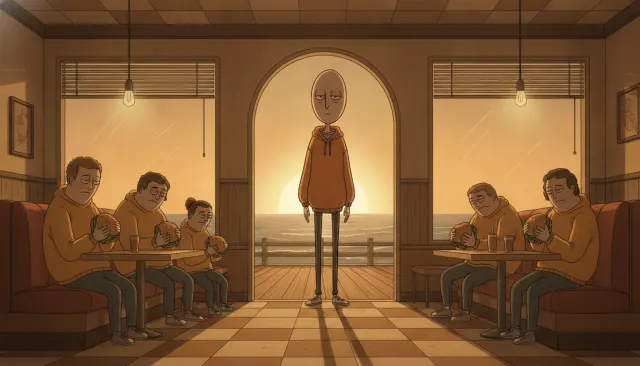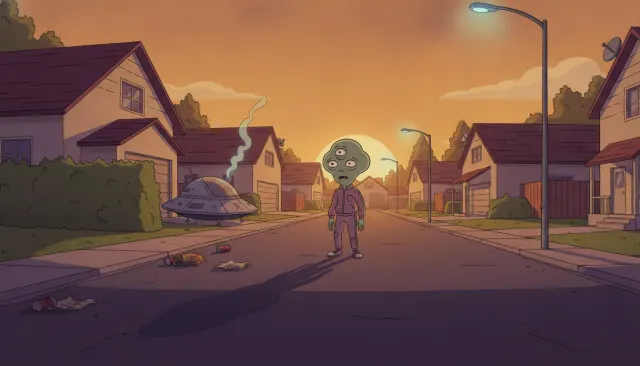
Family Guy
Seth MacFarlane · 1999
Fox primetime series; defining adult animated sitcom of the 2000s-2020s
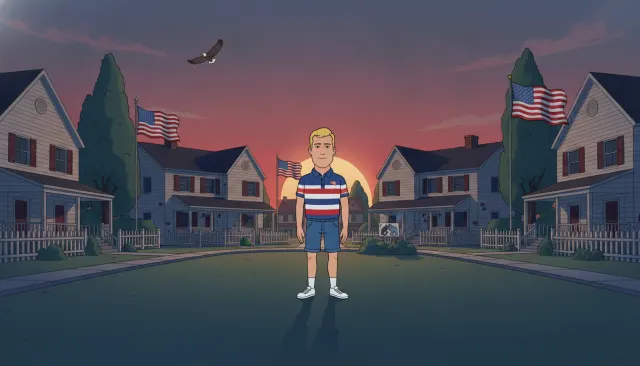
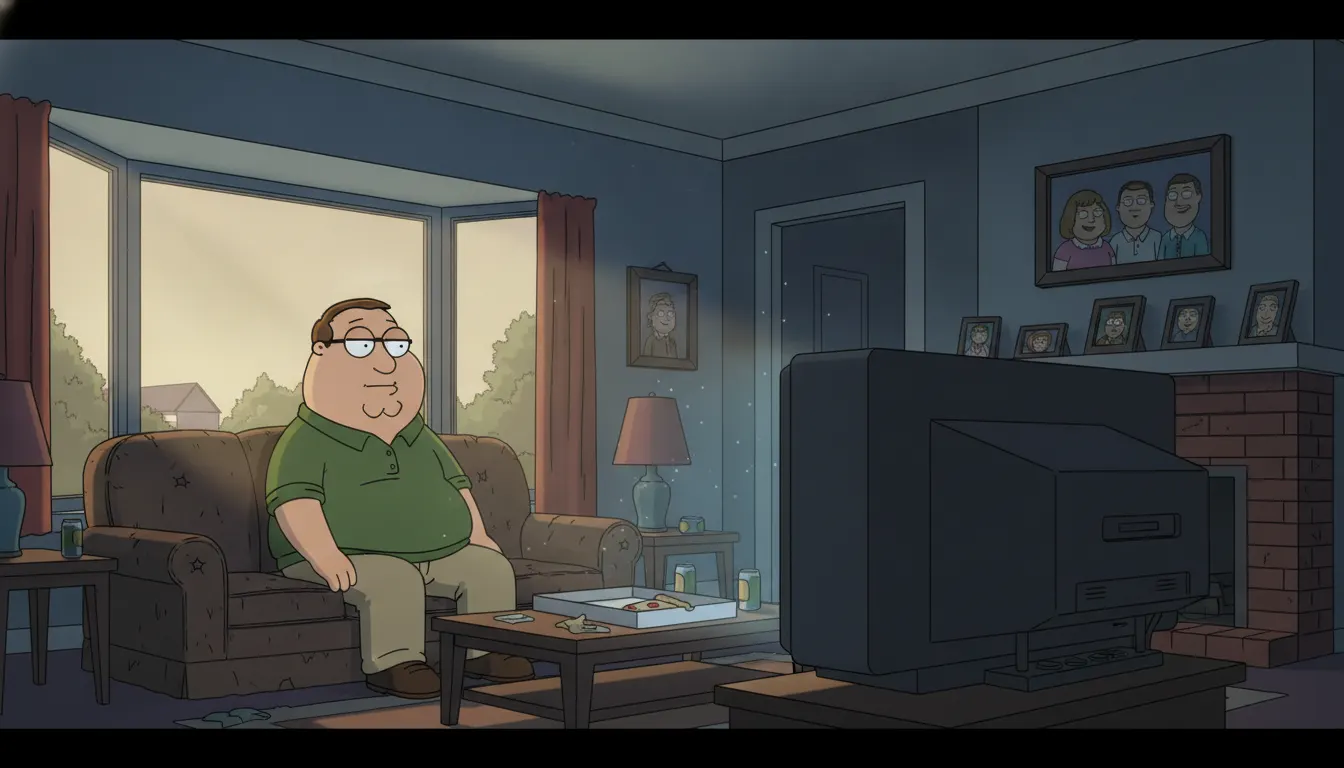
Seth MacFalrane Flash-era talking-head sitcom. Round-eye characters, suburban Quahog interiors, deadpan cutaway gags.
The moves a human crew would use to get here. Cue applies them for you, and knowing their names is how you ask for a change.
Character mouths, eyes, and hands built as interchangeable symbols, creating efficient production at the cost of individual-pose expressiveness.
Self-contained joke sequences inserted mid-scene with an implicit 'like that time when...' framing, often featuring completely different settings and parody styles.
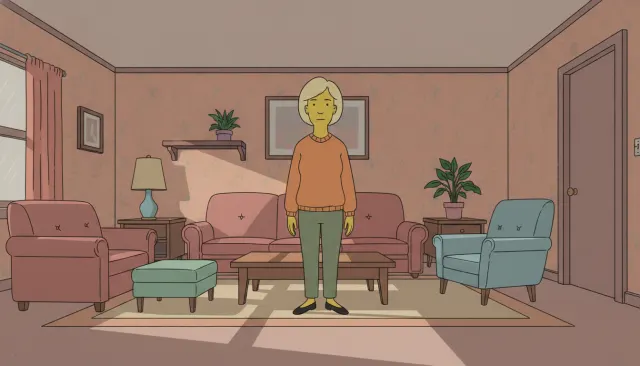
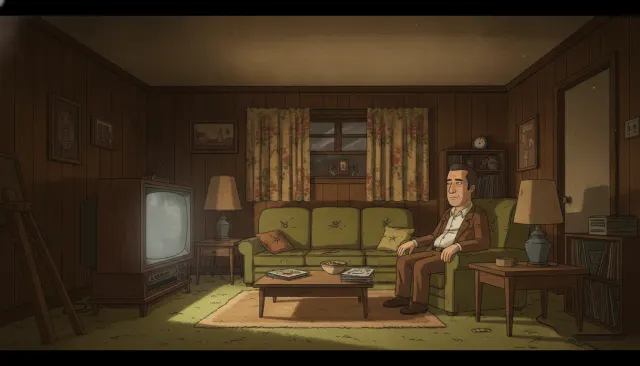
Recurring interior environments (Griffin living room, Quahog Pub) maintained with meticulous consistency as a visual anchor across hundreds of episodes.
Characters built from basic ovals and rectangles with consistent outline weights - designed for rapid production and instant recognizability.
Minimal shading on characters and environments, consistent with digital Flash production pipelines of the 2000s era.
Cutaways and episode plots frequently parody specific films, TV shows, and cultural moments with spot-on visual pastiche.
Heavy use of medium shot and over-the-shoulder compositions for dialogue scenes, reflecting efficient TV production scheduling.
Family Guy is an adult animated sitcom created by Seth MacFarlane that premiered on Fox on January 31, 1999. After cancellation in 2002 and revival via DVD sales and Adult Swim reruns in 2005, it has run continuously to the present day, making it one of the longest-running primetime animated series in American television history. Its visual style - which evolved from traditional cel animation toward Adobe Flash-assisted digital production during the 2000s - defines a specific era of American adult animation.
MacFarlane's visual influences are explicit: Family Guy was directly inspired by The Flintstones (1960), All in the Family (1971), and The Simpsons (1989). The Griffin family's suburban Quahog, Rhode Island setting mirrors the Springfield template - a white-collar aspirational neighborhood filtered through working-class reality. Character designs use simple geometric forms, consistent outline weights, and flat fills with minimal internal detail. The show's early seasons were produced with traditional ink-and-paint methods before transitioning to digital pipeline around season 4.
The shift to Adobe Flash-assisted animation during the mid-2000s is central to understanding the style's aesthetic signature. Flash encouraged specific simplifications: fewer inbetweens, symbol-based reuse of character parts (mouths, eyes, hands as interchangeable symbols), and smoother but less expressive movement than traditional frame-by-frame animation. The result is a fluid but slightly mechanical quality - characters move efficiently but rarely with the organic weight of Disney or Warner Bros. animation. This became a signature of an entire generation of 2000s TV animation.
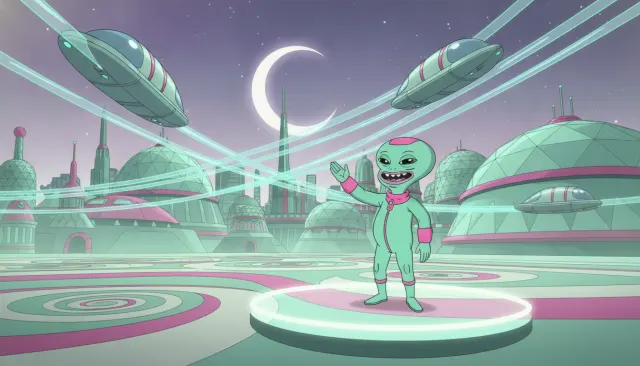
Family Guy's most distinctive contribution to animation is its cutaway gag structure. The show pioneered the use of brief, self-contained animated vignettes that interrupt the main narrative for a joke and return without explanation. These cutaways often feature drastically different settings, time periods, and visual parody styles within the same episode. The main narrative maintains the consistent Quahog suburban look while cutaways may pastiche everything from 1940s newsreels to anime to vintage commercials.
The Quahog environment uses a saturated but controlled palette: sky blues, lawn greens, warm house interiors in beiges and yellows. The Griffin house interior is meticulously consistent - the living room's specific blue couch, green walls, and TV positioning have remained largely unchanged for 20+ seasons, functioning as a stable visual anchor for a show built on instability.
Family Guy's visual style directly influenced American Dad (2005), The Cleveland Show (2009), and Bob's Burgers (2011), and by extension shaped a decade of adult animation aesthetics on Fox and Adult Swim. MacFarlane's studio, Fuzzy Door Productions, extended the template across multiple series.
Seth MacFarlane · 1999
Fox primetime series; defining adult animated sitcom of the 2000s-2020s
Seth MacFarlane, Mike Barker, Matt Weitzman · 2005
Spinoff using identical visual pipeline; CIA suburban family parody
Seth MacFarlane, Richard Appel, Mike Henry · 2009
Second spinoff; same Flash animation pipeline applied to Southern suburban setting
Matt Groening · 1989
Primary visual and structural precursor that Family Guy explicitly emulated
Loren Bouchard · 2011
Fox animated sitcom using similar digital pipeline; softer, more character-driven
Roger Black, Waco O'Guin · 2012
Adult animated series using comparable Flash-era suburban flat design
A Look is not a filter. It is a set of stored decisions the pipeline reads before it makes a single frame, so two videos in the same Look actually match.