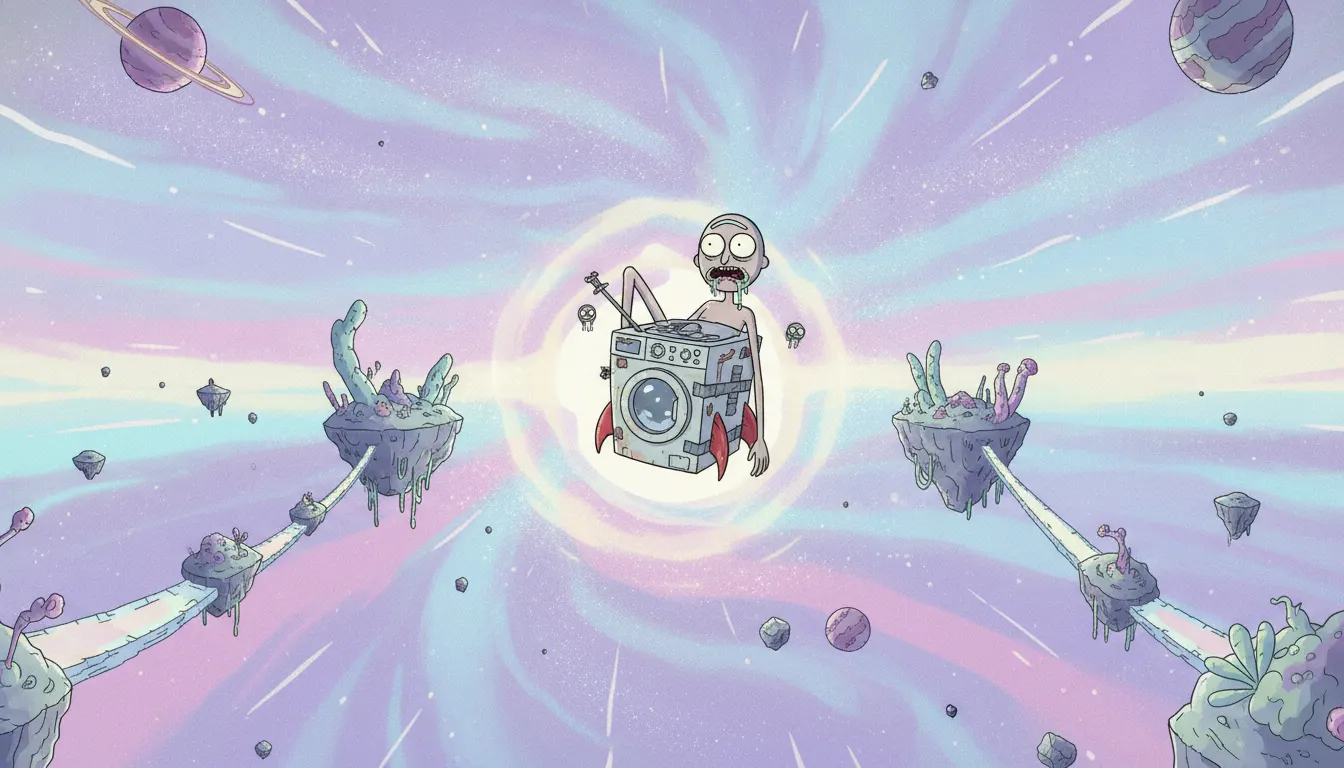
Rick and Morty Season 1
Justin Roiland + Dan Harmon / Adult Swim · 2013
Debut season establishing the sketchy aesthetic - 'Pilot', 'Meeseeks and Destroy', 'Rixty Minutes'
Justin Roiland and Dan Harmon wobbly hand-drawn line. Bug-eye drool characters, interdimensional sci-fi pastel skies, garage-laboratory clutter.
The moves a human crew would use to get here. Cue applies them for you, and knowing their names is how you ask for a change.
Character outlines that slightly gap, overlap, or wobble - lines suggesting quick-sketch energy rather than clean ink work
Rick Sanchez's signature mouth drool rendered as a dangling droplet, present even in emotional or serious scenes - an anti-dignity signature
Limited, economical character animation contrasted with richly designed alien planets, spacecraft interiors, and dimensional cityscapes
Interdimensional Cable and other in-show media use fake compression artifacts, static, and color bleed to simulate degraded transmission quality
Adult Swim tradition of bold outlines with flat, unshaded fill areas - maintaining legibility at small sizes and matching the network's visual brand
Hand-lettered spray-paint title cards and rough in-world interface graphics maintaining the anti-polish quality in typographic elements
The specific acid-green of Rick's portal gun and rift effects serves as the show's signature color - appearing in merchandise, memes, and fan work
Rick and Morty premiered on Adult Swim (Cartoon Network's late-night block) in December 2013, created by Justin Roiland and Dan Harmon. Roiland developed the visual style from his 2006 short The Real Animated Adventures of Doc and Mharti - a deliberately crude parody of Back to the Future - and the aesthetic of deliberate imperfection became the show's visual identity.
Roiland's character designs maintain a deliberately imperfect quality: lines that don't quite close, proportions that shift slightly between scenes, a roughness that suggests the characters were drawn quickly without excessive polish. Rick Sanchez's drool, his scraggly grey hair, his lab coat creases - all rendered with functional crudeness. This is not budget limitation but aesthetic philosophy: the show draws from the Adult Swim tradition (Aqua Teen Hunger Force, Tom Goes to the Mayor) of anti-polish as artistic choice.
The series is produced at Starburns Industries (Seasons 1-3) and later at Williams Street/other studios. The character animation is relatively limited in comparison to the elaborate sci-fi environment design - alien worlds, interdimensional landscapes, and the Citadel of Ricks receive detailed environmental rendering while character movement stays economical.
The visual tension between rough character art and lush sci-fi backgrounds is central to the show's identity. Background designer Jason Boesch developed the kaleidoscopic alien environments - the Blips and Chitz arcade (Season 3), the Citadel cityscape, the various Council planets - with considerably more detail and color sophistication than the character models. This contrast creates a satirical effect: the infinite universe rendered in detail, its inhabitants rendered in approximation.
Adult Swim's visual brand uses flat, bold color fills with heavy black outlines. Rick and Morty operates within this but pushes toward brighter, more varied alien palettes. The show's title card is a hand-lettered spray paint aesthetic. Interdimensional Cable sequences deliberately introduce additional visual degradation - static, color bleed, fake compression artifacts - as nested aesthetic commentary.
The show's visual grammar has been endlessly remixed across internet culture since 2013 - fan art, merchandise, and memes adopting the sketchy line quality. Season 5's 'Mortyplicity' and Season 6 introduced even more visual meta-commentary. The 2023 Season 7 continuation maintained the aesthetic with Roiland's departure, demonstrating how thoroughly the style outlasted its originator.
Justin Roiland + Dan Harmon / Adult Swim · 2013
Debut season establishing the sketchy aesthetic - 'Pilot', 'Meeseeks and Destroy', 'Rixty Minutes'
Justin Roiland + Dan Harmon · 2014
Showcases the nested Interdimensional Cable aesthetic - deliberately crude within-show animation
Justin Roiland · 2006
Origin short from which the visual aesthetic directly descended
Big Pixel Studios · 2016
Official licensed game preserving the flat-line aesthetic in pixel form
Ryan Ridley (writer) · 2017
Superhero parody episode showcasing the show's contrast between detailed world design and crude character art
Justin Roiland + Mike McMahan / Hulu · 2020
Direct visual sibling using identical Roiland line aesthetic for alien suburban comedy
Matt Maiellaro + Dave Willis / Adult Swim · 2001
Adult Swim predecessor establishing the anti-polish, limited-animation aesthetic Rick and Morty inherits
A Look is not a filter. It is a set of stored decisions the pipeline reads before it makes a single frame, so two videos in the same Look actually match.
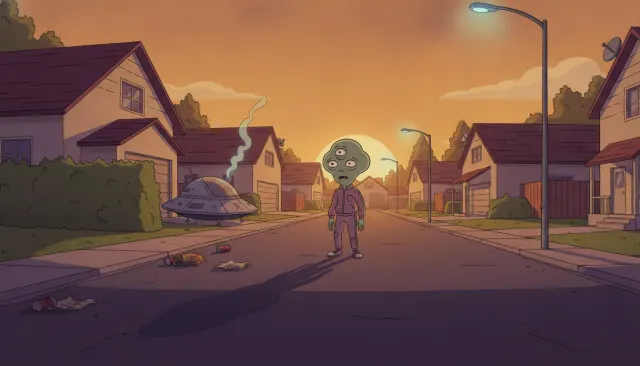 Adult Primetime ExpansionSolar Opposites Flat Sitcom
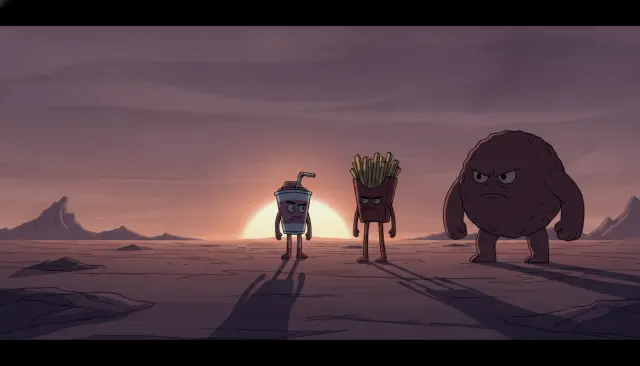 Adult Shorts AnthologyAqua Teen Hunger Force Cheap Flash
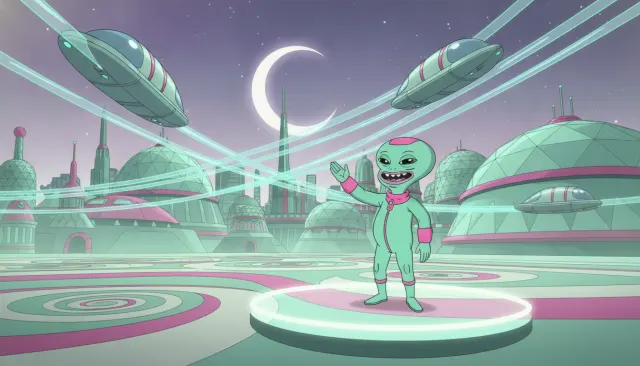 Adult PrimetimeFuturama Retro Sci-Fi
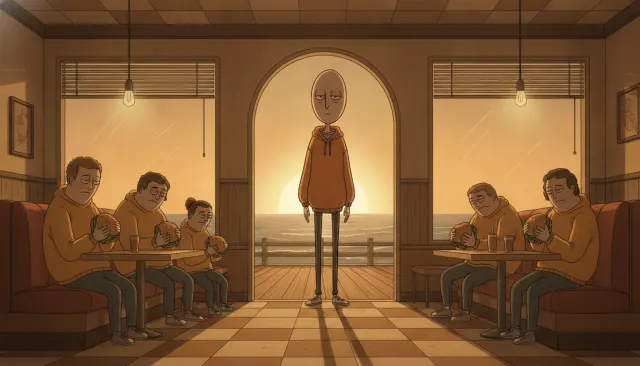 Adult PrimetimeBob's Burgers Warm Line
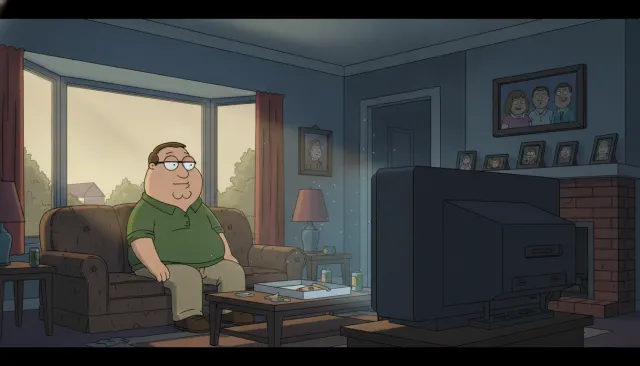 Adult PrimetimeFamily Guy Suburban Flash
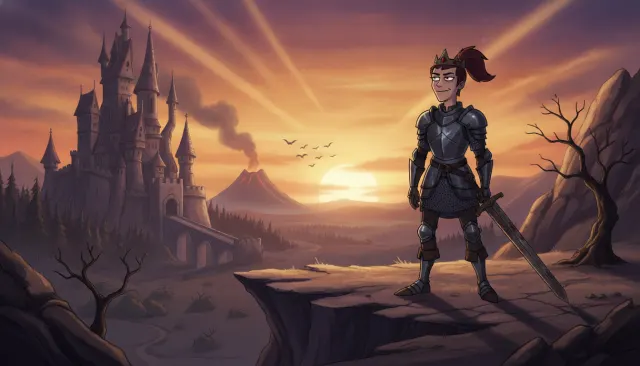 Adult Primetime ExpansionDisenchantment Groening Medieval
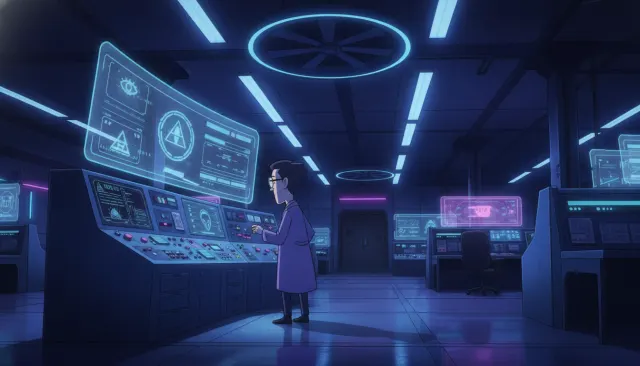 Adult Primetime ExpansionInside Job Netflix Conspiracy Sitcom