Video Days
Spike Jonze / Blind Skateboards · 1991
Spike Jonze's directorial debut; established the art-film ambition of the skate video form
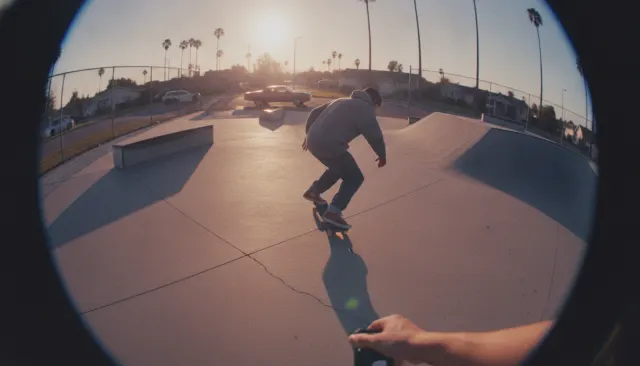
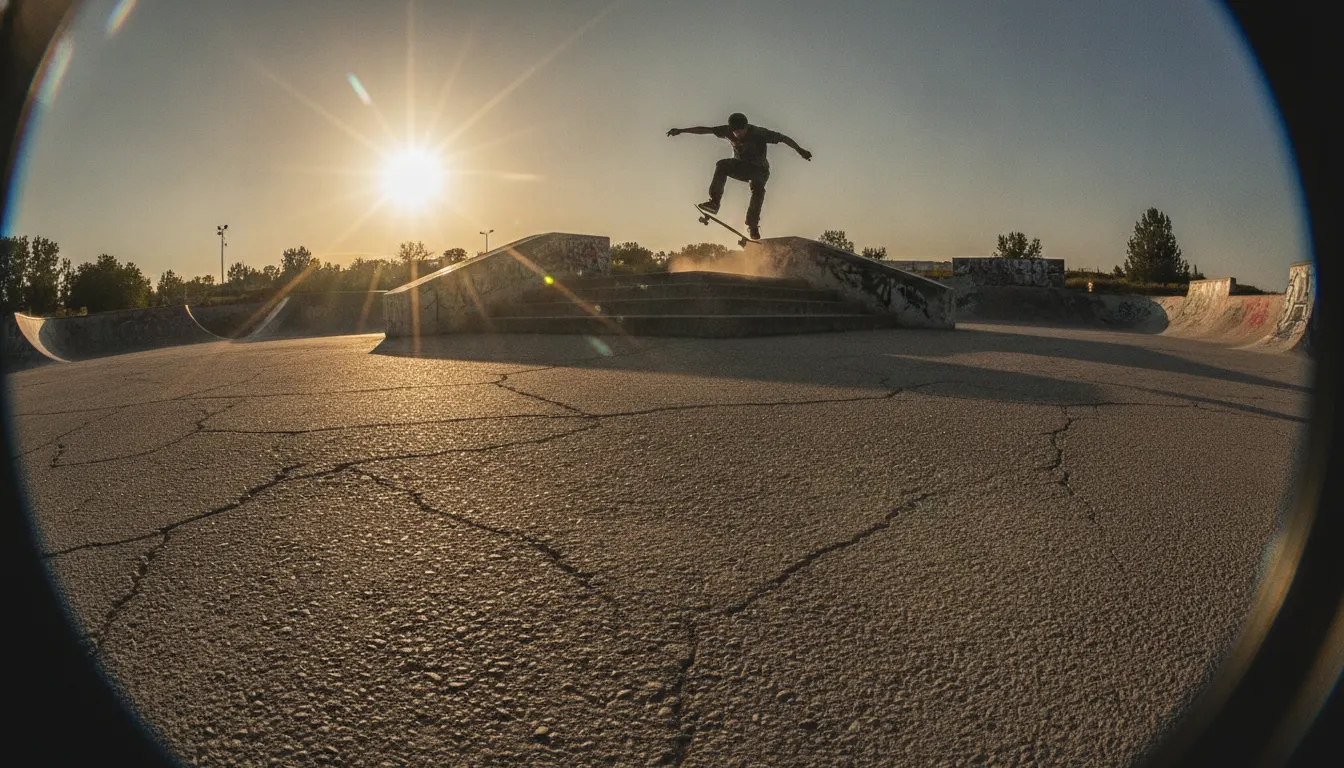
Fisheye-lens skate video. Sun flares, dust kicks, low-angle action, street energy.
The moves a human crew would use to get here. Cue applies them for you, and knowing their names is how you ask for a change.
Extreme wide-angle lens at 1-2 metres from the skater captures full body and trick geometry in confined spaces.
Digital grain and colour compression referencing the VX1000 or TRV900 camera aesthetic of 1990s-2000s skate videos.
Raking late-afternoon light on concrete surfaces creates dramatic shadow depth and amber warmth.
Camera operator skates or moves alongside the subject, creating kinetic, participant-observer perspective.
Editorial grammar that builds toward a climactic trick sequence, establishing the trick-as-payoff structure.
Fisheye close-up proximity shots intercut with long telephoto or standard lens wide shots to establish spatial context.
Skate park cinematography is a visual genre with its own rigorous aesthetic standards, developed over four decades by skateboarders who were also filmmakers and photographers, and later adopted by commercial and documentary filmmakers seeking the energy and authenticity of skate culture. The look is defined by proximity to the action, the use of fisheye lenses in close quarters, the golden hour aesthetic of late-afternoon concrete bowls, and the specific grammar of the VHS-era skate video that became the aesthetic template even after digital capture replaced it.
The foundational document of skate film aesthetics is Powell Peralta's The Bones Brigade Video Show (1984), which established the template: hand-held footage, proximity to the skater, and an editorial grammar built around the accumulation of tricks toward a climactic sequence. Stacy Peralta's subsequent Future Primitive (1985) and The Search for Animal Chin (1987) refined this into something approaching cinema.
By the 1990s, companies like Blind (Video Days, 1991, dir. Spike Jonze) and 411VM had pushed the aesthetic further. Spike Jonze, later a major music video and feature director, developed his directorial sensibility shooting skate videos - the handheld proximity, the VHS grain, the mix of performance footage with candid skateparty footage became grammar that transferred to Being John Malkovich (1999) and his music video work.
WorldIndustries and Girl Skateboards introduced more cinematic framing and editing alongside the raw documentation. The mid-2000s saw skate videos evolve toward HD while self-consciously retaining VHS aesthetics as a signal of authenticity and cultural heritage.
The fisheye lens - typically a Century Optics 0.3x adapter or similar extreme-wide optic mounted on a standard zoom - is the most iconic tool of the skating cinematographer. At close range (1-2 metres from the skater), it enables full-body capture in confined spaces like bowls and narrow street spots, while the barrel distortion creates the dramatic perspective compression and expansion that characterises the genre.
Golden hour concrete - the specific quality of late afternoon sun hitting a concrete bowl or street plaza - produces the warm-amber aesthetic seen across EMB (Embarcadero) footage, City Sequence videos, and contemporary Instagram skate content. The long shadows and raking light create dramatic depth on otherwise flat concrete surfaces.
Contemporary skate films like Propeller (Vans, 2015) and Thrasher Magazine productions blend fisheye proximity with widescreen cinematic footage, using drone and slow-motion alongside traditional hand-held VX aesthetics. The tension between raw documentation and cinematic production has been a productive creative friction throughout the genre.
Spike Jonze / Blind Skateboards · 1991
Spike Jonze's directorial debut; established the art-film ambition of the skate video form
Spike Jonze / Ty Evans / Girl Skateboards · 2003
Cinematic production values applied to skate video; invisibility trick sequence is landmark
Ty Evans / Lakai · 2007
Explosive production values; HD mixed with VHS aesthetics; slow motion as punctuation
Vans / Greg Hunt · 2015
Contemporary hybrid: fisheye plus widescreen cinematography for global skate doc
Jonah Hill / Christopher Blauvelt · 2018
Feature film that adopted 4:3 Super 16 to faithfully recreate 90s skate video grammar
Stacy Peralta / Powell Peralta · 1987
Bones Brigade road-trip video; first cinematic narrative ambition in skate film
A Look is not a filter. It is a set of stored decisions the pipeline reads before it makes a single frame, so two videos in the same Look actually match.