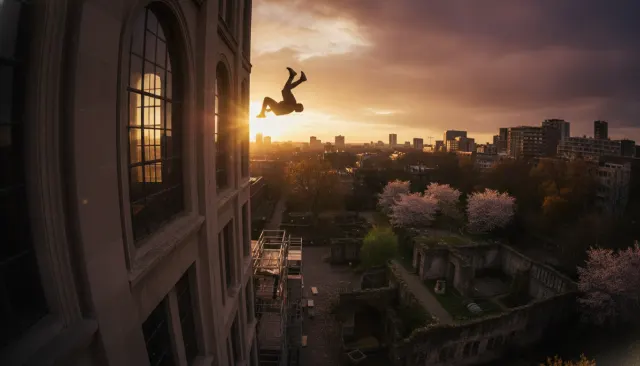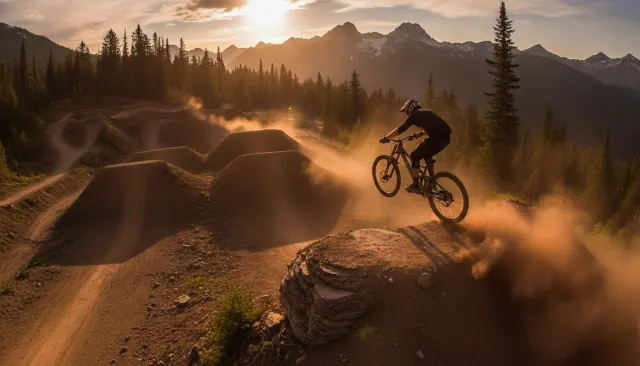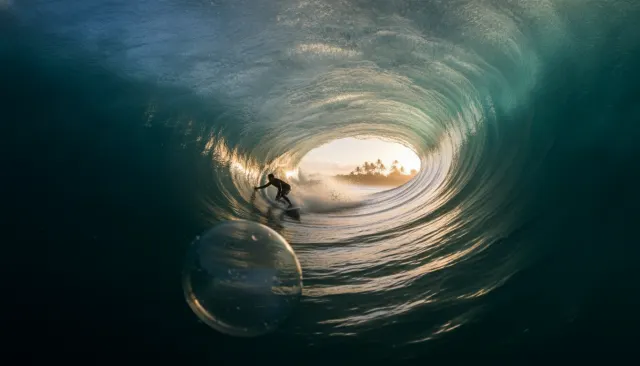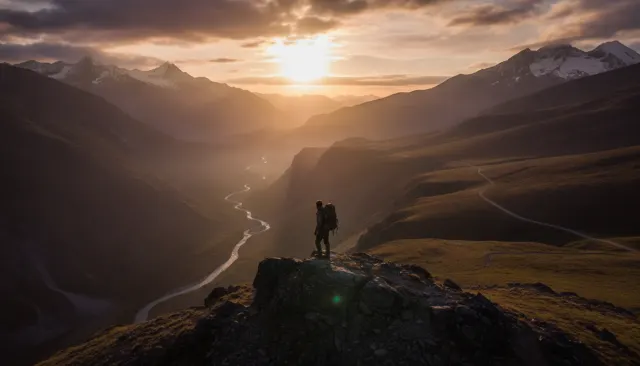
GoPro: Be a Hero (launch film)
GoPro Inc. · 2014
Brand anthem establishing the aspirational hero-narrative around the format globally
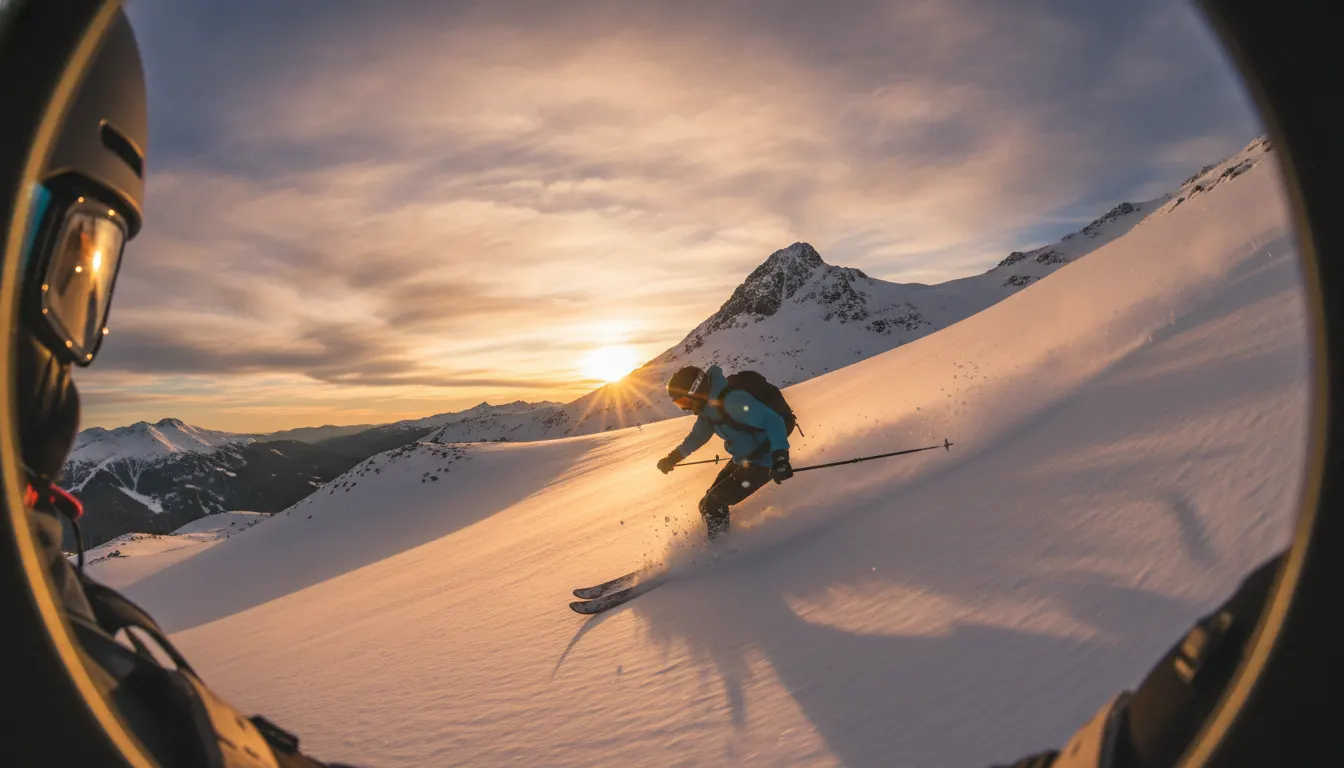
GoPro Hero action POV. Ultrawide fisheye, helmet-or-chest-mounted, mountain biking / surfing / skiing kinetic motion.
The moves a human crew would use to get here. Cue applies them for you, and knowing their names is how you ask for a change.
Camera at head height looking forward, with subject's hands or equipment in foreground and vast environment behind.
155-degree field of view creates barrel curve on horizon and periphery, the unmistakable perceptual signature of the format.
Sky frequently clips to white while subject is correctly exposed, accepted as an aesthetic property of the format.
Log-style color profile captures maximum dynamic range for post-grade while recording a flat, desaturated master.
GPS speed, altitude, G-force, and heart rate data from sensors embedded in the camera overlaid on footage.
Stabilized time-lapse at variable speed allows environmental reveals at superhuman motion, a signature GoPro format.
The GoPro Hero camera did not invent action sports cinematography, but it democratized it so thoroughly that the GoPro aesthetic - ultrawide fisheye, deep focus from 12 inches to infinity, blown highlights under open sky, kinetic first-person POV - is now the default visual language for extreme sports and outdoor adventure content worldwide.
Nick Woodman founded GoPro in 2002 after a surfing trip to Australia where he could not afford a professional camera to capture his own surfing. The Hero 1 launched in 2004 as a 35mm film wrist strap camera. The Hero 2 (2011) and Hero 3 (2012) established the 1080p/60fps and then 4K video capability that made GoPro footage broadcast-competitive. The GoPro Channel on YouTube became, between 2012 and 2016, one of the platform's most-subscribed channels, normalizing the format as aspirational lifestyle content.
The GoPro Hero 10 Black (2021) and later models shoot at up to 5.3K/60fps and 4K/120fps, with a SuperView field of view of approximately 155 degrees horizontal. The lens is a fixed 5.4mm f/2.8 equivalent that creates pronounced barrel distortion. The linear mode desaturates this distortion for non-fisheye output. Protune flat profile provides maximum dynamic range for color grading. The camera is mounted via helmet, chest harness, jaw, bite, pole, or suction cup - the mount position defines the specific aesthetic.
The helmet-mounted POV became the definitive GoPro composition: the wearer's hands or equipment occupy the lower foreground (handlebars, ski poles, surfboard rails) while the environment - mountain, wave, trail, sky - fills the vast background. The composition creates simultaneous first-person immersion and environmental scale. Chest mounts lower the camera to provide a more natural eye-level view; pole mounts create a third-person ghost-cam effect.
Major sports broadcasts adopted GoPro as a supplementary camera for shots physically impossible with larger cameras: mounting inside a race car engine, attached to a swimmer's goggles, on the front of a BASE jumping wingsuit. Red Bull's relationship with GoPro made the format synonymous with extreme sports marketing globally. The Free Solo documentary (2018, Elizabeth Chai Vasarhelyi and Jimmy Chin) used GoPro as one of multiple camera systems for the El Capitan free solo sequence, demonstrating that the format could integrate with narrative documentary work.
Skydio's AI obstacle-avoidance drones (2019 onward) extended the GoPro aesthetic into autonomous flight, creating proximity-follow shots previously requiring skilled FPV pilots. The democratization continued: any outdoor subject could now generate cinema-quality follow footage.
GoPro Inc. · 2014
Brand anthem establishing the aspirational hero-narrative around the format globally
Elizabeth Chai Vasarhelyi / Jimmy Chin · 2018
Documentary Academy Award winner integrating GoPro into multi-system El Capitan free solo coverage
Red Bull Media House · 2012
Annual mountain bike freeride films establishing the helmet-cam language as broadcast entertainment
Various / GoPro · 2013
Chest-mount and lip-mount surfing content that became the platform's defining format
Nitro Circus / GoPro · 2015
Multi-mount stunt coverage demonstrating diverse mounting positions in a single edit
Skydio · 2021
AI proximity follow extending the GoPro aesthetic into autonomous aerial format
National Geographic / GoPro · 2018
Fixed-point wall camera catching one of the most significant athletic achievements in GoPro history
A Look is not a filter. It is a set of stored decisions the pipeline reads before it makes a single frame, so two videos in the same Look actually match.