The Dark Knight
Christopher Nolan / Wally Pfister · 2008
First major integration of IMAX sequences into a studio feature, establishing the format hierarchy that Nolan would develop
Christopher Nolan IMAX scale. Hoyte van Hoytema 70mm, practical effects over CGI, brutalist composition, time-collapsed editing.
The moves a human crew would use to get here. Cue applies them for you, and knowing their names is how you ask for a change.
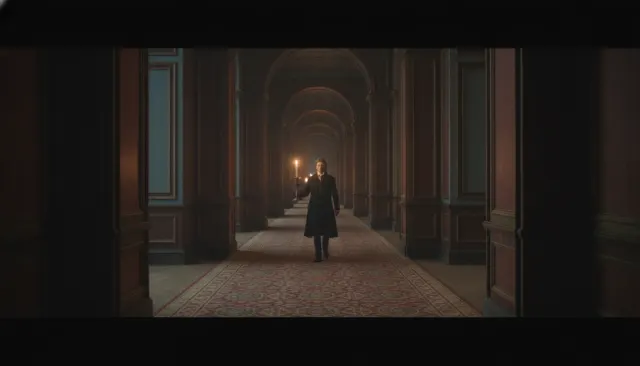
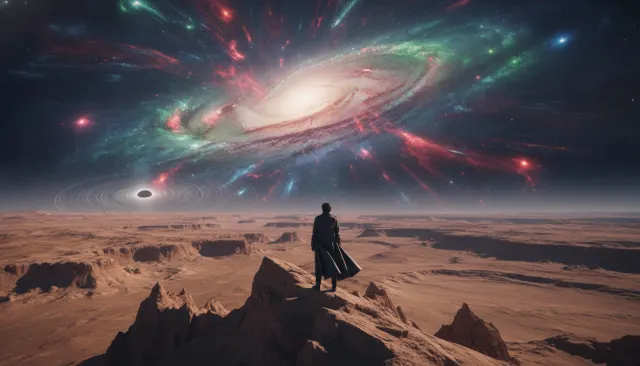
Compositions designed for the 1.43:1 IMAX aspect ratio, with additional image above and below the conventional 1.85:1 frame.
All lighting motivated by practical sources visible or implied in frame, with no unmotivated artificial augmentation.
The organic grain of 65mm film stock, which is finer than 35mm at the same exposure due to the larger image area.
Shadow values that go to genuine black without the lifted, grey-black of log-graded digital, creating absolute contrast.
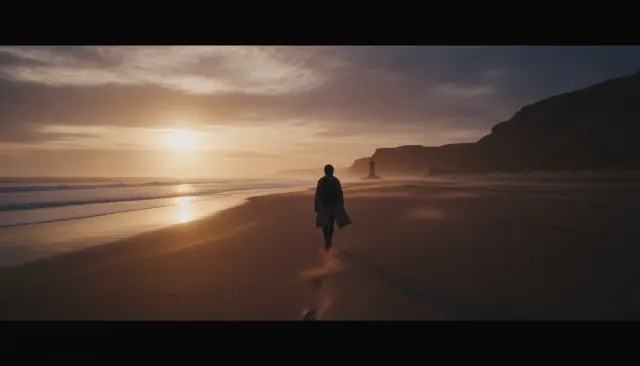
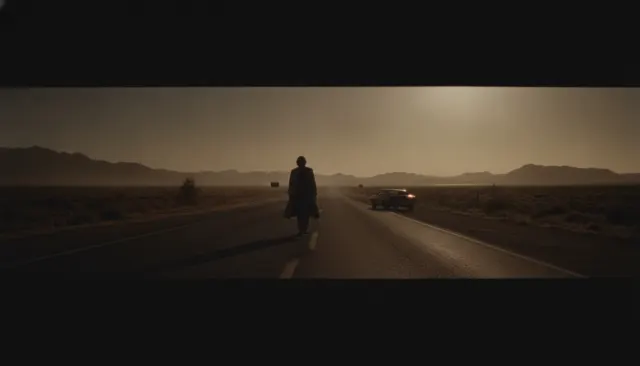
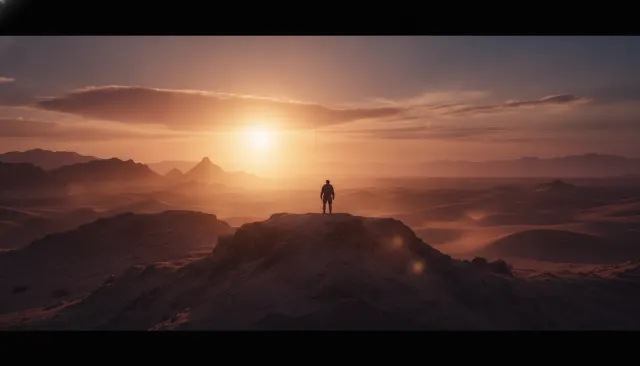
Desaturated mid-tones with warm amber push in practical-lit interior scenes and neutral or cool grading of exterior sequences.
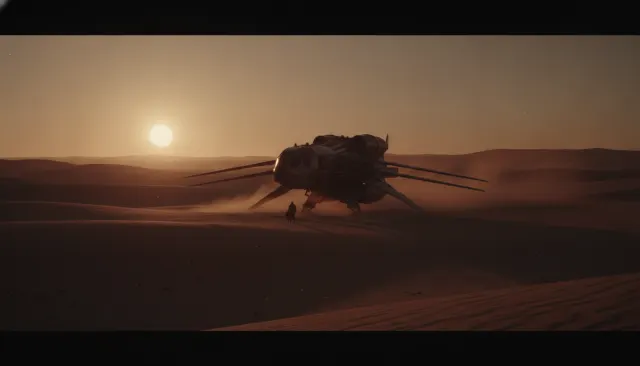
Camera moves that are mechanically smooth and unhurried, emphasizing the weight and solidity of the environment.
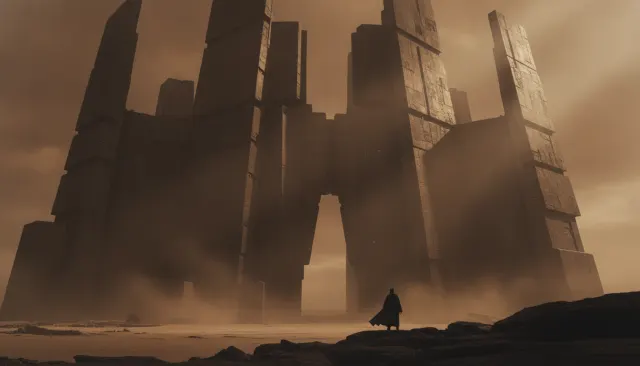
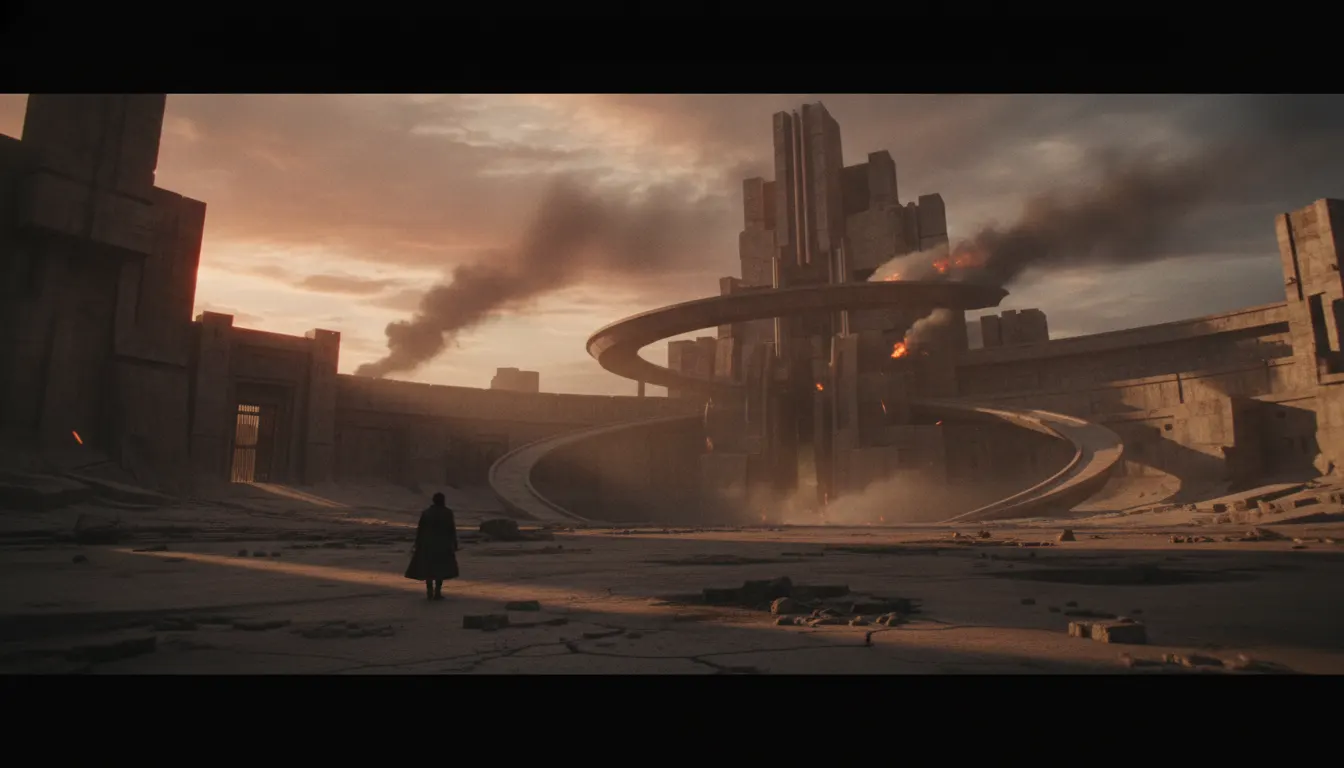
Architectural compositions that emphasize the geometric logic of structures - circular, linear, symmetric - as expressions of institutional power.
Christopher Nolan is the most commercially significant director working in large-format film in the 21st century, and his sustained commitment to shooting on IMAX 65/70mm film stock has made the format's aesthetic properties - extreme resolution, wide tonal range, organic grain, and a particular quality of depth and scale - synonymous with serious large-budget cinema. His partnership with cinematographer Hoyte van Hoytema, which began with Interstellar (2014) and continued through Dunkirk (2017), Tenet (2020), and Oppenheimer (2023), represents the fullest development of this aesthetic program.
Nolan's commitment to practical photography over digital visual effects extends to his choice of format. Where contemporaries moved to digital intermediates and LED volume stages, Nolan continued to shoot on film - specifically, 65mm IMAX film for sequences requiring maximum scale, and 35mm anamorphic for more intimate or conventional material. The combination creates a visual hierarchy within his films: the IMAX sequences register as expansive and overwhelming, while the anamorphic sequences feel more human-scaled by comparison.
This hierarchy is most fully developed in Dunkirk (2017), where the three storylines - air, sea, and land - were shot in distinct formats that correlate to their different temporal scales. The aerial sequences, shot by van Hoytema in a two-seat Spitfire using IMAX cameras, produce images of the English Channel and French coastline at a scale and detail that creates genuine vertigo in the theater.
Van Hoytema's cinematographic approach with Nolan emphasizes contrast and practical lighting. Their images tend toward strong blacks, precisely controlled highlights, and a color palette that favors neutral or slightly warm tones. The Oppenheimer sequences in color are lit with intense practical sources - the Trinity explosion itself was filmed practically with minimal post-production enhancement - while the black-and-white hearing room sequences use hard, institutional light that recalls the confrontational photography of the HUAC era.
Nolan's earlier films with cinematographer Wally Pfister - Memento (2000), Batman Begins (2005), The Dark Knight (2008), Inception (2010) - established the visual language before the IMAX expansion. Pfister's work on The Dark Knight introduced the IMAX format to Nolan's practice, with several action sequences in that film shot in 65mm IMAX for maximum scale.
Nolan's insistence on practical photography over digital visual effects is not merely aesthetic preference but a formal argument: that the camera's presence at an event creates a different quality of image than digitally generated content, and that audiences respond to this difference at some level, even without being able to identify it consciously. This doctrine reached its fullest expression in Oppenheimer (2023), where the Trinity explosion was recreated practically using scale models, forced perspective, and pyrotechnics.
Christopher Nolan / Wally Pfister · 2008
First major integration of IMAX sequences into a studio feature, establishing the format hierarchy that Nolan would develop
Christopher Nolan / Wally Pfister · 2010
Practical effects-heavy production using city-folding sequences achieved through actual set construction rather than CGI
Christopher Nolan / Hoyte van Hoytema · 2014
First Nolan-van Hoytema collaboration establishing their shared IMAX visual language across space and domestic environments
Christopher Nolan / Hoyte van Hoytema · 2017
Most fully realized use of format hierarchy, with IMAX aerial sequences creating genuine scale contrast with land and sea footage
Christopher Nolan / Hoyte van Hoytema · 2020
Time-reversal practical photography that extended the practical-over-digital doctrine into temporally complex action sequences
Christopher Nolan / Hoyte van Hoytema · 2023
Academy Award-winning work filming Trinity explosion practically and shooting IMAX color alongside 65mm black-and-white
A Look is not a filter. It is a set of stored decisions the pipeline reads before it makes a single frame, so two videos in the same Look actually match.