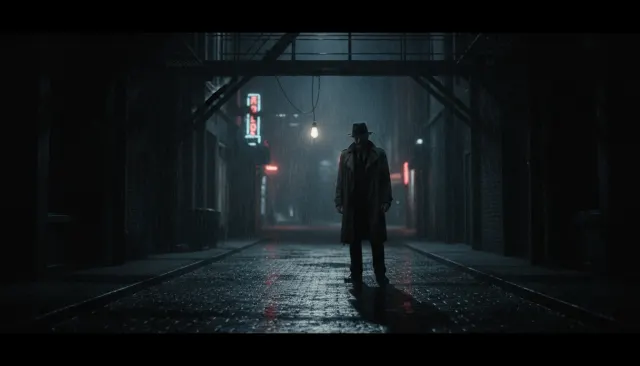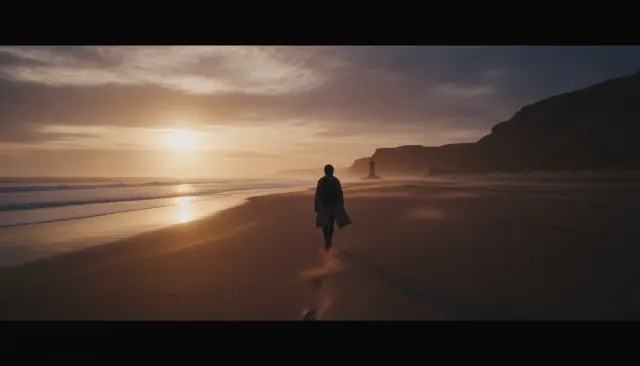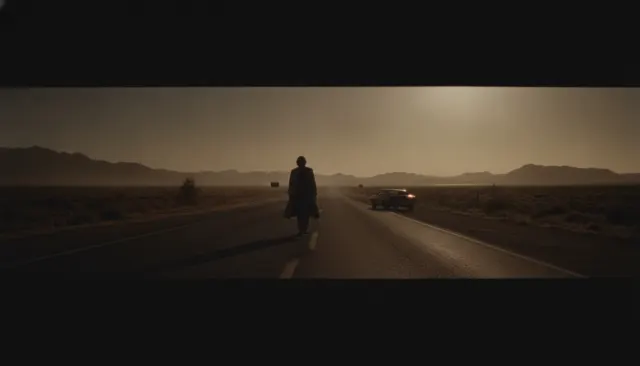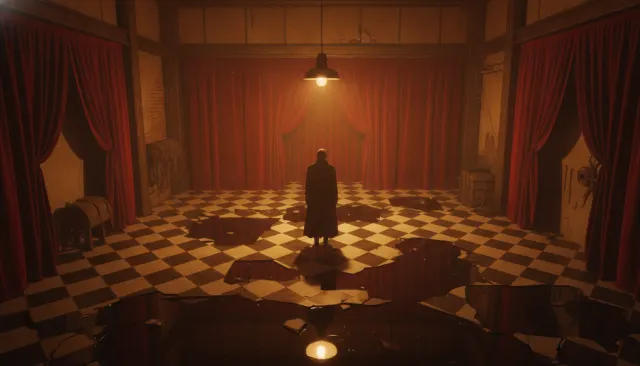
2001: A Space Odyssey
Stanley Kubrick · 1968
Kubrick's foundational use of symmetry to express the inhuman scale of space and artificial intelligence
Stanley Kubrick one-point perspective. The Shining hallway symmetry, Barry Lyndon candlelight, cold precision, slow zoom.
The moves a human crew would use to get here. Cue applies them for you, and knowing their names is how you ask for a change.
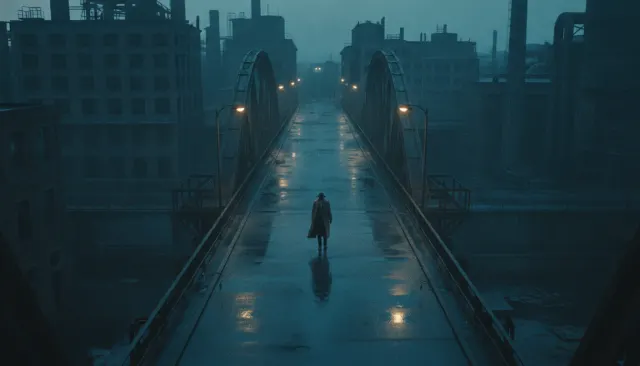
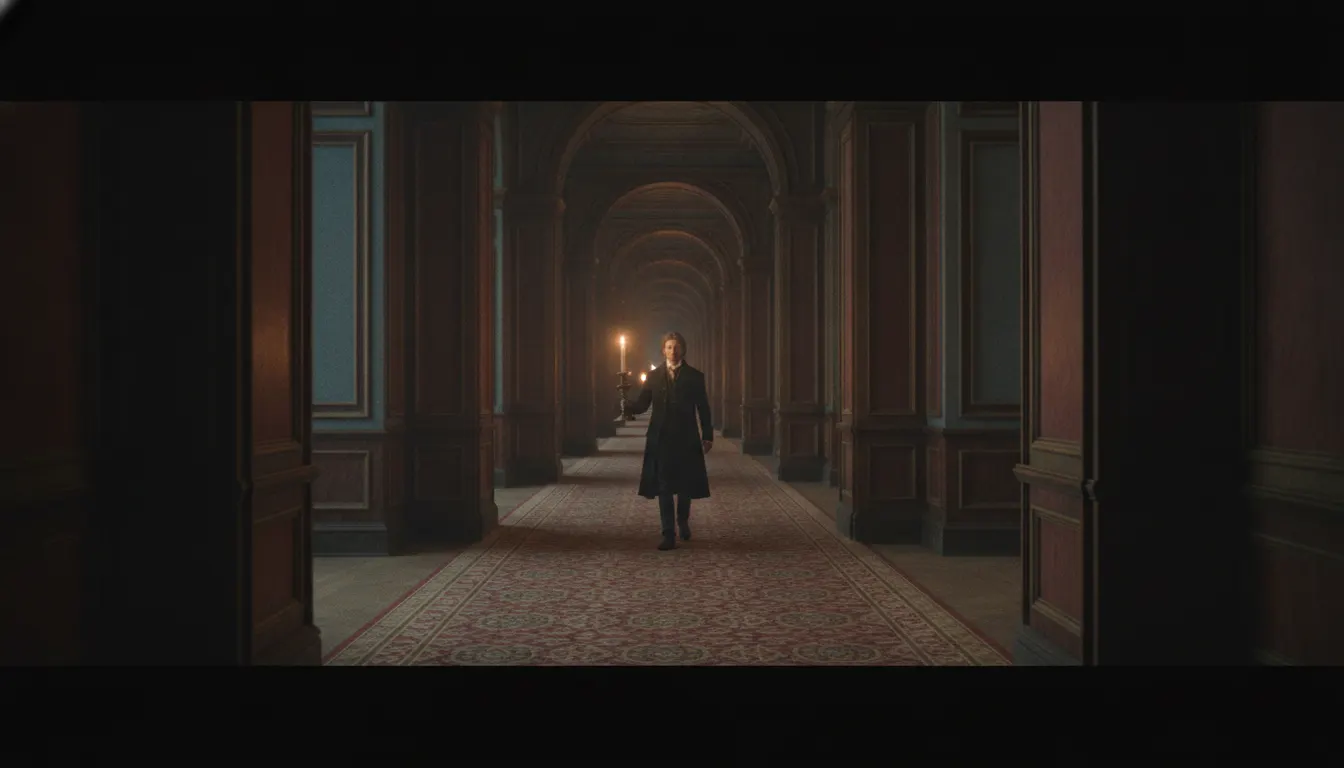
Compositions with the vanishing point centered in the frame, so that parallel lines converge at the dead center, creating a sense of geometric inevitability.
A deliberate, mechanically precise zoom or dolly forward that presses toward the center of the frame, increasing tension without cutting.
Placing actors or objects in identical positions on either side of the center axis, so the frame reads as exactly balanced.
Desaturated or blue-shifted color grades that remove warmth and naturalism, emphasizing clinical precision.
Use of wide-angle lenses that exaggerate perspective, making hallways longer and rooms more imposing.
Placing subjects directly facing the camera, parallel to the frame plane, eliminating any diagonal ambiguity.
Matching practical light sources on both sides of the frame - sconces, windows, lamps - to reinforce the bilateral symmetry.
Stanley Kubrick's use of symmetrical composition and one-point perspective is among the most studied and imitated visual strategies in cinema. Across a career spanning from Spartacus (1960) to Eyes Wide Shut (1999), Kubrick developed a visual language in which geometric precision expressed psychological pressure, institutional power, and existential dread.
Kubrick's symmetrical compositions place the vanishing point dead center in the frame. Hallways recede perfectly. Rooms divide exactly. Human subjects are positioned along the central axis, sometimes alone, sometimes flanked by identical elements. The effect is simultaneously beautiful and unsettling: the world appears ordered with a precision that humans cannot maintain, and the gap between the geometry and human messiness creates unease.
The iconic Overlook Hotel hallway in The Shining (1980) is the most reproduced example: red carpet receding to a point, identical doors on each side, the child on a tricycle at center. The image's perfection is what makes it terrifying. Similar compositions appear in the Korova Milk Bar in A Clockwork Orange (1971), the barracks in Full Metal Jacket (1987), and the Rothman residence in Eyes Wide Shut (1999).
Kubrick achieved these compositions through obsessive location scouting and set construction. For Barry Lyndon (1975), he used specially developed Zeiss f/0.7 lenses - originally built for NASA - to film by candlelight, creating a quality of light that no previous cinematographer had achieved on film. The compositions in Barry Lyndon combine symmetry with the diffused light of 18th-century portraiture, creating a film that looks more like a series of Gainsborough paintings than cinema.
Cinematographer Gordon Douglas Trumbull handled the visual effects on 2001: A Space Odyssey (1968), but the compositional approach was Kubrick's own. The Dawn of Man sequence, the Discovery One interiors, and the Star Gate sequence all demonstrate Kubrick's insistence on spatial clarity and geometric logic.
Kubrick's symmetrical style has been extensively cited and imitated. Wes Anderson's tableau compositions owe an explicit debt to Kubrick's frontal framing. Jordan Peele's Get Out (2017) uses symmetrical compositions to express the horror of institutional control. Music video directors including Michel Gondry and Spike Jonze have employed Kubrick-style symmetry for formal effect. Every film school generation rediscovers the technique, and it remains one of the most recognizable visual signatures in cinema history.
Creators applying the Kubrick symmetrical look must reckon with its weight: the style immediately signals seriousness, precision, and institutional power. It works for brand films where authority and craft are the message, for narrative content exploring control or psychological pressure, and for any creator who wants to signal mastery of compositional grammar.
Stanley Kubrick · 1968
Kubrick's foundational use of symmetry to express the inhuman scale of space and artificial intelligence
Stanley Kubrick · 1971
Symmetrical compositions in the Korova Milk Bar and throughout Alex's world expressing the geometric violence of dystopia
Stanley Kubrick · 1975
Symmetrical tableau compositions shot by candlelight with f/0.7 Zeiss lenses, evoking 18th-century painted portraiture
Stanley Kubrick · 1980
The Overlook Hotel hallway shots established the one-point perspective as cinema's most recognizable image of dread
Stanley Kubrick · 1987
Military barracks symmetry expressing the dehumanizing geometry of institutional conditioning
Stanley Kubrick · 1999
Kubrick's final film used symmetrical domestic interiors to undercut the apparent normalcy of bourgeois life
Jordan Peele · 2017
Peele's explicit homage to Kubrick symmetry as a grammar of racial horror and institutional control
A Look is not a filter. It is a set of stored decisions the pipeline reads before it makes a single frame, so two videos in the same Look actually match.