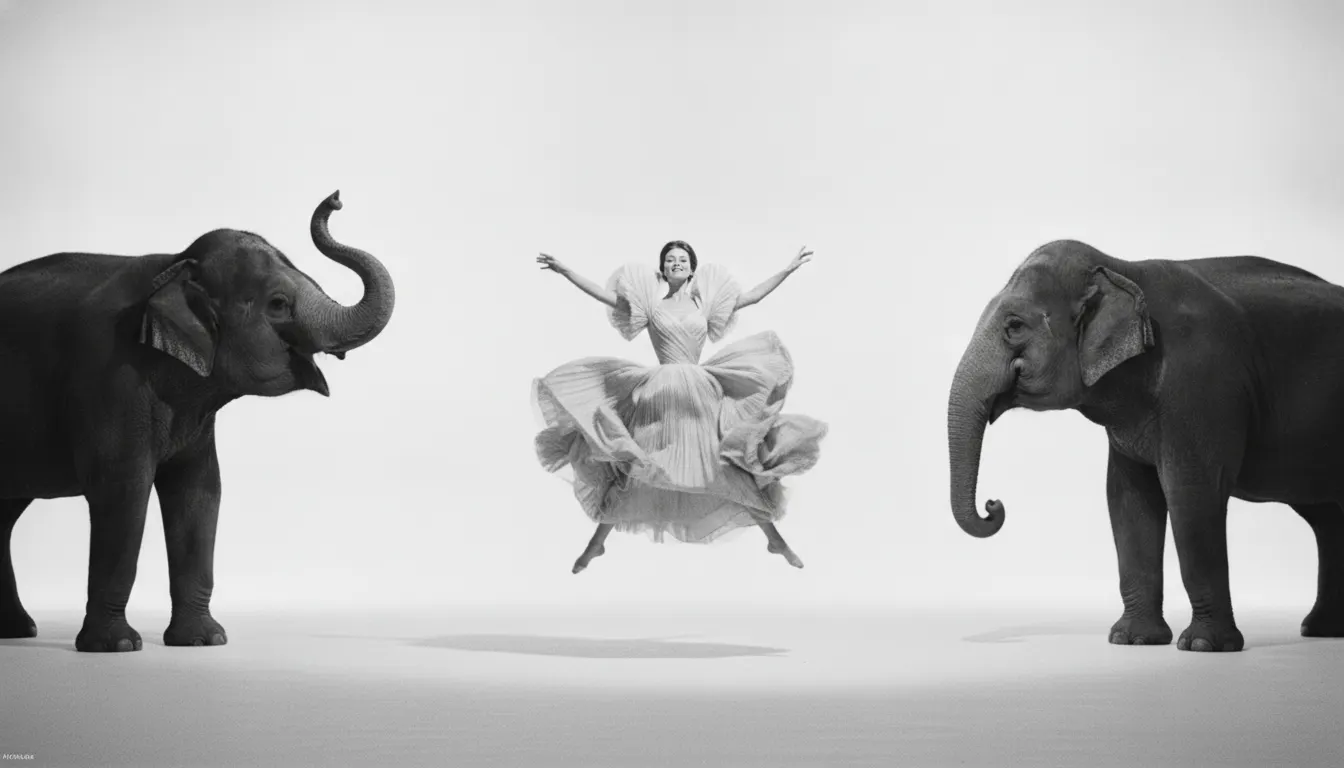
FASHION EDITORIAL · 1960S · USA
Harpers Bazaar Richard Avedon
Richard Avedon Harpers Bazaar 1960s. White seamless paper, leaping joyful model, Dovima with elephants, motion-captured haute couture.
avedonwhite-seamlessmotioncouture
LUT avedon-white-seamless
WHEN TO USE
- High-fashion editorial shoots requiring a timeless, authoritative aesthetic
- Garment-focused content where fabric texture and silhouette must be paramount
- Celebrity or talent portraits needing stark psychological presence
- Campaign imagery for luxury fashion and couture brands
- Motion-based fashion photography - leaping, running, active poses
- Black-and-white portrait series demanding graphic punch
WHEN NOT TO USE
- Lifestyle or contextual product photography where environment is part of the story
- Warm, approachable brand aesthetics - Avedon's severity reads cold to some audiences
- Budget shoots without lighting rigs capable of even, blown-out white backgrounds
- Casual or streetwear brands where the high-art register feels mismatched
SIGNATURE TECHNIQUES
How the look is made.
The moves a human crew would use to get here. Cue applies them for you, and knowing their names is how you ask for a change.
- 01Seamless white or pale grey backdrop with no shadow pooling
pure negative space
- 02High
contrast printing: deep blacks, blown highlights, minimal midtone compression
- 03Large
format 8x10 view camera for studio work yielding extreme tonal resolution
- 04Dynamic model direction
jumping, twisting, laughing - breaking the static pose convention
- 05Pairing haute couture with incongruous environments (elephants, circus performers, laborers)
- 06Tight cropping on face and figure; props and context minimized or eliminated
- 07Long sessions, psychological engagement with subjects to capture unguarded expression
HISTORY & CONTEXT
Where it comes from.
Richard Avedon for Harper's Bazaar
Richard Avedon redefined fashion photography during his twenty-year tenure at Harper's Bazaar (1945-1965) under art director Alexey Brodovitch. Where his predecessors posed models as static mannequins, Avedon brought them to life - leaping, laughing, and moving through real Parisian streets and stark studio environments.
The Avedon Formula
Avedon's signature studio approach established the template still imitated today: a seamless white background that strips all environmental context, leaving nothing but the subject and the garment. His 8x10 large-format negatives rendered fabric textures with forensic precision. The models - Dovima, Suzy Parker, Dorian Leigh - became collaborators rather than coat hangers, their personalities amplified by Avedon's direction.
His location work for Bazaar inverted the studio logic. In 1955's Dovima with Elephants (shot in Paris for an August Bazaar spread), he positioned haute couture against the rough hide of circus elephants, creating a tension between luxury and raw nature that no white sweep could achieve. His 1947 Paris fashion series placed models in motion on cobblestoned streets - a direct rejection of the era's stiff studio norm.
Technical Markers
Avedon favored the Rolleiflex and later 35mm Nikon for location work, shifting to large-format 8x10 view cameras for his controlled studio sessions. He almost always printed high-contrast, pushing blacks toward pure shadow and whites toward blown highlights. His post-Bazaar work - the In the American West portrait series (1979-1984) - carried the same white-background severity into documentary territory, photographing drifters, oil-field workers, and mental patients with the same uncompromising clarity he applied to Dior.
Legacy
Avedon's Bazaar tenure ended when he moved to Vogue in 1966, where he continued for four decades. His influence on editorial photography is total: the white-background fashion shot, the model-in-motion, the celebrity portrait stripped of flattering light - all trace back to his Bazaar years. The 1959 film Funny Face, starring Fred Astaire loosely based on Avedon, cemented his image as the archetypal fashion photographer.
NOTABLE WORKS
Where you have seen it.
Paris fashion series for Harper's Bazaar, 1947-1957
Suzy Parker series, Paris 1956-1958
In the American West portrait series, 1979-1984 (book published 1985)
The Beatles, New York, 1967
Andy Warhol and the Factory, 1969
Nastassja Kinski and the Serpent, 1981
Marilyn Monroe studio portraits, 1957
THE RECIPE
The exact knobs
the renderer turns.
A Look is not a filter. It is a set of stored decisions the pipeline reads before it makes a single frame, so two videos in the same Look actually match.
SettingValue
GradeColour LUT applied to every frame
avedon-white-seamlessTransitionHow one shot becomes the next
hard cuts · 200ms · ease-in-outKen BurnsCamera move applied to stills
Slow push · 0.025 · centerTypographyDisplay / body / mono pairing
Playfair Display · Lora · CourierMusic moodWhat the bed under the voice sounds like
bossa-nova · french-pop-yeyeyeyePrompt suffixAppended to every shot prompt in this Look
Richard Avedon Harpers Bazaar 1960s, white seamless backdrop, leaping model couture, Dovima elephants, motion capturedPALETTE
Primary
#F5F5F0
Secondary
#A89B82
Accent
#1A1A1A
Text/Light
#0A0A0A
Text/Dark
#F5F5F0
BG 900
#1A1A1A
BG 800
#2A2A28
RELATED LOOKS
Next to it on the shelf.
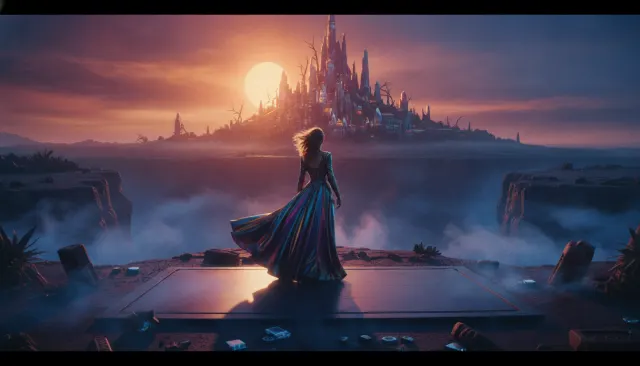 Fashion EditorialAnnie Leibovitz Celebrity Portrait
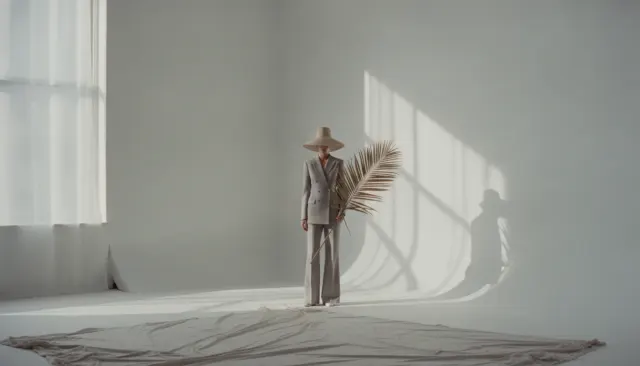 Fashion EditorialIrving Penn Still Life Fashion
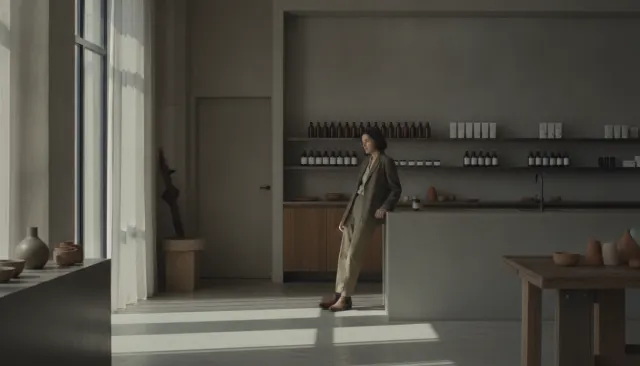 Portrait TraditionsLifestyle Editorial Portrait
 Photographers Fine ArtCindy Sherman Conceptual Portraiture
 Food Product StillLuxury Product Still Life
 Mv DirectorAnton Corbijn BW High Contrast
 Photographers Fine ArtCatherine Opie Portrait Formal
Your first cut
is on us.
+ New videoFree plan · no card · 1080p export