The Cabinet of Dr. Caligari
Robert Wiene / Warm, Röhrig, Reimann · 1920
The foundational text - painted distorted sets and somnambulist narrative establishing the entire vocabulary
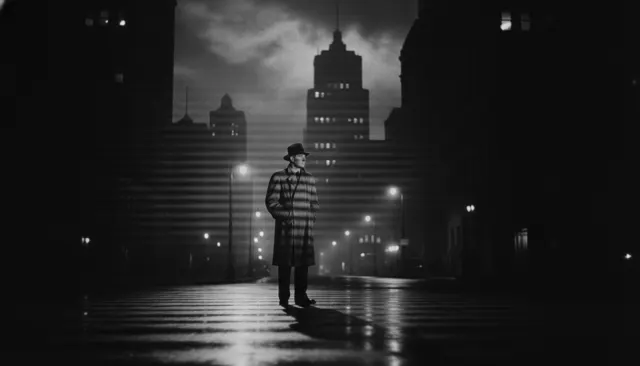
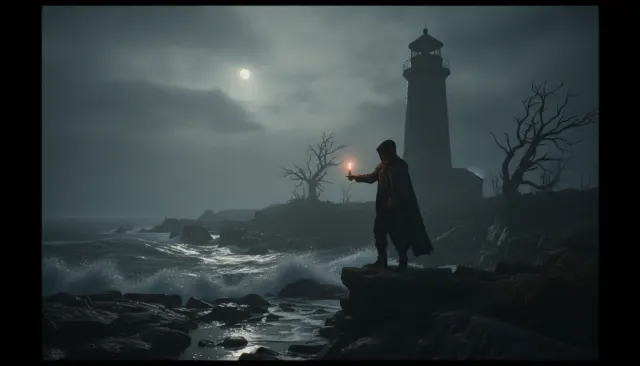
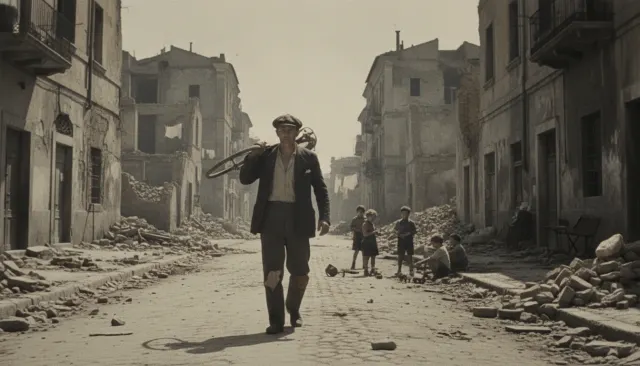
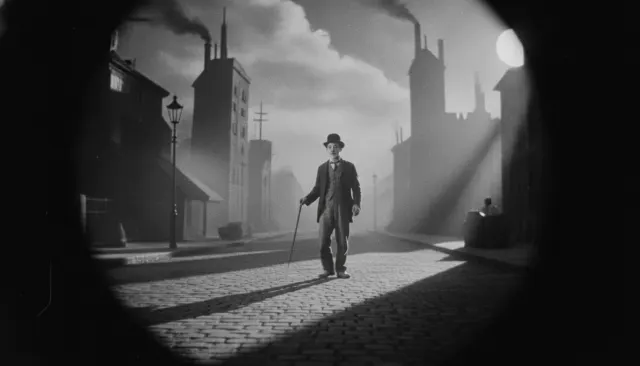
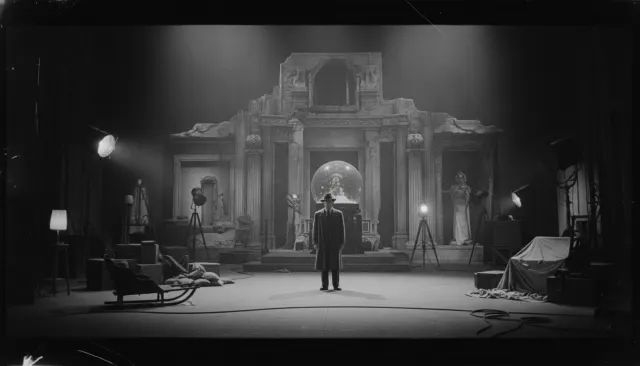
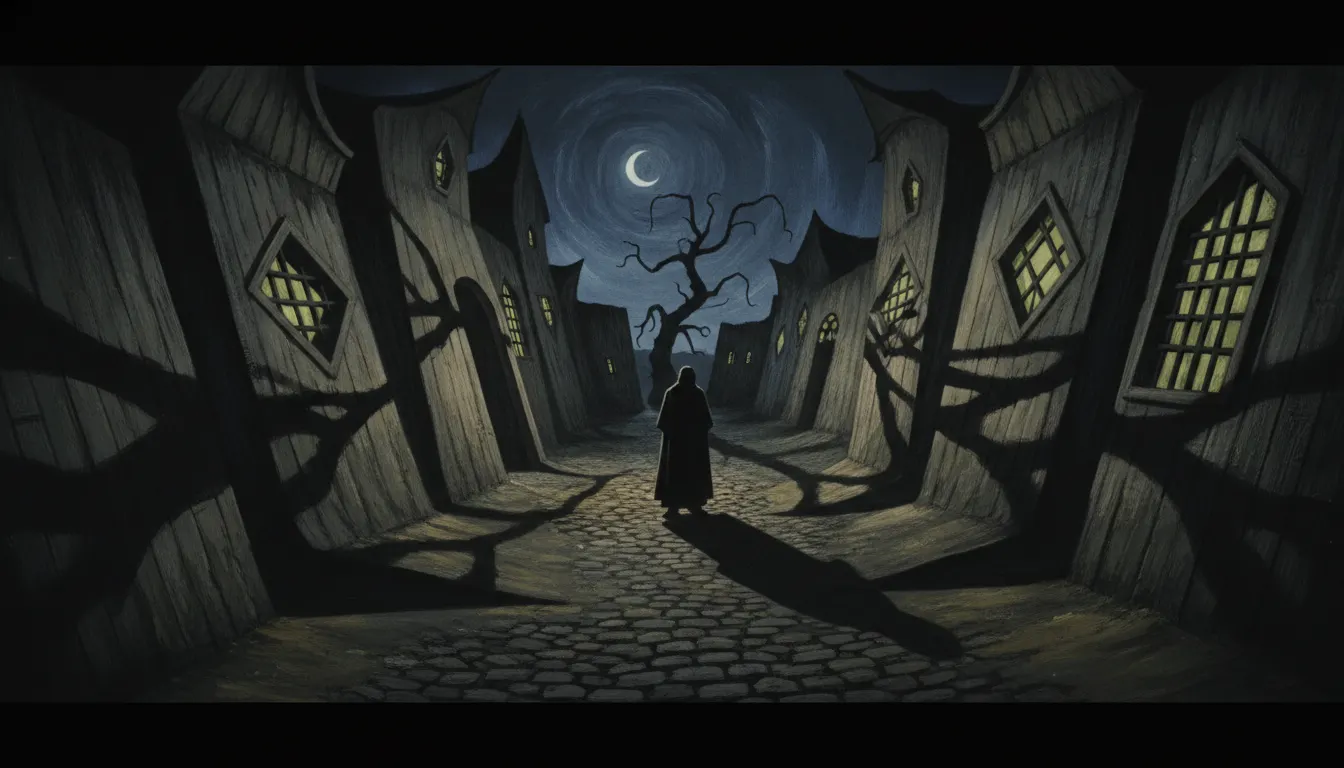
Weimar-era German Expressionism. Cabinet of Dr Caligari painted distortion, jagged shadows, skewed perspective, asylum-dream tableau.
The moves a human crew would use to get here. Cue applies them for you, and knowing their names is how you ask for a change.
Black shadows are drawn directly onto set flats and floors, eliminating the need for photographic lighting to generate shadow.
Walls tilt inward, floors rake at unnatural angles, and corners are acute rather than right, creating spaces that resist spatial orientation.
Heavy pancake foundation with kohl-darkened eye sockets and blackened lips creates the cadaverous face that orthochromatic stock amplifies.
Heavy coarse grain and extreme tonal contrast replicates the 1920s nitrate stock response - deep blacks and burning whites.
Circular iris opens or closes to begin and end scenes, a standard silent-era punctuation that reinforces the theatrical-tableau grammar.
Fraktur or Gothic blackletter typography in inter-title cards reinforces the Weimar German cultural and typographic context.
German Expressionism in cinema was born from the same cultural trauma as Expressionist painting - the aftermath of World War I, economic collapse, and a society unable to trust external reality. Robert Wiene's The Cabinet of Dr. Caligari (1920) established the visual vocabulary of cinematic Expressionism so completely that its conventions persisted for a century: distorted painted sets with skewed walls and non-Euclidean angles, graphic shadows painted directly onto floors and walls, somnambulist figures with kohl-darkened eyes moving through an asylum-nightmare architecture.
The art direction of Caligari was the work of three painters: Hermann Warm, Walter Röhrig, and Walter Reimann, all associated with Berlin Expressionist circles. Their key decision was that the sets should be painted rather than built: shadows were not lit but drawn onto flats; walls were not perpendicular but tilted inward; floors were not flat but raked at impossible angles. This was not a budget constraint but a philosophical commitment. Warm famously stated that cinema images must be "drawings brought to life." The painted shadow liberated cinema from photographic reality and established that the frame could be an interior psychological space rather than a window onto the world.
F.W. Murnau extended the Expressionist visual vocabulary into the supernatural: Nosferatu (1922) used extreme-contrast natural light and Max Schreck's physical performance to achieve a horror more unsettling than any painted set. The Last Laugh (1924) introduced the unchained camera to Expressionist cinema, with cinematographer Karl Freund using a camera mounted on a bicycle, on a fire hose, and in an elevator. Fritz Lang's The Cabinet of Dr. Mabuse (1922) and Metropolis (1927) scaled Expressionist set design to epic architectural ambition. Paul Wegener's The Golem (1920) applied the Expressionist palette to Jewish mythology.
The visual extremity of Expressionist films was partly determined by orthochromatic film stock - an emulsion that was sensitive to blue and green but not to red, causing red pigments to render as dark gray or black, and blue as white. Actors wore heavy pancake foundation, exaggerated kohl eye shadow, and lipstick that would render as near-black. This created the hollow-eyed cadaverous look associated with the movement. When panchromatic stock became standard in the late 1920s, it subtly domesticated the Expressionist face.
The Expressionist visual vocabulary migrated to Hollywood with the emigre wave of the 1930s: Lang, Murnau, Siodmak, and Ulmer brought it to Universal horror and to film noir. Tim Burton's early films - Beetlejuice (1988), Edward Scissorhands (1990), Batman Returns (1992) - are the most explicit neo-Expressionist works in contemporary cinema. Robert Eggers's Nosferatu (2024) returned directly to the 1922 source.
Robert Wiene / Warm, Röhrig, Reimann · 1920
The foundational text - painted distorted sets and somnambulist narrative establishing the entire vocabulary
F.W. Murnau / Fritz Arno Wagner · 1922
Expressionism through extreme-contrast natural light and physical performance rather than painted sets
Paul Wegener / Karl Freund · 1920
Expressionist architecture applied to Jewish mythology with massive sculpted set design
Fritz Lang / Karl Freund · 1927
Industrial Expressionism at epic scale - machine-cathedral architecture and class-warfare nightmare
F.W. Murnau / Karl Freund · 1924
The unchained camera in Expressionist grammar - tracking, crane, and subjective POV as emotional registers
Tim Burton / Stefan Czapsky · 1990
Modern neo-Expressionism transplanting the distorted-environment grammar into suburban America
Robert Eggers / Jarin Blaschke · 2024
Direct 2024 return to 1922 source material with period-accurate orthochromatic emulation and physical horror design
A Look is not a filter. It is a set of stored decisions the pipeline reads before it makes a single frame, so two videos in the same Look actually match.