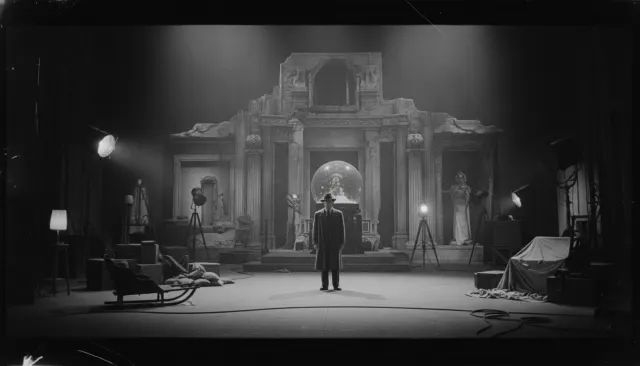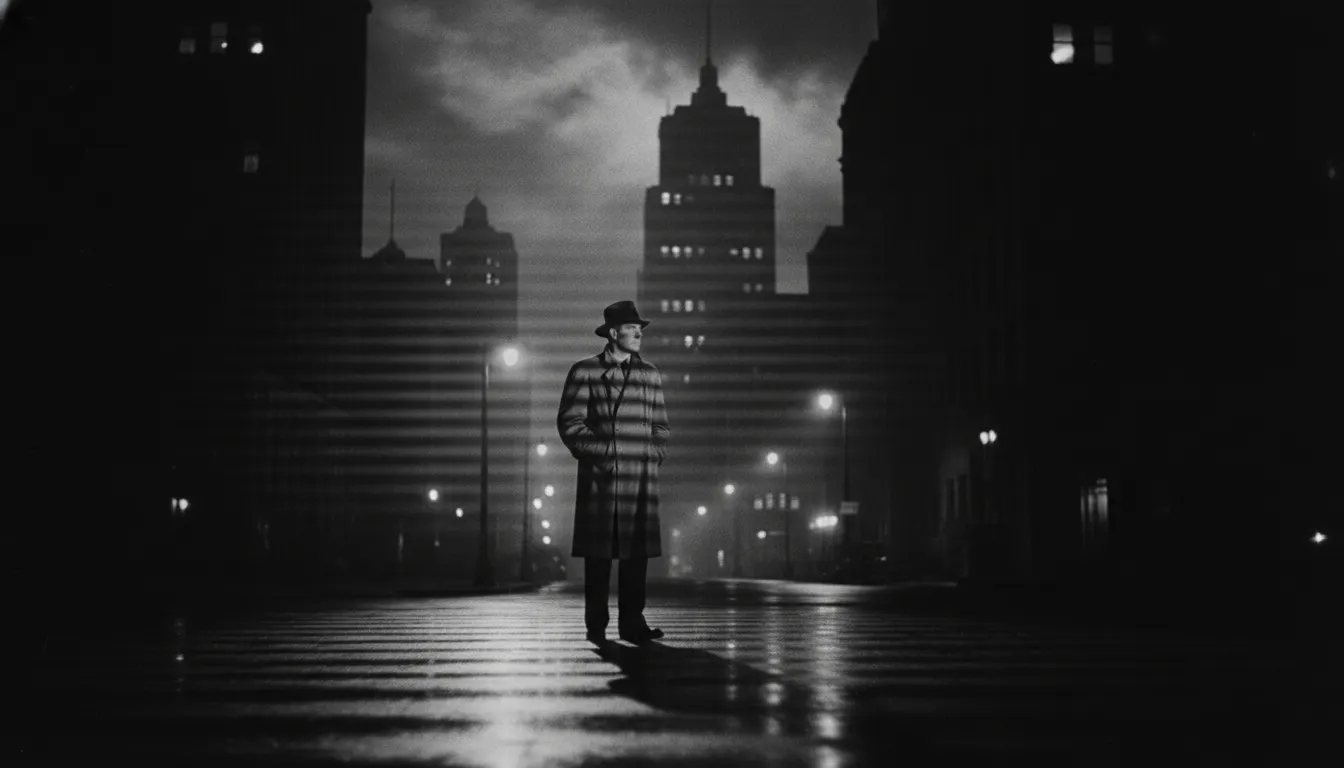
Double Indemnity
Billy Wilder / John Seitz · 1944
The genre's blueprint - venetian-blind stripes, femme fatale, insurance fraud, cigarette delivery
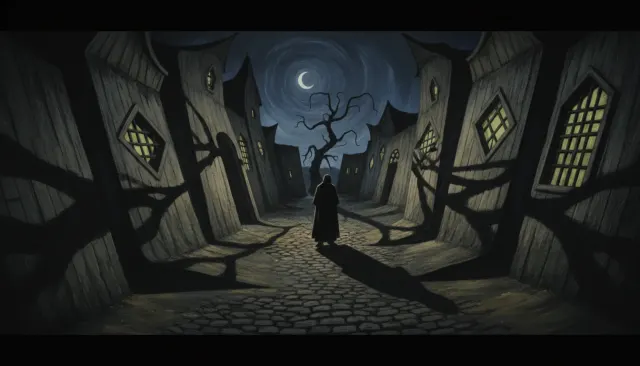
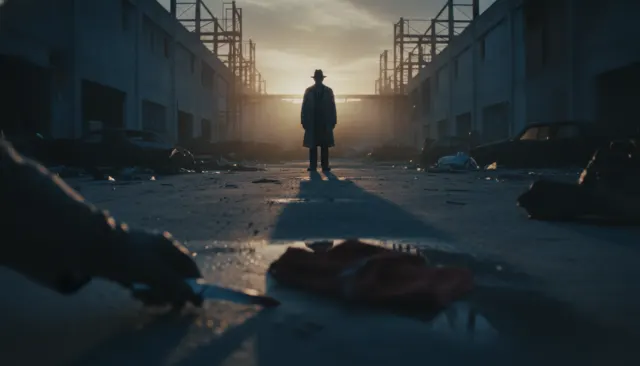
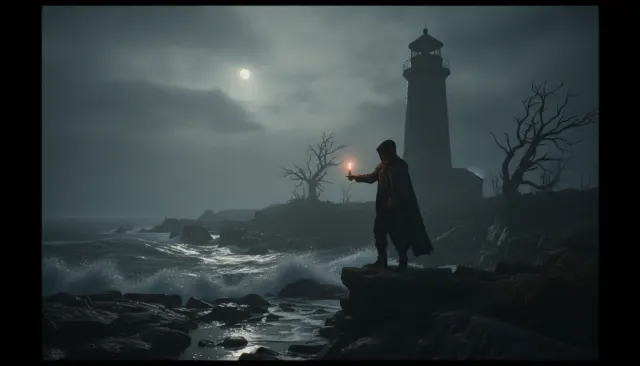
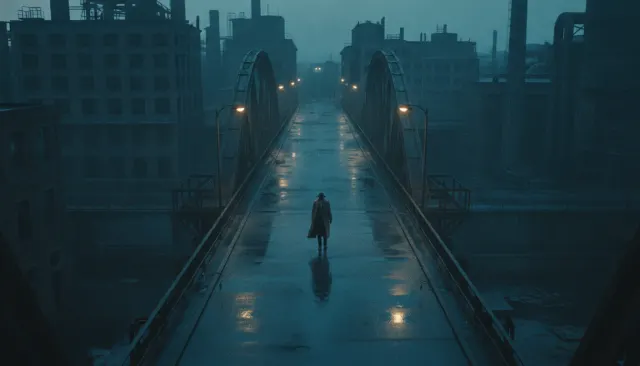
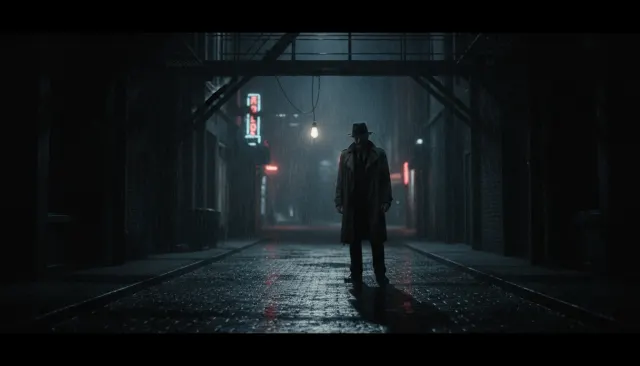
Classic film noir. Venetian-blind shadows, fedoras and trench coats, John Alton chiaroscuro, German Expressionist composition.
The moves a human crew would use to get here. Cue applies them for you, and knowing their names is how you ask for a change.
Gobo with horizontal slats projects diagonal stripe shadows across the subject's face, a universal signal of entrapment.
One Fresnel from extreme angle with no fill creates absolute black shadow areas and brilliant highlight faces.
Camera placed below subject eye-line, shooting upward against a ceiling or sky, creating physical and moral dominance.
Cigarette smoke passing through a single-source beam creates visible light-shaft and organic atmospheric movement.
Wide-angle lens at small aperture keeps the full urban environment sharp, from wet asphalt foreground to distant street lamp.
Temporal inversion with protagonist narrating their own downfall introduces fatalism and retrospective dramatic irony.
Film noir is the defining visual language of Hollywood's postwar disillusionment. Emerging between approximately 1941 and 1958, the cycle was identified and named by French critics - most influentially Raymond Borde and Etienne Chaumeton in their 1955 essay Panorama du film noir américain - before American critics fully recognized it as a coherent movement. The visual grammar was forged by a collision of German Expressionist emigres (Fritz Lang, Billy Wilder, Robert Siodmak) fleeing Nazi Germany and the hard-boiled literary tradition of Raymond Chandler, James M. Cain, and Dashiell Hammett.
John Alton, whose 1949 book Painting with Light remains the definitive statement of noir lighting philosophy, was the movement's technical master. Alton understood that the camera sees darkness differently than the eye: shadows on screen can be absolute black rather than gradations of gray. He used single hard Fresnel keys from extreme angles, venetian-blind gobos to cast diagonal stripe shadows across faces, and minimal or no fill, creating images of extraordinary chiaroscuro contrast. His work for Anthony Mann - T-Men (1947), Raw Deal (1948), He Walked by Night (1948) - and later The Big Combo (1955) with Joseph Lewis, are the canonical technical references.
The visual architecture of noir is inseparable from Weimar German cinema. Fritz Lang, who had directed Dr. Mabuse (1922), M (1931), and The Testament of Dr. Mabuse (1933) before fleeing Germany in 1933, brought the canted frame, the low-angle hero shot, and the expressionist shadow to Hollywood. His American noirs - The Woman in the Window (1944), Scarlet Street (1945), The Big Heat (1953) - are the direct link between Weimar composition and Hollywood genre.
Billy Wilder's Double Indemnity (1944), shot by John Seitz, established the narrative and visual template: insurance salesman manipulated by femme fatale, venetian-blind shadow stripes, ceiling fans, and cigarette smoke drifting through single-source beams. The film's flashback structure (the protagonist narrating his own undoing) became the genre's preferred temporal grammar. Sunset Boulevard (1950), also Wilder-Seitz, pushed the formula to self-parodic extremes.
Film noir never fully stopped; it mutated into neo-noir from the 1970s onward. Roman Polanski's Chinatown (1974, John A. Alonzo), Ridley Scott's Blade Runner (1982, Jordan Cronenweth), and Joel and Ethan Coen's Blood Simple (1984, Barry Sonnenfeld) each translated the original visual lexicon into color and contemporary settings. The venetian-blind shadow, the low-angle master shot, and the chiaroscuro face are now immediately legible as moral ambiguity signals across all genres.
Billy Wilder / John Seitz · 1944
The genre's blueprint - venetian-blind stripes, femme fatale, insurance fraud, cigarette delivery
Joseph Lewis / John Alton · 1955
Alton's extreme chiaroscuro at its most technically audacious - faces half in absolute black
Jacques Tourneur / Nicholas Musuraca · 1947
Tourneur and Musuraca's fog and shadow define the nostalgic-fatalistic register
Orson Welles / Russell Metty · 1958
The genre's baroque finale - extreme low angle, crane long-take, and corrupt authority
Billy Wilder / John Seitz · 1950
Self-aware noir at the genre's peak - dead protagonist narrating his own murder from the pool
Carol Reed / Robert Krasker · 1949
Post-war Vienna noir using radical canted angles as moral-geography signifiers
Roman Polanski / John A. Alonzo · 1974
The defining neo-noir transplanting the original grammar into 1970s color cinematography
A Look is not a filter. It is a set of stored decisions the pipeline reads before it makes a single frame, so two videos in the same Look actually match.