Mank
Erik Messerschmidt / David Fincher · 2020
Academy Award winner for Best Cinematography - definitive digital period monochrome emulation
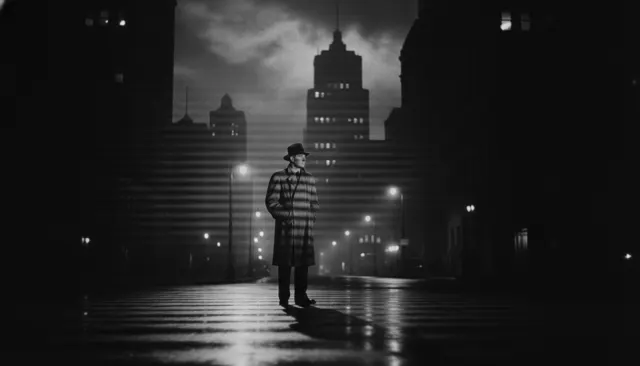
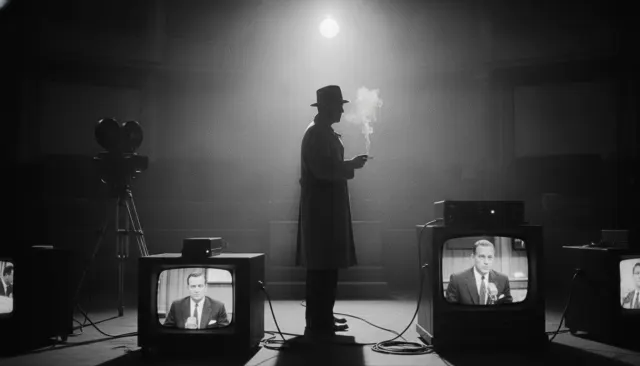
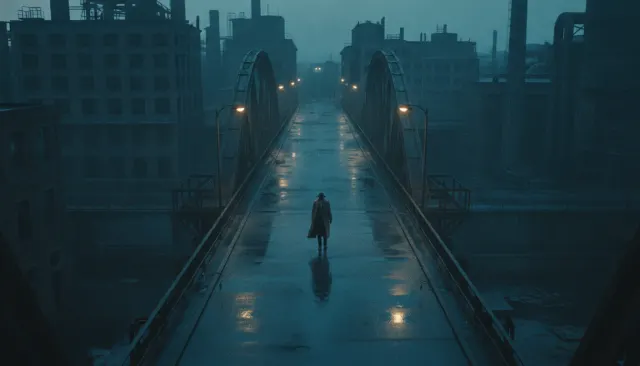
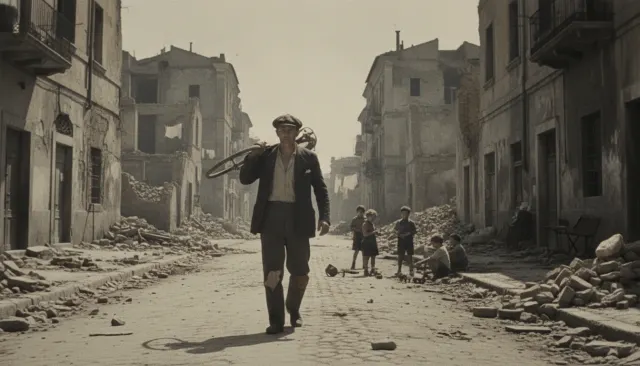
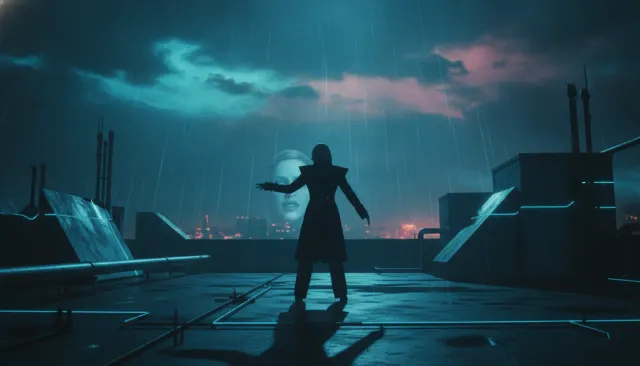
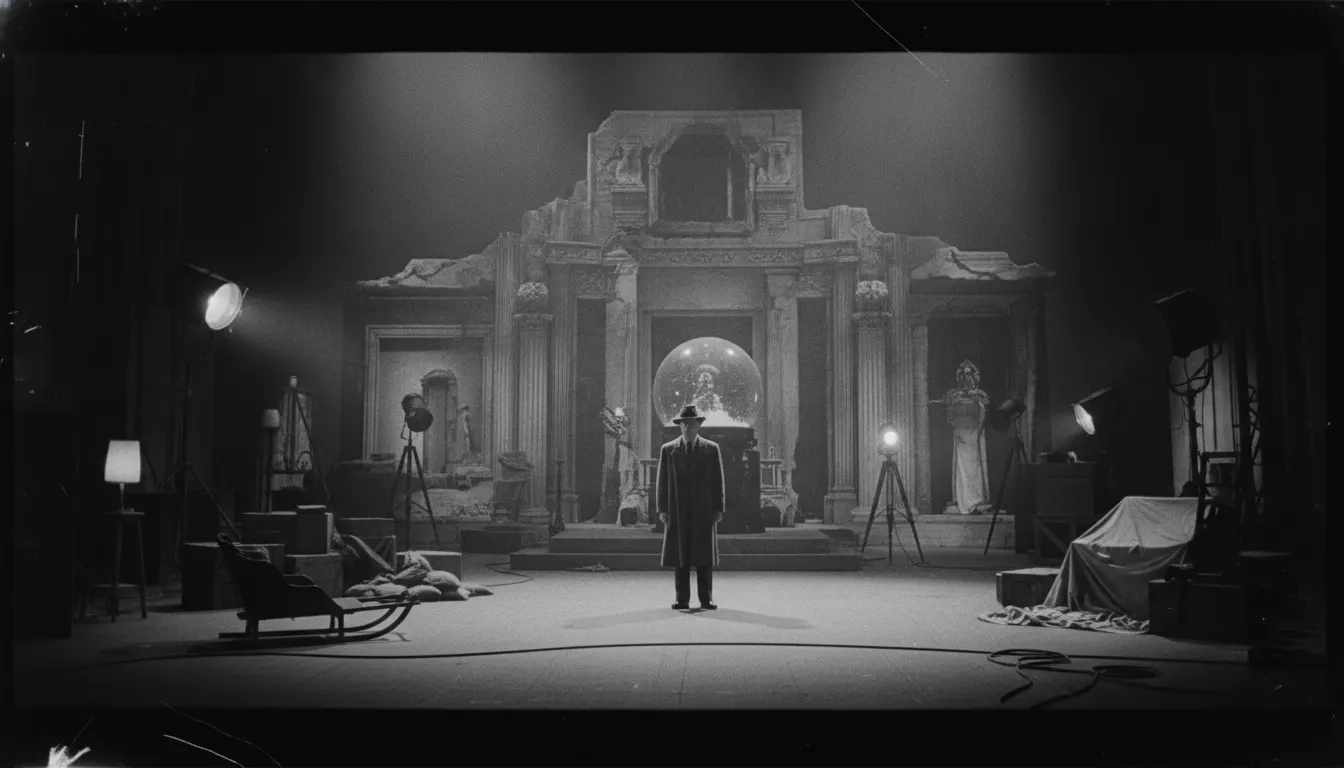
Erik Messerschmidt Mank period black-and-white. 1940s soundstage emulation, cigarette-burn reel marks, classical staging, faithful Citizen Kane homage.
The moves a human crew would use to get here. Cue applies them for you, and knowing their names is how you ask for a change.
Center-sharp with soft glowing edge falloff, creating a hand-drawn optical quality impossible in modern glass.
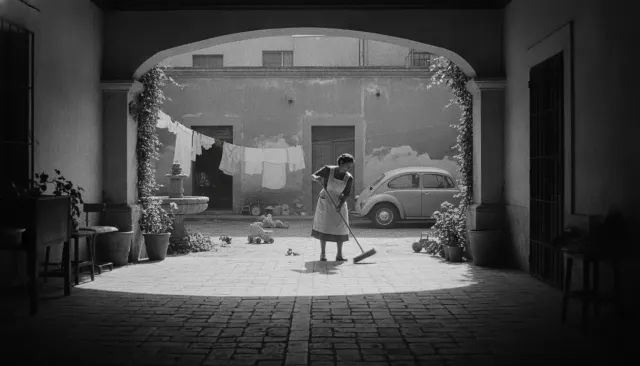
Wide-angle lenses at small apertures place subjects in full focus from foreground to background, the Toland/Kane compositional grammar.
Hard backlight at high ratio produces luminous edge on hair and shoulder against deep shadow, classical Hollywood glamour technique.
Reel-change cue mark in upper-right corner signals projector-booth authenticity and period verisimilitude.
Color-to-monochrome conversion weighted to mimic 1940s panchromatic film tonal response - deep blue skies, luminous skin.
Practical light sources glow and bleed into surrounding frame area, mimicking orthochromatic halation from early cinema stocks.
Erik Messerschmidt's cinematography for David Fincher's Mank (2020) represents the most technically rigorous black-and-white period emulation in the digital era. Working on RED Monstro 8K VV cameras with vintage Baltar lenses that had been meticulously restored and re-housed, Messerschmidt and Fincher set out to recreate the specific optical and photochemical qualities of 1930s-1940s Hollywood studio photography - not as nostalgia, but as a precise research project.
The Baltar lenses (originally designed in the 1940s by Angenieux and Cooke) were selected for their distinctive resolving characteristics: sharp in the center with a soft, slightly glowing falloff toward the edges. This is the opposite of modern cinema glass, which strives for edge-to-edge consistency. The soft periphery creates the impression that the image is drawn from the world rather than mechanically captured - a quality impossible to replicate in post-production alone.
Gregg Toland's cinematography for Citizen Kane (1941) - the film that Mank directly engages with as subject matter - used deep-focus photography, low-angle wide-lens compositions, and hot rim lighting to create the classical Hollywood grammar that defined the studio era. Messerschmidt studied Toland's contact sheets and frame grabs extensively. His lighting design uses high-ratio single-key Fresnels with a hard hot rim, reproducing the broad shadow areas and luminous face separation of 1940s three-point lighting.
Fincher and Messerschmidt deliberately added physical period artifacts: cigarette burn marks in the upper-right frame corner (which once cued projectionists to change reels), optical vignetting from period lenses, and the particular halation of orthochromatic film stock around practical light sources. These were not applied uniformly as a filter layer but were composited selectively to appear organic.
The Monstro 8K was shot in color at native ISO and then converted to monochrome using a process that exploited the camera's native color channels. By adjusting the relative weighting of red, green, and blue channels in conversion, Messerschmidt achieved a tonal response that mimicked panchromatic film - where sky and foliage render differently than they would on orthochromatic stock. Skin tones were retained with full luminous detail rather than being crushed to mid-gray.
Messerschmidt's earlier work on Mindhunter (2017-2019, with Fincher as executive producer) demonstrated his facility with extreme darkness and controlled interior lighting. Mank applied that precision to a historically specific period rendering. He subsequently won the Academy Award for Best Cinematography for Mank at the 93rd Oscars (2021), the first digital black-and-white film to win the award.
Erik Messerschmidt / David Fincher · 2020
Academy Award winner for Best Cinematography - definitive digital period monochrome emulation
Erik Messerschmidt / David Fincher · 2017
Extreme shadow-ratio controlled interior work preceding and informing Mank's Fincher collaboration
Gregg Toland / Orson Welles · 1941
The direct reference work - deep focus, low angle, hard rim that Messerschmidt studied and homaged
John Seitz / Billy Wilder · 1944
Classical Hollywood three-point lighting at peak refinement, the grammar Mank consciously invokes
Arthur Edeson / John Huston · 1941
Period single-key studio cinematography with deep shadow ratios and hard practical separation
Jeff Cronenweth / David Fincher · 2014
Fincher precision in color that preceded and contextualizes the controlled rigor of Mank
Robert Elswit / George Clooney · 2005
Comparable period digital monochrome achieving 1950s broadcast grammar from research-based lensing
A Look is not a filter. It is a set of stored decisions the pipeline reads before it makes a single frame, so two videos in the same Look actually match.