See It Now - McCarthy Report
Edward R. Murrow / CBS · 1954
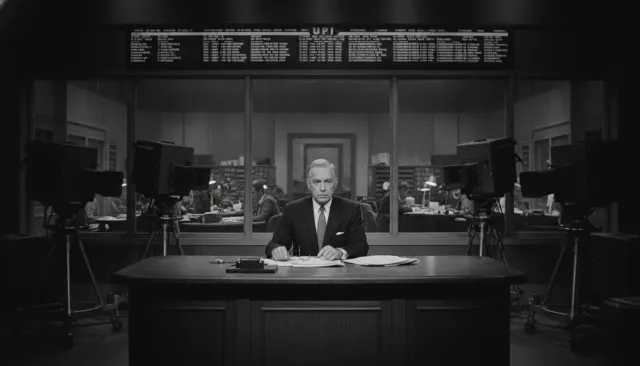
The definitive broadcast - single-key monochrome, cigarette delivery, direct McCarthy indictment
Edward R Murrow See It Now 1954. Cigarette-smoke single-key newsreel, McCarthy hearing broadcast, hard-edged voice-of-democracy, tight black-and-white close.
The moves a human crew would use to get here. Cue applies them for you, and knowing their names is how you ask for a change.
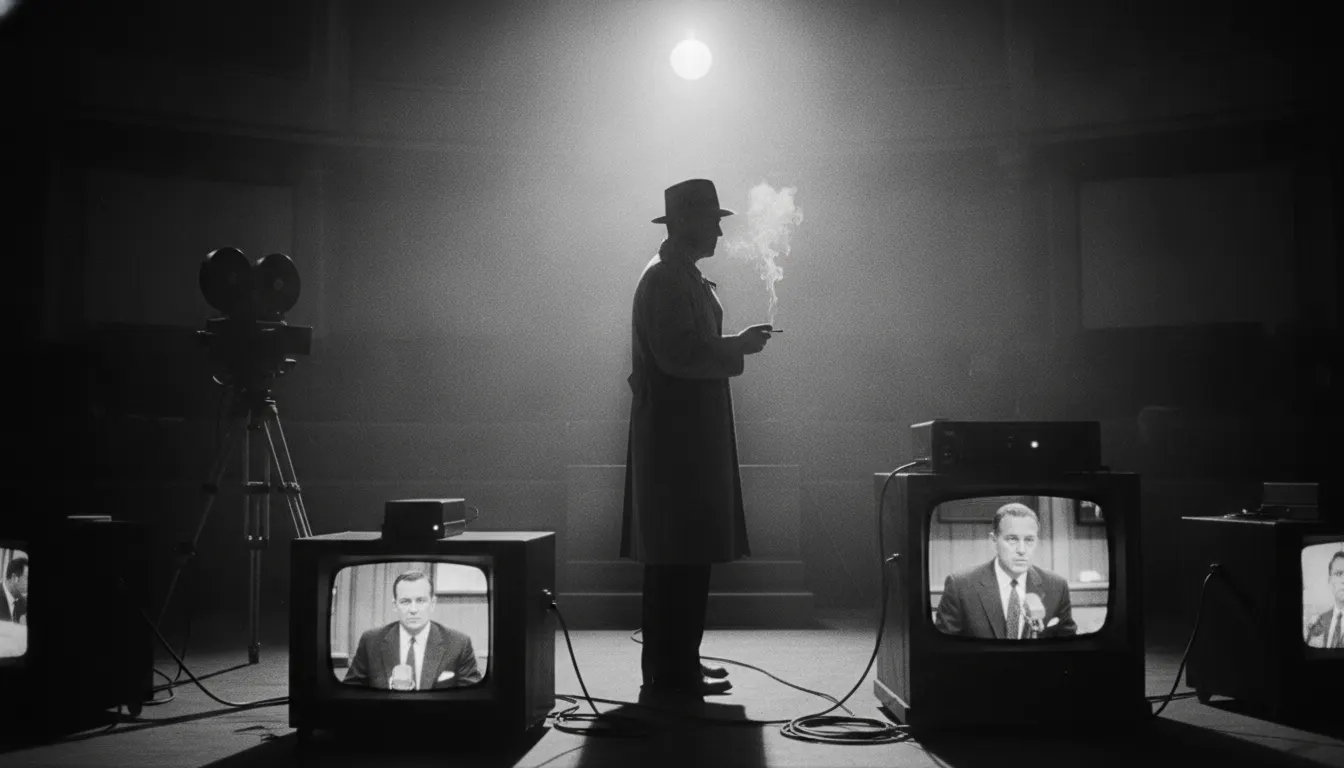
One hard spotlight from 30-40 degrees above the anchor, with no fill, creating a near-noir shadow ratio on broadcast monochrome.
The cigarette marks rhetorical pauses and segment transitions, its smoke providing organic movement in an otherwise static frame.
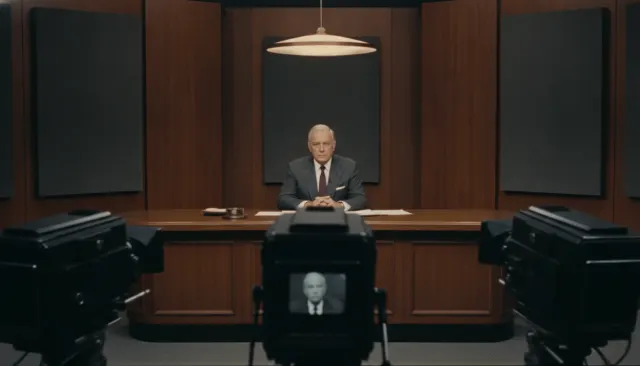
Camera is locked on a 50mm equivalent at chest-to-crown framing, with no panning, tilting, or movement during the delivery.
16mm film-to-video transfer chain adds organic grain and a slight temporal flicker distinct from modern digital noise.
Full black point with no shadow lift, and near-specular highlights on the skin, matching broadcast monochrome contrast curves.
Anchor speaks directly into the camera lens without eye-deflection, creating a moral-authority vector with the viewer.
Edward R. Murrow's broadcast aesthetic defined American television journalism at its most consequential moment. Between 1951 and 1958, his CBS program See It Now established a visual grammar for serious television news that persisted for four decades: the static anchor framing, the cigarette as prop and punctuation, the single hard key light, and the tight black-and-white close-up conveying authority through restraint.
The pivotal broadcast was the March 9, 1954 episode of See It Now - "A Report on Senator Joseph R. McCarthy" - in which Murrow used McCarthy's own filmed speeches and newsreel footage to construct a direct indictment. Shot on 16mm Kodak Plus-X kine (kinescope transfer from studio broadcast), the images carry the characteristic attributes of that era: deep crushed blacks, slight halation around practical lights, a slight flicker from the film-to-video transfer chain. Murrow delivered his famous closing monologue - "Good night, and good luck" - in a medium close, cigarette burning, tie knotted, no teleprompter visible, looking directly into the lens.
CBS broadcast studios in the early 1950s used a single hard key from a Fresnel spot mounted at about 30 degrees elevation above the anchor. The cigarette provided both a prop that naturalized the studio setup (Murrow smoked throughout, often with the cigarette in frame during segments) and a practical light source that added a second point of luminous reference in the frame. No fill light was used; shadow depth on the non-key side of the face was total, producing a near-noir ratio incompatible with the "objective journalistic" style that would emerge in the 1960s.
Clooney's biographical film Good Night, and Good Luck (2005), shot by Robert Elswit in digital black-and-white, is the most studied modern recreation of the Murrow visual language. Elswit achieved the period look by lighting with Kinoflo tubes that mimicked the hard fluorescent broadcast instruments of the era, then grading to a high-contrast monochrome with lifted grain. David Strathairn's performance as Murrow - the deliberate delivery, the cigarette timing, the controlled urgency - is the primary actor reference for the aesthetic.
The Murrow style became the template for broadcast authority: news anchors from Walter Cronkite through Peter Jennings inherited the tight medium close, the direct address, and the controlled gravitas. The cigarette disappeared from broadcast after the mid-1960s, but the lighting ratio, the restrained delivery, and the sense that the anchor was personally vouching for the information survived intact.
Edward R. Murrow / CBS · 1954
The definitive broadcast - single-key monochrome, cigarette delivery, direct McCarthy indictment
Edward R. Murrow / CBS · 1953
Celebrity interview series establishing the tight single-camera studio setup
George Clooney / Robert Elswit · 2005
Modern digital recreation of 1950s CBS aesthetic using Kinoflo-based monochrome lighting
Edward R. Murrow / CBS · 1952
Field-and-studio hybrid broadcast with 16mm combat kine transfers defining the war-report grammar
Walter Cronkite / CBS · 1963
Emotional peak of the Murrow-descended anchor aesthetic - suit, tight frame, controlled devastation
Edward R. Murrow / David Lowe · 1960
Field documentary showing Murrow's format extended to social justice investigative reportage
A Look is not a filter. It is a set of stored decisions the pipeline reads before it makes a single frame, so two videos in the same Look actually match.