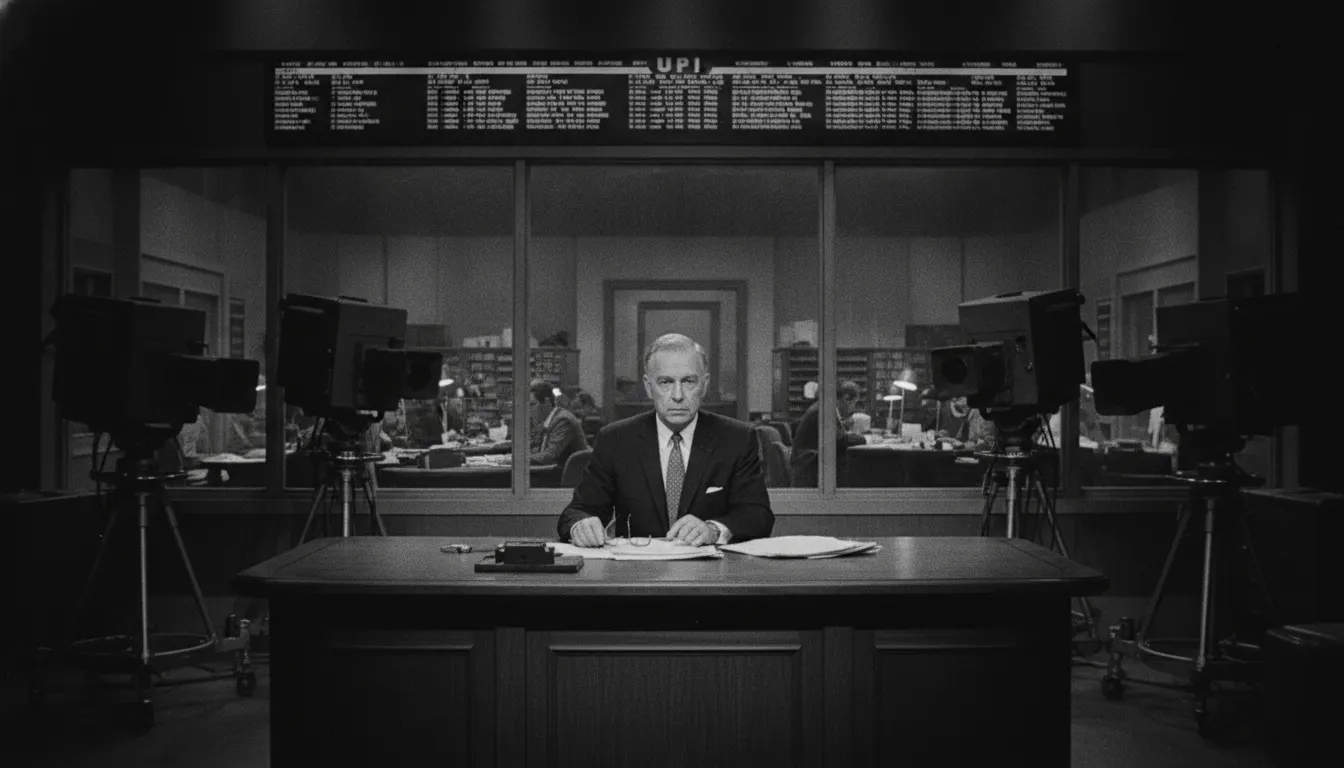
CBS Evening News with Walter Cronkite
CBS News · 1963
The canonical black-and-white anchor grammar; thirty-minute newscast format that defined American broadcast journalism
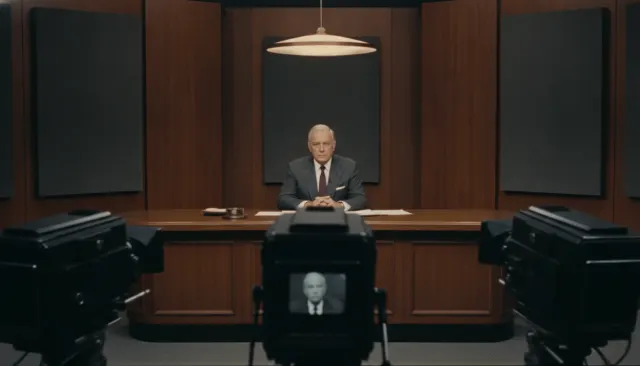
Walter Cronkite CBS Evening News 1968. Black-and-white three-camera anchor desk, hand-rolled newsroom UPI ticker, glasses-off Apollo announcement gravitas.
The moves a human crew would use to get here. Cue applies them for you, and knowing their names is how you ask for a change.
All visual hierarchy carried through tonal contrast alone - white shirts against medium-gray suits against darker backgrounds - with no color information.
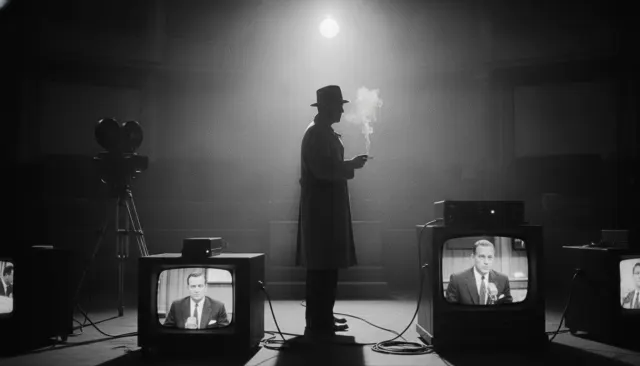
Period-accurate phosphor glow, reduced fine detail, and kinescope grain texture that marks footage as authentic early broadcast archive.
Minimal, uncluttered background behind the anchor desk - institutional without being busy, designed for monochrome tonal contrast.
Slow, purposeful cuts that give significant information time to register; the editorial rhythm matches the news gravity.
Clean, authoritative serif or early sans-serif lower-thirds in white on dark fields, period-accurate character generator style.
The Cronkite-grammar emphasis technique: removing glasses or pausing delivery to signal that the following information is of extraordinary weight.
Walter Cronkite's CBS Evening News from roughly 1962 to the late 1960s defines the apex of black-and-white American broadcast journalism. Cronkite anchored CBS's transition from a 15-minute to a 30-minute evening newscast in September 1963, and over the following years presided over the assassination of President Kennedy, the Apollo missions, Vietnam, and the cultural upheaval of the decade. The visual grammar of those broadcasts - composed black-and-white three-camera work, the anchor desk as civic altar, and Cronkite's measured, authoritative address - became the baseline against which all American television journalism has since been measured.
The CBS Evening News was produced in black-and-white until color conversion in the late 1960s. Monochrome television cameras of the era had limited sensitivity and required high-key studio lighting to produce clean images. The absence of color information meant that contrast relationships - the tonal distribution between the white of a shirt, the medium gray of a suit, and the dark background - carried the entire compositional load. Studio designers and lighting directors worked specifically with tonal contrast rather than color to create legible, authoritative compositions.
Kinescopes - photographic recordings of live broadcasts made by filming the CRT monitor with a film camera - produced the slightly soft, slightly flared black-and-white look that characterizes archival footage from this era. Kinescope recordings added grain, reduced fine detail, and created the ghostly phosphor glow that now reads as definitively "period."
Cronkite's on-camera grammar is inseparable from the look. He reads copy directly from his desk, glasses on, occasionally removing them for moments of particular weight (the Apollo 11 landing, the JFK assassination report). The CBS studio behind him is spare - no visual clutter, just the institutional backdrop and the anchor desk. Lower-thirds identify him in spare CBS typography. The camera cuts from wide establishing to medium to close-up following the logical rhythm of emphasis, not the decorative rhythm of visual variety.
The November 22, 1963 CBS News coverage - Cronkite interrupting programming to announce President Kennedy's assassination and later confirming his death - is the most-analyzed moment of anchor television. The visual grammar of that broadcast, including Cronkite removing his glasses and pausing to compose himself before confirming Kennedy's death, represents the form at its most morally weighty.
The Apollo 11 lunar landing coverage, with Cronkite joining astronaut Wally Schirra at the CBS anchor desk, demonstrates the look in its most celebratory mode: black-and-white studio production integrated with color NASA footage, the contrast between the two formats underscoring the historical significance of the event.
CBS News · 1963
The canonical black-and-white anchor grammar; thirty-minute newscast format that defined American broadcast journalism
CBS News / Walter Cronkite · 1963
The most-analyzed moment of anchor television; glasses-removal and paused delivery as grammar of civic weight
CBS News / Walter Cronkite · 1969
Cronkite and Wally Schirra at the anchor desk during lunar landing; monochrome studio and color NASA footage integration
George Clooney · 2005
Fictional recreation of 1950s CBS newsroom in authentic black-and-white, demonstrating the grammar's cinematic legibility
CBS News / Edward R. Murrow · 1951
The Cronkite grammar's direct predecessor; Murrow's CBS newsroom as formal ancestor
A Look is not a filter. It is a set of stored decisions the pipeline reads before it makes a single frame, so two videos in the same Look actually match.