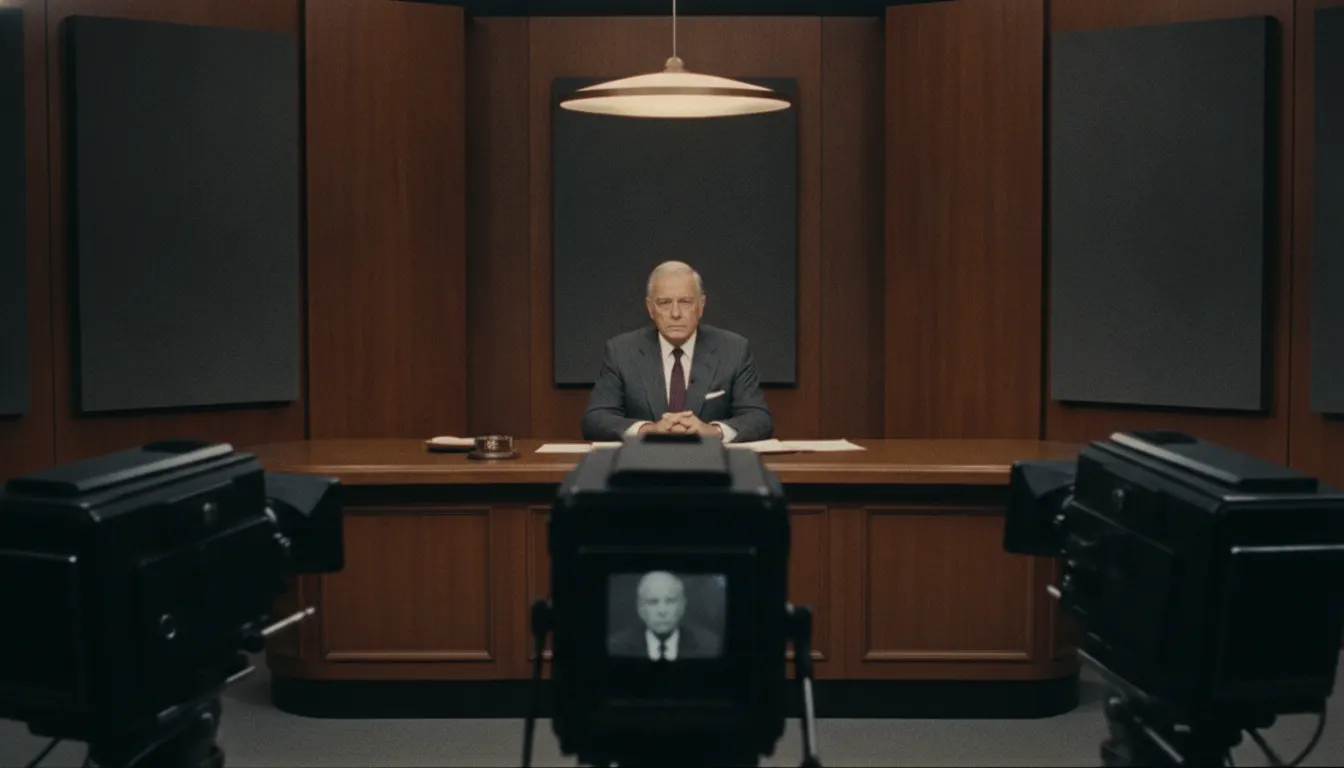
CBS Evening News with Walter Cronkite
CBS News · 1962
The canonical vintage anchor format; Cronkite's direct address and composed gravity defined the grammar
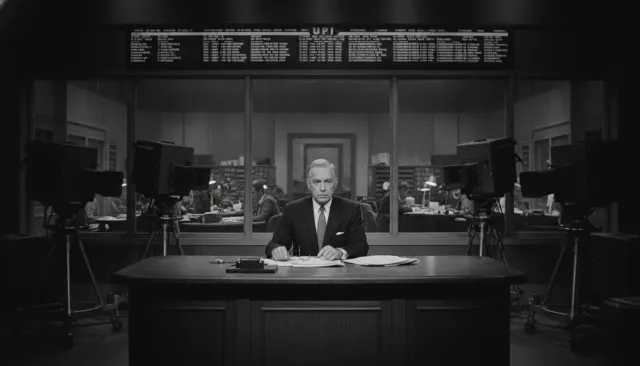
Walter Cronkite 1970s three-camera news anchor. Wood-paneled set, single-light flat key, sober dignity, manual-wipe transitions.
The moves a human crew would use to get here. Cue applies them for you, and knowing their names is how you ask for a change.
Camera at slightly below eye level, centered on the anchor, with direct lens address that communicates composed authority.
Period-accurate rear-projection or keyed graphic display behind and over the anchor's shoulder, illustrating the story subject.
Broad, shadowless studio illumination producing even face exposure with minimal shadow, communicating transparency and composure.
Slow, purposeful cuts between wide, medium, and close framings that follow editorial emphasis rather than action rhythm.
Raised anchor desk with network branding, reference bookshelves in background, and organized professional environment communicating preparedness.
Network-specific lower-third fonts and color palettes from the era - CBS blue, NBC peacock, ABC yellow - in period character generator style.
The vintage three-camera anchor look represents the visual grammar of American network television news through its most authoritative and format-defining period: the late 1960s through the 1980s. Three-camera studio production was the technological and institutional solution to live broadcast news, and its conventions - the anchor desk, the shoulder box, the flat key light, and the grave-but-composed correspondent address to camera - became the universal grammar of how authoritative information delivery looks.
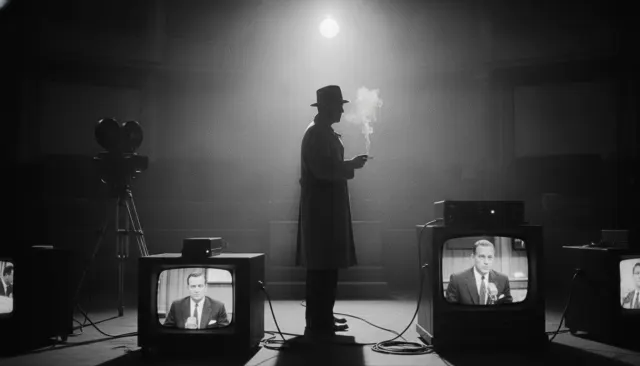
Live broadcast news required multiple cameras to cover the anchor desk from different angles without cutting to dead air during camera repositioning. The standard setup used a wide establishing shot (Camera 1), a medium anchor shot (Camera 2), and a tighter close-up (Camera 3). Directors cut between these in real time at a vision-mixer console. This technical necessity created the grammar: all three cameras framed the anchor from a slight downward angle at roughly eye level, creating the characteristic head-on, slightly below-chin framing that reads as authoritative and composed.
The three-camera news set was designed as a theater of information delivery. The anchor desk - raised, broad, with the network logo and name visible - functioned as a stage. Behind the anchor, the "box" (a rear-projection window or later a screen) displayed relevant images or maps. Bookshelves of reference materials were often visible in background, communicating scholarship and preparation. Studio lighting was designed to produce flat, high-key illumination on the anchor's face with minimal shadow - a technical necessity for early tube cameras that lacked dynamic range, but also a visual grammar of transparency and composure. The anchor has nothing to hide, and the light says so.
What distinguishes the vintage three-camera anchor look from other news formats is its formal commitment to composed address. The anchor looks directly into Camera 2 - into the living rooms of the national audience. Eye contact is steady, unhurried, and uninterrupted by handheld movement or whip pans. The edit rhythm matches this composure: cuts between cameras are slow and purposeful, following the editorial logic of emphasis rather than the visual rhythm of action. This is television news at its most formally theatrical.
The three major American networks developed slightly different variants. CBS with Walter Cronkite and later Dan Rather favored a slightly warmer, more intimate visual grammar. NBC with John Chancellor and Tom Brokaw emphasized the graphic design elements - lower-thirds, the peacock palette. ABC with Peter Jennings introduced a more photogenic international correspondent aesthetic. All three, however, shared the fundamental grammar of the raised anchor desk, the direct address, and the composed high-key lighting.
CBS News · 1962
The canonical vintage anchor format; Cronkite's direct address and composed gravity defined the grammar
NBC News · 1982
The polished 1980s evolution with stronger graphic design and the NBC peacock palette fully developed
ABC News · 1983
International-correspondent aesthetic applied to the anchor desk; slightly warmer and more photogenic
Sidney Lumet · 1976
Satirical treatment that exposed the theatrical grammar of the anchor desk as performance
James L. Brooks · 1987
The most authentic fictional recreation of three-camera news production from the inside
Ron Howard · 1994
Newspaper journalism but with broadcast news visual grammar demonstrating the cross-medium influence
A Look is not a filter. It is a set of stored decisions the pipeline reads before it makes a single frame, so two videos in the same Look actually match.