Roma
Alfonso Cuarón (Director/DP) · 2018
Golden Lion Venice; Academy Award Best Cinematography and Best Director
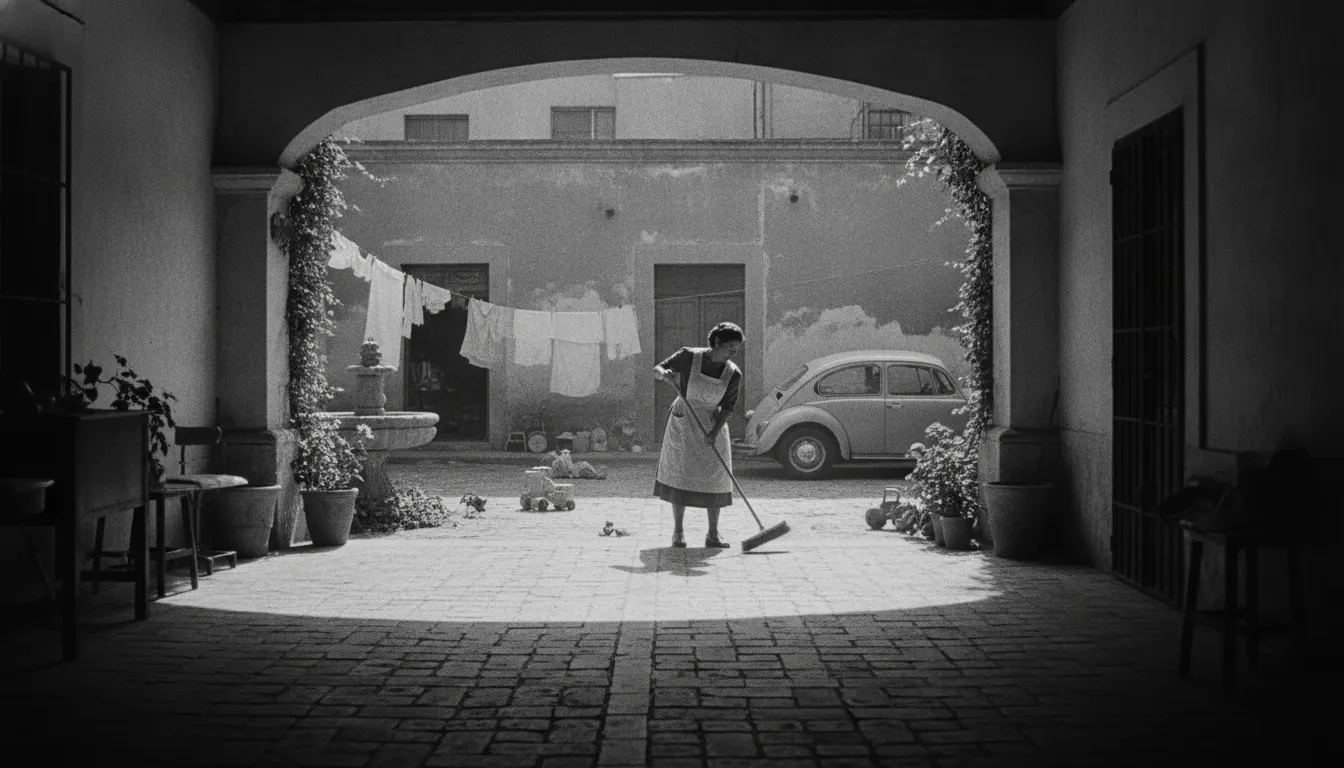
Alfonso Cuarón Roma black-and-white. Self-shot 65mm digital, observational long takes, 1970s Mexico City domestic, panning master shots.
The moves a human crew would use to get here. Cue applies them for you, and knowing their names is how you ask for a change.
Extended horizontal pan following characters through domestic and public space, refusing to cut when movement would conventionally demand it.
ARRI Alexa 65 color capture converted to B&W in post, giving precise luminance control unavailable with photochemical B&W.
Architecture and environment kept in sharp focus alongside characters at equal visual weight, making place a narrative agent.
Shot lengths of 60-120 seconds that ask viewers to actively find meaning within the wide, patient frame.
Mexico City colonial architecture's concrete and tile producing a cool, silvery diffuse quality that the large-format sensor resolves with extreme detail.
Camera follows behavior as it occurs rather than staging it for the lens, producing documentary-credible physical truth.
Alfonso Cuarón's Roma (2018) is simultaneously a deeply personal memoir film - a tribute to Liboria 'Libo' Rodríguez, the domestic worker who raised him in 1970s Mexico City - and a formally radical act: Cuarón acted as his own director of photography, shooting digitally on the ARRI Alexa 65 large-format system and converting to black-and-white in post, producing images of a scale and precision rarely seen outside large-format film photography.
Cuarón chose the ARRI Alexa 65 - a digital cinema camera using a sensor larger than standard 35mm film - for its ability to resolve extreme detail and dynamic range. The camera captured in color, and the black-and-white conversion was performed digitally in post-production, giving Cuarón precise control over luminance relationships that photochemical B&W cannot offer.
Lenses were primarily spherical (35-65mm range), chosen for minimal distortion while maintaining the environmental presence that Cuarón's observational style requires. The depth of field was calculated to keep the Colonia Roma neighborhood's architecture in focus throughout, making the built environment of 1970s Mexico City a constant, equally-weighted presence alongside the human subjects.
Roma's cinematographic grammar is built on extended panning master shots. The camera is typically positioned in a wide establishing view and then rotates - sometimes 180 degrees or more - following characters as they move through domestic and public spaces. This panning master technique derives from a tradition of observational documentary filmmaking: the camera follows behavior rather than anticipating it, and the viewer is asked to actively locate the narrative center within the wide field.
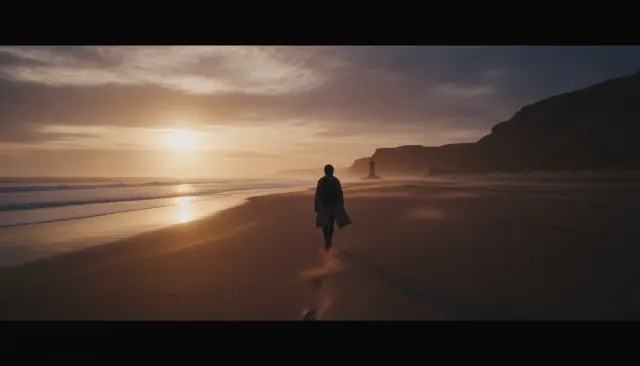
The most analyzed shot in the film is the beachside sequence, where the camera pans from the crash of Pacific Ocean waves to the figures of Cleo and the children in the shore break, then back to the horizon and the approaching sea. The shot's duration (approximately 90 seconds) and its insistence on keeping all elements - sea, family, horizon - simultaneously visible is a formal argument about scale, insignificance, and love.
Cuarón has stated that black-and-white was essential to Roma because it creates a visual language of memory and historical past that color resists. The black-and-white removes the film from the comfortable visual specificity of period television reconstruction and places it in the continuous cinematic tradition of personal documentary and neorealist fiction.
The luminance relationships in the grade were calibrated to the specific light qualities of Mexico City's colonial street architecture: concrete walls, tile roofs, and courtyards that yield a silvery diffuse exterior light in the winter rainy season that the large-format sensor could resolve with extraordinary detail.
Roma won the Golden Lion at Venice 2018, the Academy Award for Best Cinematography, and Best Director - the first film to win both cinematography and directing awards for the same individual since the Lumière Brothers.
Alfonso Cuarón (Director/DP) · 2018
Golden Lion Venice; Academy Award Best Cinematography and Best Director
Alfonso Cuarón / Emmanuel Lubezki (DP) · 2006
Single-take action sequences; color precursor to Roma's observational grammar
Ermanno Olmi · 1978
Neorealist Italian long-take domestic reference that Cuarón cites for Roma
Pawel Pawlikowski / Lukasz Zal (DP) · 2013
Polish B&W Academy-ratio memory film; formal contemporary parallel
Pawel Pawlikowski / Lukasz Zal (DP) · 2018
B&W 1950s Polish romance; contemporaneous prestige B&W partner work
A Look is not a filter. It is a set of stored decisions the pipeline reads before it makes a single frame, so two videos in the same Look actually match.