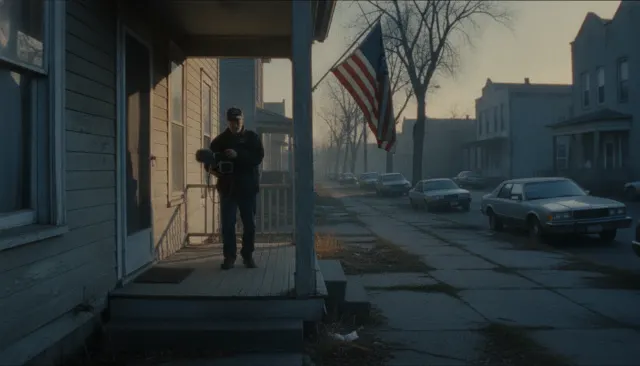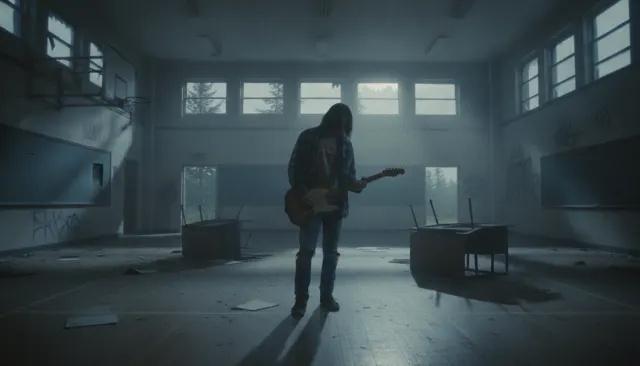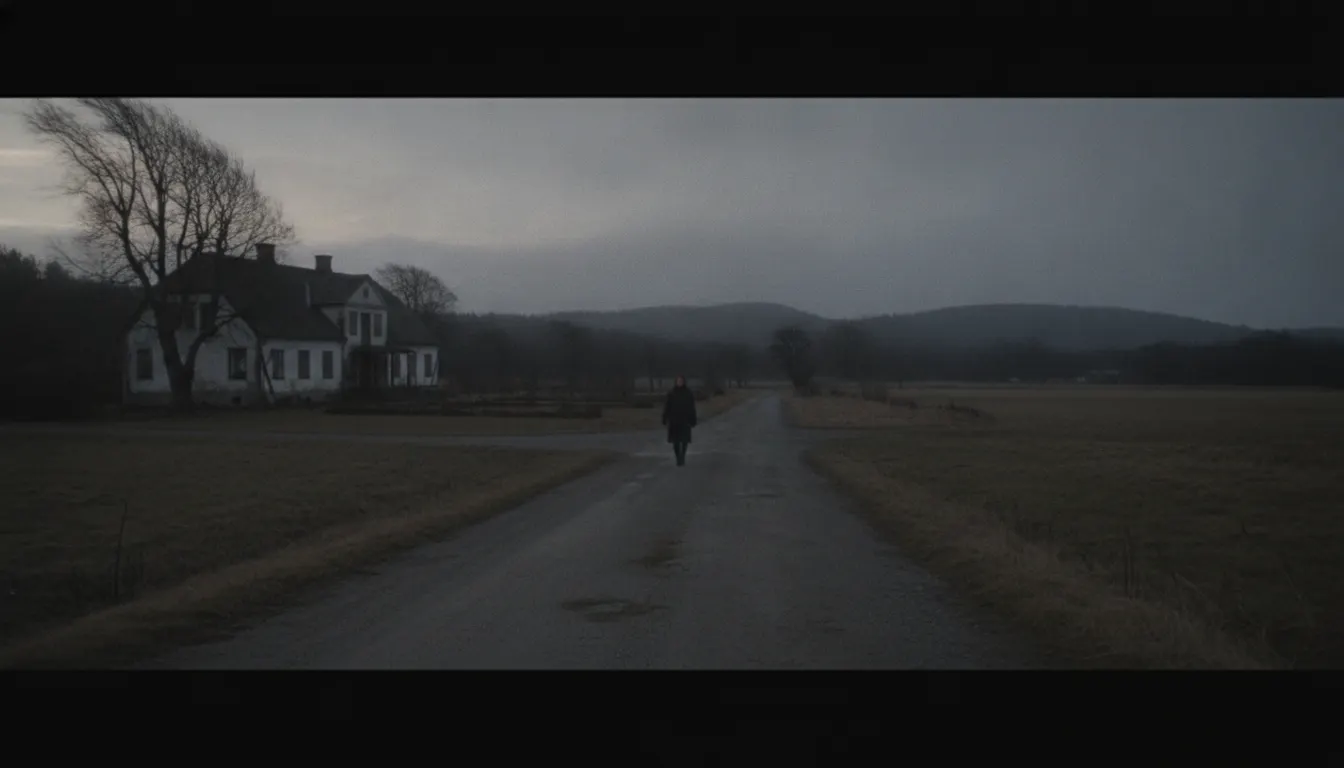
Festen (The Celebration)
Thomas Vinterberg / Anthony Dod Mantle (DP) · 1998
First certified Dogme film; DV family confrontation; Cannes Jury Prize
Dogme 95 vow of chastity. Von Trier Festen and Vinterberg, handheld DV camera, no added light, no soundtrack, location-only.
The moves a human crew would use to get here. Cue applies them for you, and knowing their names is how you ask for a change.
No tripod permitted; small digital video camera held by the operator or rested on location surfaces, always physically present in the scene.
No supplementary lighting; scene must be designed around existing light sources in the actual location.
No post-production music or sound effects; only sound genuinely present in the scene during shooting.
All shooting in actual physical locations rather than constructed sets, using existing architecture and environment.
Consumer DV sensor's limited dynamic range produces clipped windows and blocked shadows, functioning as an authenticity signal.
No directorial credit on the film, suppressing auteur authority in service of collective and performative reality.
Dogme 95 was a film movement founded in Copenhagen in 1995 by directors Lars von Trier and Thomas Vinterberg, who published their 'Vow of Chastity' - a ten-rule manifesto for filmmaking stripped of all cinematic artifice. The manifesto's constraints were designed as a productive obstruction: by prohibiting virtually all conventional filmmaking tools, they forced directors and cinematographers back to raw performance, location reality, and the portable DV camera as the primary creative instrument.
The ten rules of the Vow of Chastity, signed by von Trier and Vinterberg on March 13, 1995, prohibited: shooting on location (no sets), non-diegetic sound (music must be present in the scene), cameras not hand-held, color correction that is not done in the scene, temporal or spatial alienation of story, genre films, superficial action, first-person crime, and director credit on the final work.
The rules' practical effect was to require DV cameras (or 16mm without a tripod), available light only, sync location sound, and narrative grounded entirely in performer behavior within real locations. The 'no tripod' rule meant handheld was mandatory. The 'available light only' rule meant cinematographers had to design scenes around the existing light in real interiors and exteriors.
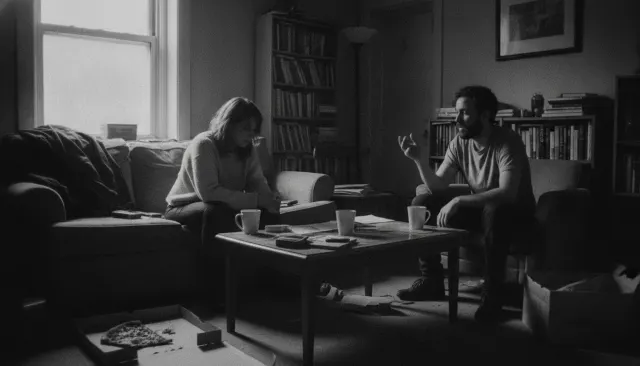
Thomas Vinterberg's Festen was the first certified Dogme film. Shot by Anthony Dod Mantle on a Sony VX1000 DV camera, the film depicts a family confrontation during a birthday dinner in a country hotel. Mantle's cinematography - handheld, often cramped within the hotel's actual rooms, using available interior light supplemented occasionally with what light was already present - became the template for the movement.
The image quality is deliberately degraded compared to 35mm film: the DV camera's limited dynamic range causes clipping in windows and shadow blocking in darker areas. These are not errors but authenticating features. The camera is physically present within the scene in a way that film cameras cannot be - small enough to move through doorways and between seated dinner guests.
von Trier's Dogme contribution The Idiots (1998, DP Jesper Jargil) took the available-light constraint to an extreme in natural locations across suburban Copenhagen. The film's guerrilla production - genuinely operating without permits in public locations - gave it a vérité authenticity that scripted documentary cannot replicate. Von Trier subsequently continued to work with Dogme-adjacent aesthetics in Dancer in the Dark (2000) and Dogville (2003), though neither certified as official Dogme productions.
Dogme 95's 35 certified films were produced between 1998 and 2005. The movement's broader influence extends far beyond its certified productions: the aesthetic of handheld DV naturalism it promoted shaped American mumblecore (Andrew Bujalski, Joe Swanberg), the Romanian New Wave (Cristian Mungiu's 4 Months, 3 Weeks and 2 Days, 2007), and the visual language of reality television. Anthony Dod Mantle went on to shoot Slumdog Millionaire (2008), winning an Academy Award - explicitly carrying Dogme aesthetics into mainstream prestige production.
Thomas Vinterberg / Anthony Dod Mantle (DP) · 1998
First certified Dogme film; DV family confrontation; Cannes Jury Prize
Lars von Trier / Jesper Jargil (DP) · 1998
Von Trier's Dogme contribution; guerrilla natural-location shooting
Lone Scherfig · 2000
Most commercially successful Dogme film; ensemble naturalism
Soren Kragh-Jacobsen / Anthony Dod Mantle (DP) · 1999
Rural Danish Dogme; early Anthony Dod Mantle natural-light work
Cristian Mungiu / Oleg Mutu (DP) · 2007
Romanian New Wave; direct Dogme influence; Palme d'Or
Danny Boyle / Anthony Dod Mantle (DP) · 2008
Dogme aesthetic methods applied at mainstream scale; Academy Award Cinematography
A Look is not a filter. It is a set of stored decisions the pipeline reads before it makes a single frame, so two videos in the same Look actually match.