Fire Emblem: Three Houses (Intelligent Systems / Koei Tecmo, 2019)
the defining reference
Fire Emblem Three Houses Intelligent Systems cel-shaded JRPG aesthetic. Switch tactical RPG, monastery school-life sim, anime portrait cinematics with map battle.
The moves a human crew would use to get here. Cue applies them for you, and knowing their names is how you ask for a change.
step cel lighting: full-value flat lit areas dropping to single shadow tone at hard boundary
time outline rendering extracting silhouette and significant edge lines from 3D geometry
house, role, and rank all readable from costume design
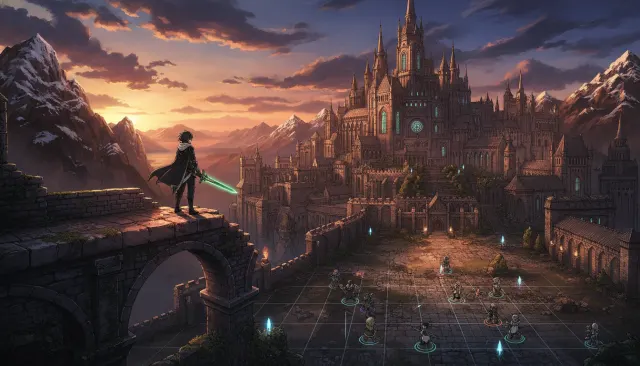
isometric strategy view plus close-up cinematic animation showcase
tall slender forms, large luminous eyes, fashion-forward hair design as personality
four distinct exterior lighting setups matching narrative time progression
Fire Emblem: Three Houses (Intelligent Systems / Koei Tecmo, 2019) is the benchmark cel-shaded JRPG of the Nintendo Switch generation, and one of the most commercially successful Fire Emblem titles in the series' history. The visual design, particularly the decision to hire character designer Chinatsu Kurahana, fundamentally repositioned the franchise - expanding from a dedicated tactics audience to a broader JRPG and anime fan base. This look entry focuses specifically on how the cel-shaded 3D rendering approach constructs the game's identity.
Cel-shading in Three Houses uses a two-step lighting model: lit surfaces remain full-value flat color, shadow areas drop to a single darker tone with minimal gradient. The boundary between lit and shadow is hard - this is the defining characteristic of cel-shading. This technique mimics the look of hand-drawn animation cel coloring, where flat color areas were bounded by inked outlines. Applied to 3D models with outline rendering, the result reads as animated illustration rather than photorealistic simulation.
Kurahana's character designs treat fashion as character writing. House leaders wear their heraldic colors; teaching staff have professorial layered robes; the church hierarchy has byzantine ecclesiastical detailing. These costumes communicate social position and narrative role without dialogue. The seasonal timeskip in the game is marked partly by character design changes - new armor, new aesthetics post-time-skip - that signal transformation visually.
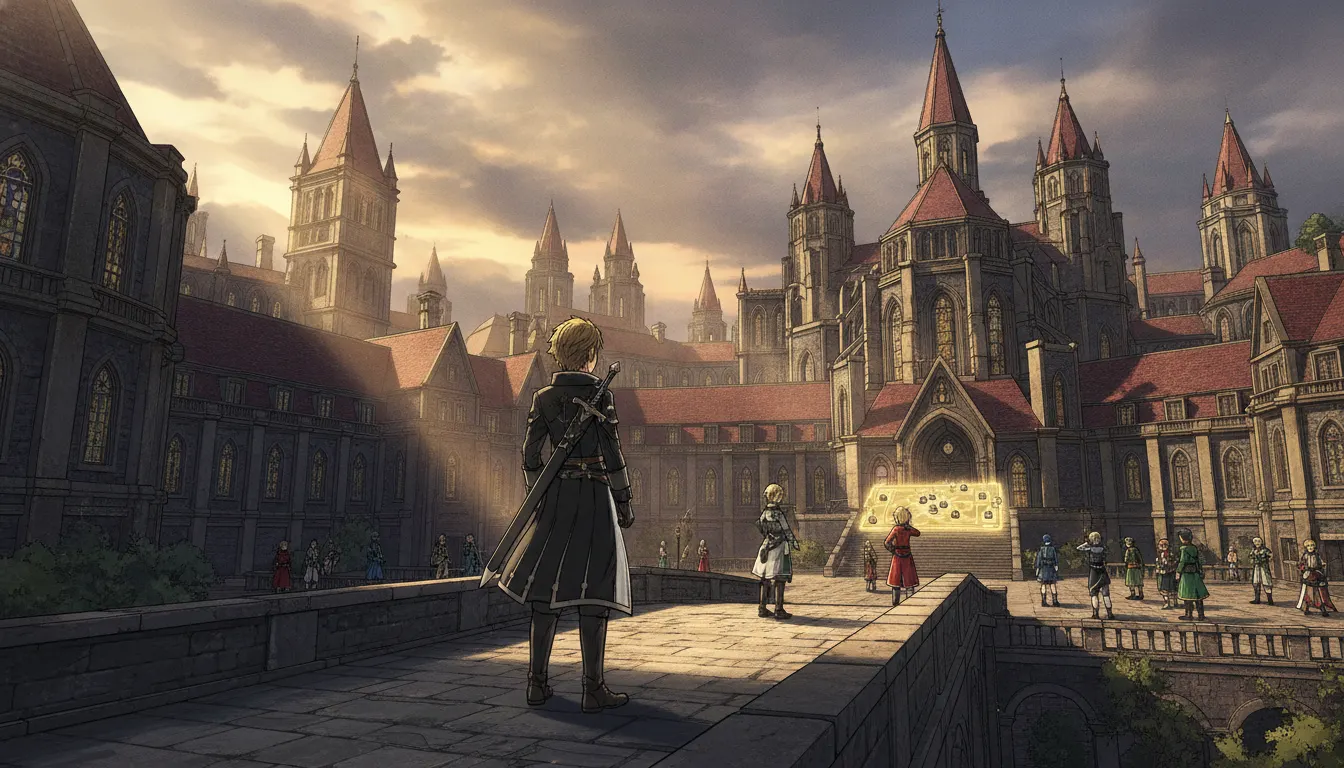
Garreg Mach Monastery, the academy setting that occupies the first half of each route, is designed as a richly detailed European fantasy architecture space. Stone courtyards, gothic vaulted ceilings, garden landscapes in multiple seasons - the monastery functions as a recurring visual anchor that establishes the aesthetic baseline before routes diverge into war.
Tactical combat uses a pulled-back isometric view; character animations in combat are triggered in a close-up cinematic view. This dual-register design - strategic abstraction alternating with character-specific animation showcase - is a defining structural feature of the series that this entry executes most fully.
the defining reference
musou spin-off same character designs
parallel cel-shaded social sim JRPG at peak visual execution
sequel pushing further into color saturation
parallel Akira Toriyama-designed cel-shaded JRPG
evolved cel-shaded JRPG contemporary
scale-focused JRPG with similar cel approach
A Look is not a filter. It is a set of stored decisions the pipeline reads before it makes a single frame, so two videos in the same Look actually match.