Borderlands
2009
Gearbox Software, dir. Matthew Armstrong, art dir. Jeramy Cooke
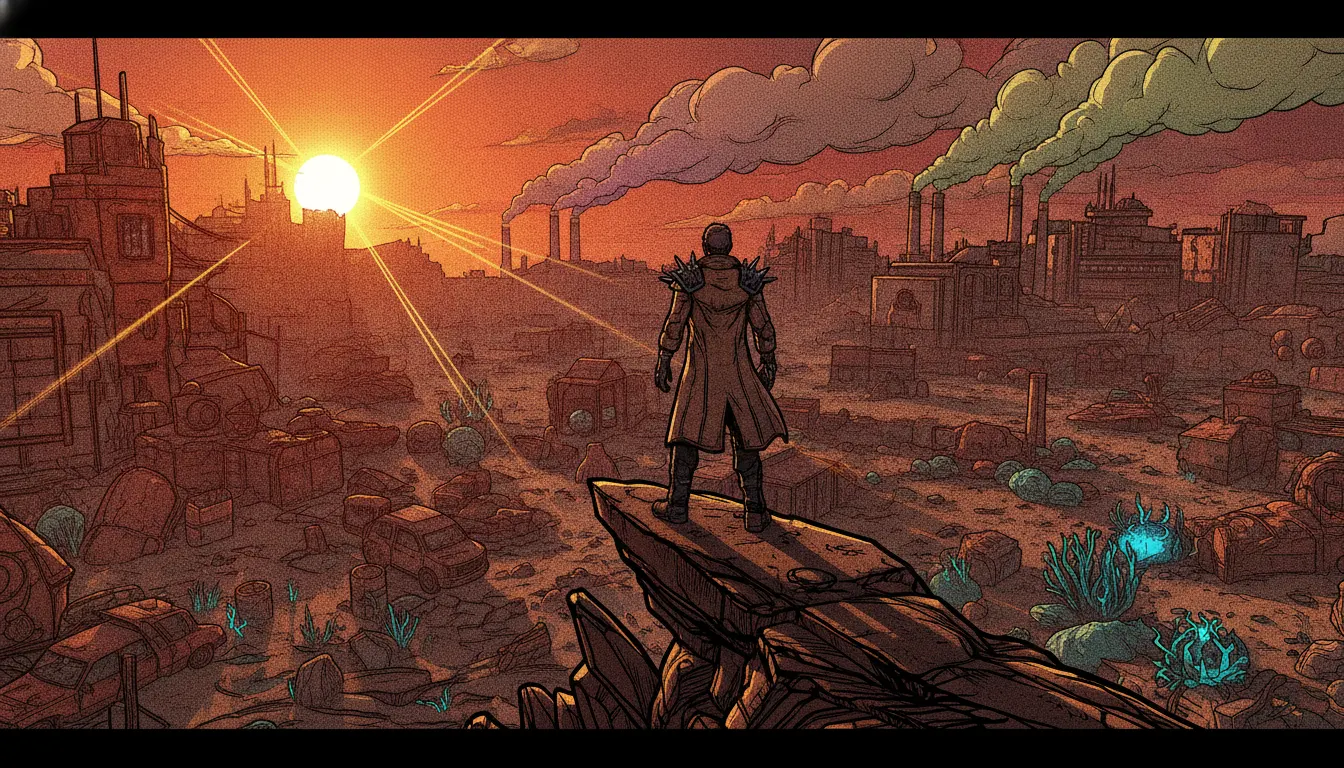
Borderlands ink-outlined cel-shaded 3D. Hand-drawn outlines on 3D models, saturated post-apocalyptic palette, attitude-comic energy.
The moves a human crew would use to get here. Cue applies them for you, and knowing their names is how you ask for a change.
process edge detection (Sobel operator on depth/normal buffer) generating thick black outlines
step toon ramp shading with 3-5 quantized lighting bands (no smooth gradients)
book crosshatch marks baked into diffuse textures for damage, rust, and grime areas
blob silhouette shapes
Gearbox Software's Borderlands (2009, directed by Matthew Armstrong) introduced one of the most recognizable proprietary shader looks in game history: a cel-shaded 3D aesthetic using thick black outlines extracted from geometry edge detection, combined with hard-stepped toon shading, highly saturated colors, and comic-book crosshatch textures baked into surface maps. This style was famously introduced late in development-replacing a more conventional sci-fi shooter look in a pivotal artistic pivot made approximately 8 months before release.
Gearbox president Randy Pitchford has publicly described the visual style switch as a response to the game feeling generic in focus testing. Art director Jeramy Cooke and the team looked to comic book art-particularly Mike Mignola's Hellboy, Jim Lee's X-Men, and general DC/Marvel crosshatch illustration-as a reference that would make Borderlands visually distinct. The technical implementation used a post-process edge detection shader (Sobel operator on the depth buffer) to generate outlines, combined with a multi-step toon ramp shader that quantizes continuous lighting into three to five flat shading bands.
The fictional planet Pandora (predating Avatar by several months-same year, 2009) in Borderlands uses the cel-shaded look to amplify its wasteland aesthetic. Rust, grime, and damage on vehicles and architecture are conveyed through heavy black crosshatch marks baked into diffuse textures-a texture technique that borrows directly from hand-drawn comic art. Character designs are anatomically exaggerated: oversized heads, barrel-chest body builds, massive boots. Bullet-hole and impact effects use 2D sprite decals with ink-blob silhouettes.
Borderlands 2 (2012) refined the pipeline with more detailed character models and richer environment geometry maintaining the visual language. Borderlands 3 (2019) pushed the engine to higher resolutions and added screen-space ambient occlusion within the cel-shaded pass. Tiny Tina's Wonderlands (2022) adapted the style to a fantasy setting, demonstrating the system's genre flexibility.
2009
Gearbox Software, dir. Matthew Armstrong, art dir. Jeramy Cooke
2012
Gearbox Software
2014
2K Australia / Gearbox
2019
Gearbox Software
2022
Gearbox Software
2003
Ubisoft Paris - earlier cel-shaded comic game precursor
2000
Smilebit / Sega - foundational cel-shaded 3D game reference
A Look is not a filter. It is a set of stored decisions the pipeline reads before it makes a single frame, so two videos in the same Look actually match.