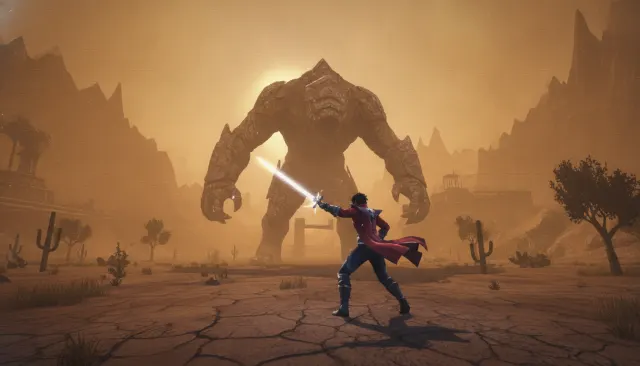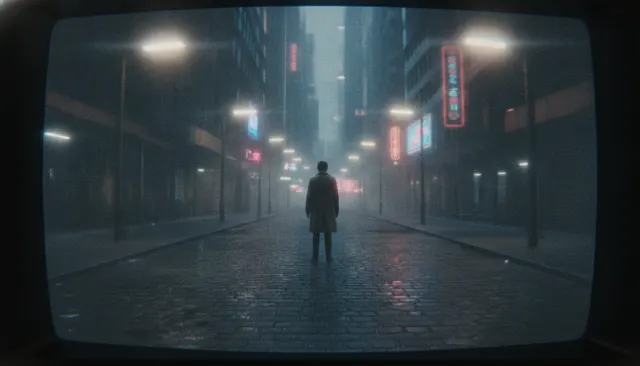
Halo: Combat Evolved (Bungie, 2001)
the canonical Xbox early-shader showcase
Original Xbox shader-era 3D. Halo Combat Evolved bumpmap rocks, Splinter Cell pioneering shadow, Doom 3 stencil dynamic lights, dark-edge palette.
The moves a human crew would use to get here. Cue applies them for you, and knowing their names is how you ask for a change.
pixel specular highlights with correct view-angle response - the defining shader quality
map reflections: blurry scene reflections in metallic and glossy surfaces
pixel normal mapping: bump-detail applied at pixel level rather than vertex level
vertex light and displacement calculations
pixel response across terrain
early specular overshoot
time shadow mapping beginning to appear, though shadow quality was variable
The original Xbox (Microsoft, 2001) introduced programmable vertex and pixel shaders to console gaming - a technical transition that fundamentally changed what real-time graphics could look like. Using a custom nVidia NV2A GPU based on the GeForce 3 architecture, the Xbox was the first console to implement DirectX 8's programmable shader pipeline. The visual results are distinctively "early shader": per-pixel specular highlights, environment cube-map reflections, and vertex deformation effects that look sophisticated by pre-Xbox standards but retain a characteristic early-2000s sheen.
Before programmable shaders, 3D rendering used fixed-function pipelines: lighting calculations were predetermined operations the GPU always performed in the same way. The NV2A's programmable shader architecture allowed developers to write custom programs (shaders) specifying exactly how each pixel was lit. This enabled effects previously impossible in real time: specular highlights that correctly responded to viewing angle (not just light direction), environment map reflections that updated dynamically, and per-pixel normal mapping that made low-polygon geometry appear highly detailed.
The characteristic "early shader" look comes from the first-generation use of these capabilities. Specular highlights are pronounced - surfaces gleam with reflections that look slightly too metallic and uniform by contemporary standards. Environment cube-maps reflect blurry approximations of the surrounding scene. Bump mapping creates surface normal variation that reads as highly textured even on relatively simple geometry.
Halo: Combat Evolved (Bungie, 2001) was the Xbox launch title that demonstrated these capabilities. Master Chief's armor was the canonical early-shader surface: green military ceramic with per-pixel specular highlights that shifted correctly as the camera moved, environment map reflections of the surrounding landscape in the helmet visor, and bump-mapped texture variation across the suit panels. This look - the green metallic sheen of Master Chief - is the Xbox's visual signature.
The exterior environments of Halo's ring world demonstrated something else: large outdoor scenes with dynamic sky lighting and per-pixel lighting applied to terrain. The rolling hills of the first level, the coastal cliffs of the second, the swamp and snow levels - all used the NV2A's capabilities to produce outdoor lighting quality not previously seen on console hardware.
The original Xbox existed in a transition period: better than PS2 but not as versatile as the PS3 generation's deferred rendering approaches. Its aesthetic is the "peak of forward rendering before deferred shading" - rich per-pixel lighting on individual geometry elements without the complex global illumination that followed. The result has a characteristic "bright" quality - well-lit surfaces, strong directional light, visible specular response - that reads as a specific historical moment in rendering history.
the canonical Xbox early-shader showcase
refined continuation of the Xbox shader visual language
dramatic shadow and specular use on original Xbox
RPG using Xbox shader pipeline
cel-shading via early shader techniques
early launch title showcasing per-pixel skin shading
A Look is not a filter. It is a set of stored decisions the pipeline reads before it makes a single frame, so two videos in the same Look actually match.