First hand X-ray of Anna Bertha Ludwig
Wilhelm Röntgen · 1895
The founding image of X-ray imaging - Röntgen's wife's hand with ring visible, reproduced in newspapers worldwide within weeks of discovery
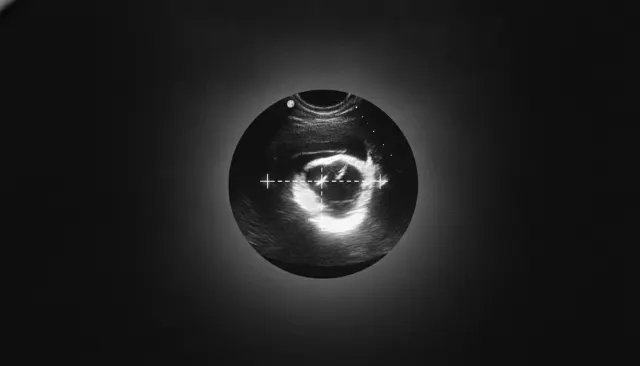
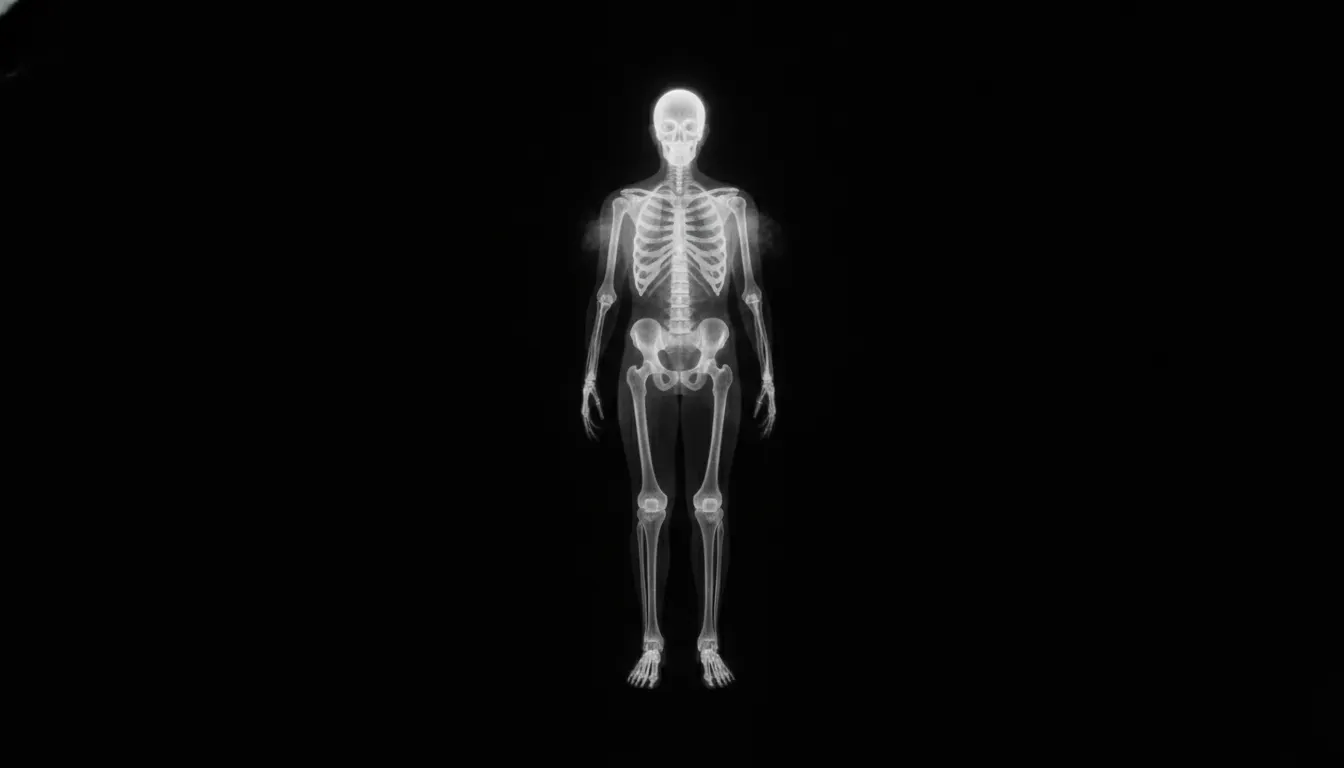
Medical x-ray radiograph. Bones bright against translucent flesh, soft-tissue grey wash, classic black-background radiology film.
The moves a human crew would use to get here. Cue applies them for you, and knowing their names is how you ask for a change.
The fundamental radiographic tonal logic: calcium/metal/dense materials appear white; air appears black; soft tissue appears in intermediate grays.
Skeletal elements rendered as bright, high-contrast white structures against dark backgrounds - the most recognizable element of the X-ray aesthetic.
Soft tissue rendered as semi-transparent gray, allowing the viewer to see through to internal structures beneath.
Blending a standard photographic subject with a radiographic or 3D-rendered skeleton underneath, with multiply or screen blend modes, for the composite portrait technique.
Slight diffusion and blooming around very dense structures, from X-ray scatter and film fogging at high-contrast boundaries.
No color in standard radiography - a strict grayscale from pure black to pure white with the full tonal range mapped to anatomical density.
Lead markers, patient name plates, and measurement scales overlaid on the image field as design elements that reference the clinical document format.
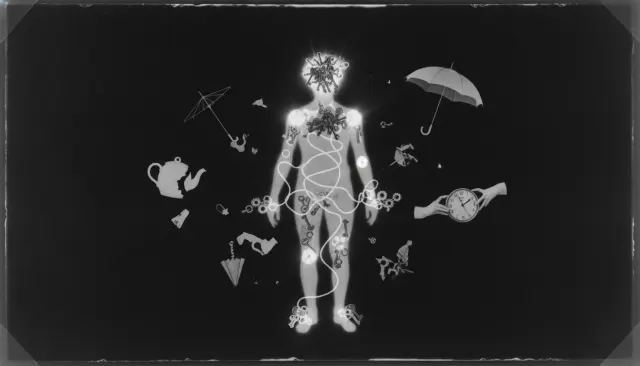
X-ray aesthetic photography and design reproduces the visual language of radiographic imaging: high-contrast black backgrounds with luminous white or blue-white renderings of dense internal structures, translucent rendering of soft tissue and organic outer forms, and the specific tonal inversion that makes bone appear bright while air and soft tissue appear dark. The look reveals internal structure through the external surface - the defining visual proposition of X-ray imaging.
Wilhelm Conrad Röntgen discovered X-rays on November 8, 1895, at the University of Würzburg. His first radiograph of his wife Anna Bertha Ludwig's hand - showing the bones of her fingers and the ring on her fourth finger - was taken on December 22, 1895 and became one of the most reproduced scientific images in history. Röntgen called the new radiation X-strahlen (X-rays) because of their unknown nature; he published his discovery on December 28, 1895 and was awarded the first Nobel Prize in Physics in 1901.
The radiographic image is produced by differential absorption of X-ray photons: calcium in bone is dense and absorbs most X-rays (appearing white/bright on the developed film); air absorbs almost none (appears black); soft tissue absorbs an intermediate amount (appears in various grays). The photographic film used until the 1980s-1990s was large-format silver halide film exposed in a cassette, with intensifying screens converting X-ray photons to light for greater sensitivity.
The chest X-ray (PA view) remains the most common radiographic procedure globally, taken approximately 2 billion times per year worldwide. The digital radiography revolution (computed radiography from ~1983, digital radiography from ~1994) produced digital DICOM files rather than film, but the visual language - white bones on black or dark background - remained consistent by convention even though digital systems could have inverted the tonality.
CT scanning (computed tomography, EMI scanner developed by Godfrey Hounsfield, commercially introduced 1972) extended X-ray imaging into 3D volumetric cross-sections, producing the axial, sagittal, and coronal slices that populate medical illustration. Nick Veasna and Torsten Moeller's pocket atlas series, and anatomical CT atlases from Thieme and Elsevier, establish the standard visual vocabulary for educational anatomy imaging.
Nick Veasna's medical illustration work at Visible Human Project (NLM, 1994-1996) digitally segmented and rendered the complete human body. The Body Worlds exhibitions (Gunther von Hagens from 1995 using plastination) brought anatomy-as-visual-art to museum contexts. Digital composite photography placing X-ray-style internal rendering inside normal photographic portrait subjects - popularized through compositing tutorials in early 2000s Photoshop communities - established the creative art direction use of the look.
Wilhelm Röntgen · 1895
The founding image of X-ray imaging - Röntgen's wife's hand with ring visible, reproduced in newspapers worldwide within weeks of discovery
National Library of Medicine · 1994-1996
Complete CT, MRI, and cryosection digital atlas of the human body that established the standard for anatomy visualization
Gunther von Hagens · 1995-present
Plastinated human body exhibitions that brought anatomical interior-exterior reveal to 49 million museum visitors across 35 countries
various Photoshop tutorial communities · 2000s
Early composite photography technique superimposing X-ray skeleton on portrait subjects, widely replicated and establishing the creative application
Arie van't Riet · 1994-present
Color botanical X-ray art photographs revealing internal plant structure, widely exhibited and reproduced as the defining art-X-ray crossover work
various manufacturers · 2000s-present
Industrial X-ray CT used to visualize component interiors without disassembly, extending the aesthetic from biology to engineering and product design
A Look is not a filter. It is a set of stored decisions the pipeline reads before it makes a single frame, so two videos in the same Look actually match.