Maurice Sendak
Where the Wild Things Are (1963, Harper & Row)
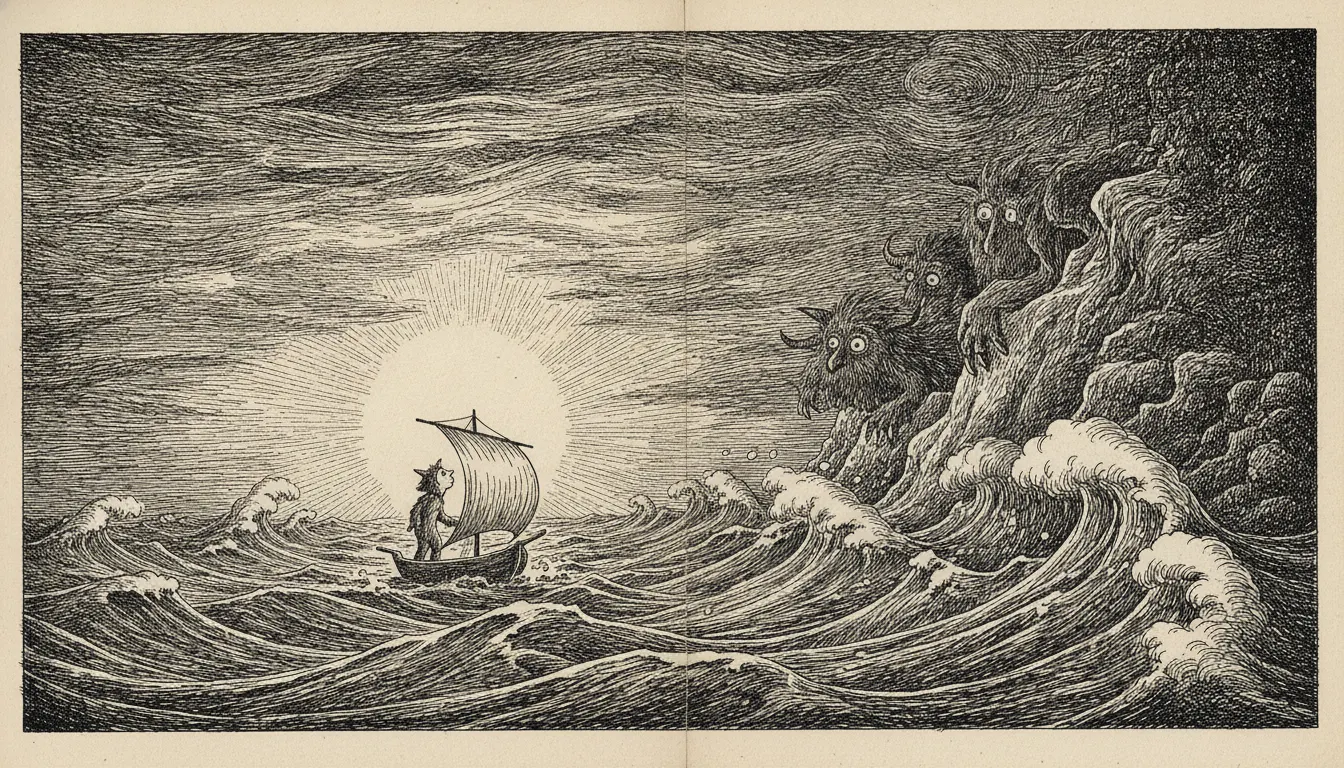
Where the Wild Things Are page-specific cross-hatch ink. Tight parallel-line shading, sailing-the-boat fore-edge spread, wolf-suit Max.
The moves a human crew would use to get here. Cue applies them for you, and knowing their names is how you ask for a change.
hatching in ink - fur, scales, tree bark all rendered through varied-direction overlapping line
amber, forest green, ochre, coral - colors inclusive and non-threatening even on monsters
costume as permission, imagination as protection
Maurice Sendak's Where the Wild Things Are (1963, Harper & Row) is one of the most analyzed picture books ever published, and also one of the most imitated visually. It won the Caldecott Medal in 1964 and has never gone out of print. But beyond its cultural status, the book's visual style - dense cross-hatched pen drawing under warm watercolor washes - defines a specific register of picture book illustration that is simultaneously childlike and psychologically serious.
Sendak drew the Wild Things in dense cross-hatched ink, building tonal values and fur texture through overlapping lines that give the creatures genuine physical density and weight. The hatching is expressive rather than mechanical - varied in direction and pressure so that the monsters feel alive. Over this ink drawing he applied warm watercolor washes: ambers, yellows, burnt reds, forest greens. The palette is deliberately warm and inclusive - these are not cold, menacing monsters but hot, childlike ones, their rage and energy the same as Max's own.
The book's compositional structure is famous: the white margins gradually shrink through the early pages as Max's imagination expands, until the "wild rumpus" spreads across three consecutive wordless double-page spreads - the only wordless pages in the book - and then the margins return as Max comes home. The picture plane itself enacts the psychology of fantasy and return.
Sendak named Wilhelm Busch's 19th-century illustrated stories (Max und Moritz, 1865) and the earlier German picture-book tradition as formative influences. He was deeply engaged with Winsor McCay's Little Nemo in Slumberland newspaper strips (1905–1914), whose architectural dreamscapes prefigure Wild Things' impossible spaces. His later work - In the Night Kitchen (1970) and Outside Over There (1981) - pushed the cross-hatch technique in increasingly complex, Dürer-influenced directions.
In the Night Kitchen shifted to a New York cityscape built from cereal-box typography and art deco building shapes, with Mickey as the book's naked protagonist tumbling through a fantasy urban-culinary world. The cross-hatch continued but became more architecturally precise. Outside Over There (1981), the most painterly of the three books, reduced cross-hatching in favor of oil-painting influence, the imagery moving toward Caspar David Friedrich's Romantic landscapes.
The Sendak cross-hatch register communicates childhood imagination that is genuine and slightly dangerous - not saccharine, not safe, but warm. The creatures are real within the world of the book because the cross-hatching gives them physical substance. As a look for video, it signals authentic emotional engagement with childhood, wonder that includes fear, and the picture book as a serious art form.
Where the Wild Things Are (1963, Harper & Row)
In the Night Kitchen (1970, Harper & Row)
Outside Over There (1981, Harper & Row)
The Nutshell Library (4 volumes, 1962)
1956
Kenny's Window
Max und Moritz (1865, source influence)
Little Nemo in Slumberland (1905–1914, newspaper strip influence on Sendak)
A Look is not a filter. It is a set of stored decisions the pipeline reads before it makes a single frame, so two videos in the same Look actually match.