John Tenniel
Alice's Adventures in Wonderland illustrations (1865, Macmillan)
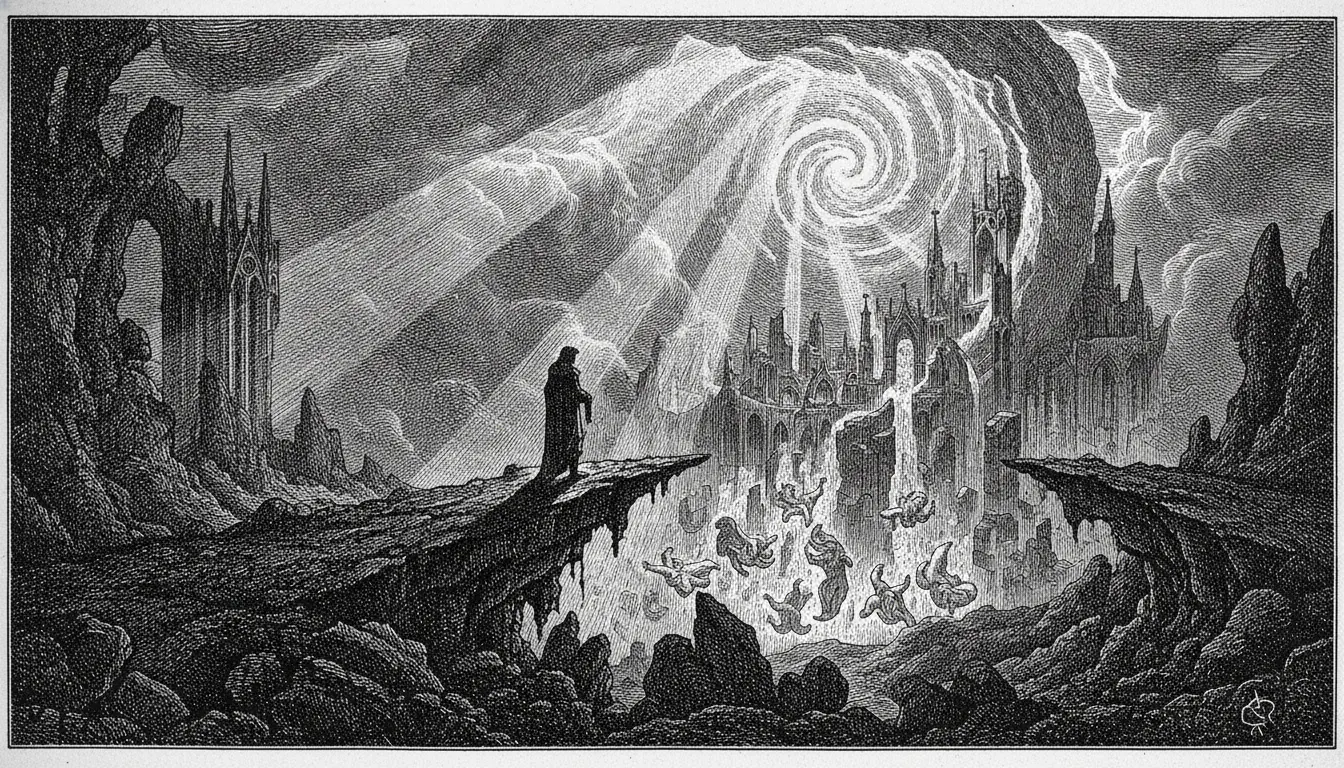
Gustave Dore Victorian wood-engraving. Dense parallel cross-hatch, dramatic biblical or Dantean tableau, awe-and-shadow chiaroscuro print.
The moves a human crew would use to get here. Cue applies them for you, and knowing their names is how you ask for a change.
hatching to build tonal values from black line alone - multiple angles of parallel lines layered to create grey
based) transitions for smooth gradations in skin, sky, and stone
faces rendered with exaggerated but anatomically consistent features
the cartoonist's skill of choosing the single frame that tells the whole story
Wood engraving and steel engraving were the dominant image-reproduction technologies of the 19th century, before photographic halftone printing became commercially viable in the 1880s. Every illustration in a Victorian newspaper, magazine, or book was drawn by an artist, then cut into a wood or metal block by a specialist engraver, then printed as part of the typeset page. The technique enforced a specific visual logic: all tonal information had to be built from line alone, using cross-hatching, parallel hatching, stipple, and white-line techniques.
Punch (founded 1841) became the defining venue for Victorian satirical engraving. Its illustrators - John Tenniel, John Leech, George du Maurier, and Charles Keene - developed the British caricature tradition that had been established by Gillray and Rowlandson in the previous century into a more refined, newspaper-printable form. Tenniel's Punch cartoons, particularly Dropping the Pilot (1890, depicting Bismarck's dismissal by Kaiser Wilhelm II), are among the most reproduced political cartoons in history. The image worked because Tenniel's engraving style combined immediate clarity of concept with tonal complexity that rewarded close inspection.
Tenniel's illustrations for Lewis Carroll's Alice's Adventures in Wonderland (1865) and Through the Looking-Glass (1871) are the most enduring achievement of Victorian book illustration. Drawing on wood block and reproduced by the Dalziel Brothers - the leading engraving house of the period - Tenniel's images achieved an extraordinary synthesis of comedic character, psychological menace, and formal precision. The Mad Hatter, the Cheshire Cat, the Red Queen, Humpty Dumpty: each is simultaneously a caricature and a portrait, the cross-hatched tone giving physical substance to creatures that have no physical referent.
Carroll worked closely with Tenniel, and their 13-year correspondence reveals the degree to which the illustrations were collaborative - Carroll rejected an early Alice design as "too old," and the pale, correct, slightly nervous Alice Tenniel eventually produced has defined the character's appearance for over 150 years.
French engraver Gustave Doré (1832–1883) worked in a more dramatic, Romantic register than the English satirists. His illustrations for Dante's Inferno (1861), the Bible (1865–68), and Don Quixote (1863) used cross-hatching at operatic scale - massive crowd scenes, vertiginous perspectives, shadow architecture that competed with painted Romanticism. His London: A Pilgrimage (1872) applied this grand-manner technique to social documentation of East End poverty.
Cross-hatching builds tone through overlapping sets of parallel lines at different angles. Close parallel hatching creates dark shadow; widening the lines opens them to midtone; stopping at a single layer gives highlight. White-line engraving (used by Thomas Bewick) reverses this, working from a black ground and drawing lines into it. Stipple uses dots rather than lines for a softer tonal transition. Victorian engravers combined all three in a single illustration.
Alice's Adventures in Wonderland illustrations (1865, Macmillan)
Through the Looking-Glass illustrations (1871, Macmillan)
Dropping the Pilot (Punch, March 1890)
1861
Illustrations to Dante's Inferno
Bible Illustrations (1865–68, La Sainte Bible)
1872
London: A Pilgrimage
A History of British Birds woodcuts (1797–1804)
Society illustrations for Punch (1860s–1890s)
A Look is not a filter. It is a set of stored decisions the pipeline reads before it makes a single frame, so two videos in the same Look actually match.