The Economist
"The World in 2024" cover series (annual tradition)
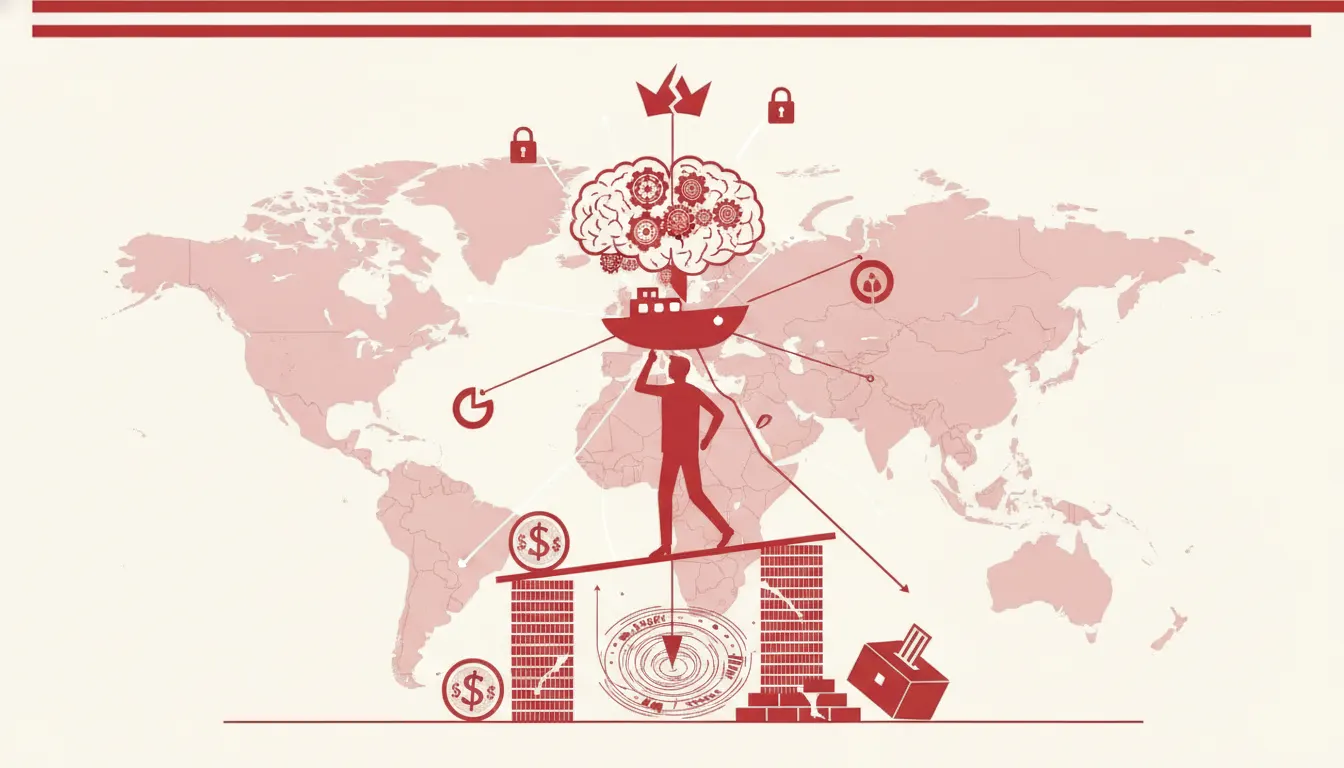
The Economist cover illustration. Conceptual flat-vector metaphor, red-and-white masthead palette, political-economy visual pun.
The moves a human crew would use to get here. Cue applies them for you, and knowing their names is how you ask for a change.
color grounds (Economist red, midnight blue, or white) with figures in precise line drawing
enormous debt crushing a tiny minister, a small nation dwarfed by a giant corporation
nations as animals, economies as weather, political dynamics as chess or sport
flat fills with a single directional shadow at most
red masthead and image conceived as a unified composition
a graph and a cliff simultaneously
The Economist has maintained one of the most distinctive editorial illustration styles in media since its founding in 1843. Its cover art, developed to its mature form in the 1980s and 1990s, is characterized by a specific paradox: images that are visually simple but conceptually dense. A single cover image must communicate the thesis of a complex geopolitical or economic argument in under two seconds of looking.
The look uses a narrow tonal range - typically a dominant red (Pantone 485, the Economist's brand red), blue, or neutral ground with figures rendered in flat, precise line drawing. Shadows are minimal and geometric. Backgrounds are often pure white or a single flat color. The illustration style owes debts to Victorian satirical illustration (Punch magazine, John Tenniel) and to the mid-century editorial tradition of Time and Fortune magazine covers.
Key techniques include: objects rendered at impossible or improbable scale to make a point (a tiny politician underneath an enormous national debt); allegorical personification (nations as chess pieces, economies as weather systems, politicians as animals); and typographic integration where the red masthead and the image are conceived as a single composition.
The Economist does not traditionally credit its cover illustrators, maintaining an institutional voice rather than individual bylines. However, artists including Kevin Kallaugher (KAL), who illustrates the weekly back-page cartoon and has contributed covers since the 1980s, epitomize the style. Kallaugher's caricatures of world leaders are grotesquely precise - anatomically specific enough to be recognizable, exaggerated enough to be damning.
The Economist was founded in 1843 by James Wilson to advocate for free trade and the repeal of the Corn Laws. That founding mission - making the case for a single clear position on a contested economic or political question - is still encoded in the cover illustration's structure. The image is not decorative; it is argumentative. This is the core distinction between The Economist look and other editorial illustration traditions: every element of the cover image is a logical proposition, not a mood.
The physical cover format has remained remarkably consistent: landscape-oriented masthead in white text on the Economist red, single full-bleed illustration below, headline copy overlaid on the image in white or black. The constraint drives designers toward ideas that are immediately legible at tabloid scale on a newsstand, which in turn enforces a useful discipline of concept clarity that has become the house style's most exportable quality.
The Economist look has been widely emulated in business media, consulting firm reports, and fintech brand illustration. It signals intellectual seriousness, global perspective, and a willingness to take positions. When a brand wants to communicate that it operates at the level of ideas - not products - the Economist editorial register is the reference.
"The World in 2024" cover series (annual tradition)
"The Dangers of a World Economy in Crisis" (various years, Lehman/COVID editions)
KAL cartoons (weekly since 1978, The Economist back page)
Brexit-related covers 2016–2020 (Union Jack imagery distorted)
"It's Time" covers (progressive policy advocacy series, 2010s)
A Look is not a filter. It is a set of stored decisions the pipeline reads before it makes a single frame, so two videos in the same Look actually match.