Emigre magazine
Rudy VanderLans and Zuzana Licko (1984-2005)
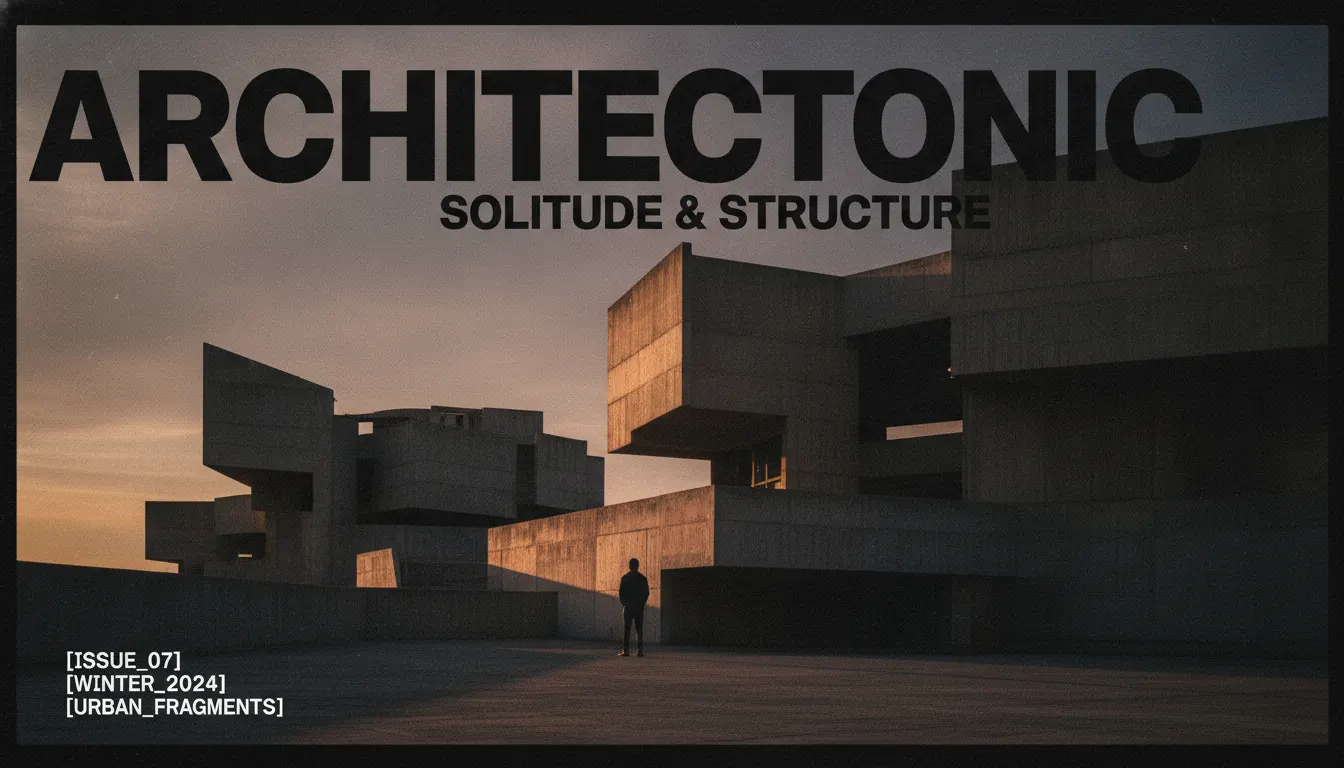
Brutalist magazine cover. Oversize bold sans masthead, raw photography crop, overlapping text, monospaced caption tags, indie publication energy.
The moves a human crew would use to get here. Cue applies them for you, and knowing their names is how you ask for a change.
adjacent backgrounds, or black on near-black
Brutalist magazine cover design is the editorial equivalent of architectural béton brut: it refuses the conventions of legibility, beauty, and commercial appeal in order to foreground the raw fact of its own construction. Where a conventional magazine cover assembles its elements to create desire and recognition, the brutalist cover uses confrontation, ugliness, and violation of reader expectations as its primary tools.
The most coherent early tradition of brutalist editorial design emerged from Rudy VanderLans and Zuzana Licko's Emigre magazine, founded in Berkeley in 1984. Emigre began as a Macintosh experiment - early issues were set in bitmap fonts that Licko designed specifically for low-resolution output, embracing the limitations of the medium rather than fighting them. By the late 1980s and early 1990s, designers contributing to or influenced by Emigre - including Ed Fella, Elliott Earls, and Barry Deck - were using layered, overprinted, dissonant type that directly challenged the clean legibility standards of Swiss modernism.
Rudy VanderLans's own layouts for Emigre treated the page as a field of competing forces: columns that didn't align, margins that changed unpredictably, typography set at sizes that made reading deliberately uncomfortable. The 1991 issue with the headline 'Can't Get Enough Ugly' was the movement's self-aware peak.
Brutalist editorial design deploys printing artifacts and material evidence as aesthetic choices: misregistered color separations, halftone dots visible at reading distance, smeared ink, overprinting that creates unintended colors, and paper grain that fights the image. The confrontational quality comes partly from this collision between the physical and the informational.
Since the 2010s, a second wave of brutalist editorial design has emerged, this time digital but deliberately anti-digital. Publications like The Gentlewoman in its more experimental issues, Toilet Paper magazine (Maurizio Cattelan and Pierpaolo Ferrari, founded 2010), and i-D in its early years used unexpected crops, jarring type scales, and deliberate ugliness as signatures of editorial personality. The aesthetic signals that the publication has opinions too strong to be packaged neatly.
Rudy VanderLans and Zuzana Licko (1984-2005)
Maurizio Cattelan and Pierpaolo Ferrari (2010-present)
David Carson as art director (1992-1995)
1980
Terry Jones
1990
Emigre era
A Look is not a filter. It is a set of stored decisions the pipeline reads before it makes a single frame, so two videos in the same Look actually match.