Universal typeface
1925
Herbert Bayer
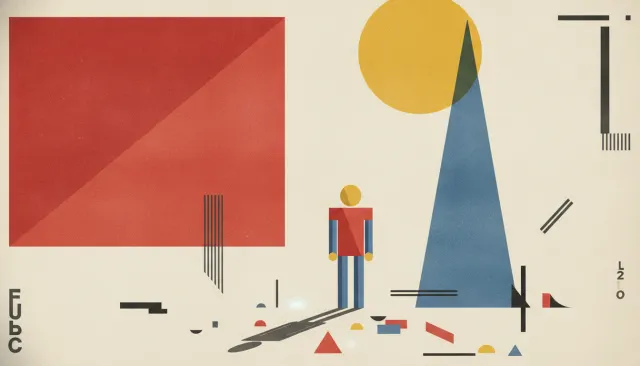
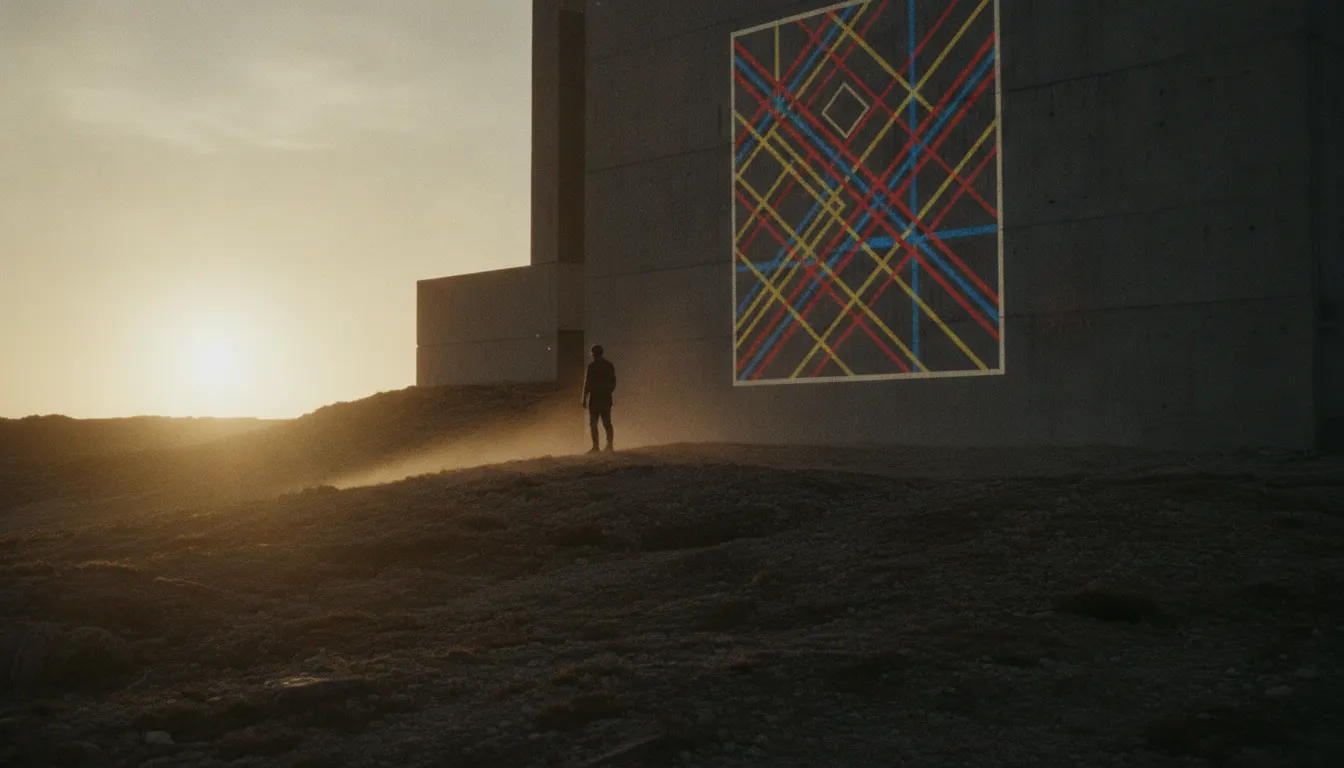
Bauhaus typography experiment poster aesthetic. Herbert Bayer Universal lowercase, Moholy-Nagy diagonal composition, rule lines and primary geometry as type ornament.
The moves a human crew would use to get here. Cue applies them for you, and knowing their names is how you ask for a change.
serif letterforms constructed from circles and straight lines
only or all-caps-only text as a deliberate philosophical choice
single characters filling 50%+ of a frame
If the Bauhaus graphic grid is a compositional system, the Bauhaus typography experiment is its most radical edge: the moment when letters stop being transparent vehicles for meaning and become visible objects. This sub-tradition within Bauhaus ran from 1919 until the school's closure in 1933 and produced experiments that still feel contemporary.
Herbert Bayer's most provocative act was not his typeface designs but his campaign to eliminate uppercase letters entirely. In a 1925 manifesto he argued that using two separate alphabets for the same sounds was irrational - a survival of class-based print culture. Bauhaus official communications briefly adopted lowercase-only typography. This iconoclasm was consistent with the broader Bauhaus drive to strip tradition down to functional necessity.
Bayer's Universal typeface (1925) applied this logic to letterform design. Each glyph was constructed using only a compass and ruler: circular curves and straight stems derived from geometric primitives. The result was a typeface that looked constructed rather than calligraphed - letterforms as engineered objects. Paul Renner's Futura (1927) and Jan Tschichold's later sans-serif advocacy drew directly on this example.
El Lissitzky, the Russian constructivist who collaborated closely with Bauhaus faculty, pioneered the fusion of typography and visual composition. His Proun series (from 1919) treated the page as a three-dimensional space where letters and geometric forms occupied the same visual plane. His 1925 essay 'Topography of Typography' stated that the book must be visual communication, not merely verbal.
Joost Schmidt's exhibition poster for the 1923 Bauhaus Ausstellung is the clearest example of the approach: letterforms are simultaneously text and graphic form, scaled, rotated, and weighted to create rhythm and hierarchy through visual logic rather than conventional rules. The poster reads as both information and image.
Jan Tschichold, though not a Bauhaus member, systematized these experiments in 'Die neue Typographie' (1928), the movement's definitive theoretical statement. Tschichold argued for asymmetric layouts, sans-serif typefaces, and clear functional hierarchy - principles directly descended from Bauhaus practice. The book influenced every editorial and graphic designer working in the subsequent decades.
1925
Herbert Bayer
1923
Joost Schmidt
El Lissitzky (1919-1923)
1928
Jan Tschichold
1927
Paul Renner, drawing on Bauhaus influence
1925
Herbert Bayer
1925
El Lissitzky
1926
László Moholy-Nagy
A Look is not a filter. It is a set of stored decisions the pipeline reads before it makes a single frame, so two videos in the same Look actually match.