Alexander Rodchenko
Lengiz Books poster (1925, Lilia Brik shouting КНИГИ)
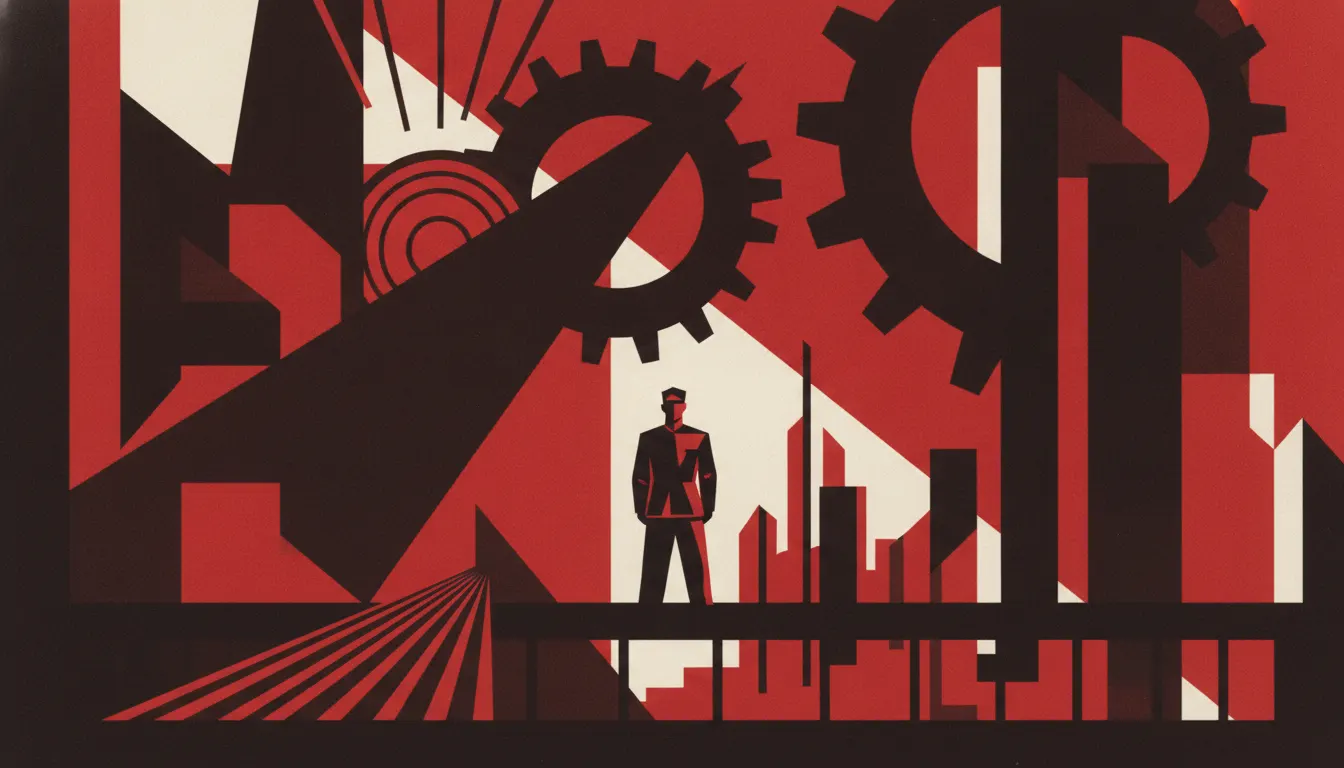
Russian Constructivism Rodchenko and El Lissitzky. Red-black diagonals, geometric agitprop, sans-serif Cyrillic, Soviet utopian poster.
The moves a human crew would use to get here. Cue applies them for you, and knowing their names is how you ask for a change.
axes tilted 30-45 degrees to create dynamic energy and forward motion
red, black, and white - occasionally adding a single secondary color
serif typography integrated with imagery rather than caption beneath it
cropped photographs combined with geometric graphic elements
radical worm's-eye and bird's-eye views
circles, triangles, rectangles - used as compositional building blocks
black on white, red on black
Russian Constructivism was an artistic and architectural movement that emerged in Russia around 1913-1915, reached its creative peak in the 1920s, and was suppressed under Stalinist Socialist Realism doctrine from the early 1930s. It sought to abolish the distinction between fine art and practical design, directing all visual creativity toward the construction of a new communist society: propaganda posters, architectural plans, textile design, theatre, photography, typography, and film were all legitimate fields for the movement's practitioners.
Alexander Rodchenko (1891-1956) is the movement's most important graphic designer and photographer. His 1925 poster for the Lengiz state publishing house - depicting Lilia Brik (Vladimir Mayakovsky's companion) cupping her hands to her mouth, face radically foreshortened, with the word КНИГИ (books) in bold constructivist type - is one of the most iconic works of 20th-century graphic design. His photographic series taken from extreme angles (above and below) challenged bourgeois pictorial conventions and became defining images of 1920s Soviet visual culture.
Rodchenko collaborated closely with poet Vladimir Mayakovsky (1893-1930) on advertising campaigns for state enterprises - GOSIzdat (state publishing), Rezinotrest (rubber trust), Mossel'prom (food trust) - that represent the movement's unique fusion of radical aesthetics and commercial function. Their slogan-and-image posters used rhyming text, diagonal lines, and pure color to make state propaganda sing.
El Lissitzky (1890-1941) developed the Proun (PROject for the Affirmation of the New) paintings - abstract geometric compositions that explored the relationship between flat painting and three-dimensional space. His 1919 propaganda poster Beat the Whites with the Red Wedge is the most politically direct distillation of Constructivist visual language: a red triangle driving into a white circle against a white field, with minimal text.
Lyubov Popova (1889-1924) applied Constructivist principles to textile design and stage sets, creating integrated visual environments.
Constructivist typography - as practiced by Rodchenko, Lissitzky, Varvara Stepanova (1894-1958), and in Germany by Jan Tschichold's adaptation in Die neue Typographie (1928) - established the principles: bold geometric sans-serif type, asymmetric layouts on a diagonal axis, red and black as primary colors, the combination of type and photographic image (photomontage), and the rejection of centered symmetrical composition as bourgeois.
Constructivism's formal vocabulary - diagonal composition, limited palette, photomontage, geometric type - is the direct ancestor of 20th-century political poster design globally, Swiss International Typographic Style, and contemporary graphic design for technology and brand identity.
Lengiz Books poster (1925, Lilia Brik shouting КНИГИ)
1919
Beat the Whites with the Red Wedge
Proun series (1919-1923)
photographic series of apartment blocks, stairs, and radio towers (1925-1928)
1924
textile designs for First State Textile Print Factory
stage set for The Magnanimous Cuckold (1922, dir. Vsevolod Meyerhold)
Die neue Typographie (1928, drawing on Constructivist principles)
A Look is not a filter. It is a set of stored decisions the pipeline reads before it makes a single frame, so two videos in the same Look actually match.