A.M. Cassandre
1935
Normandie ocean liner poster
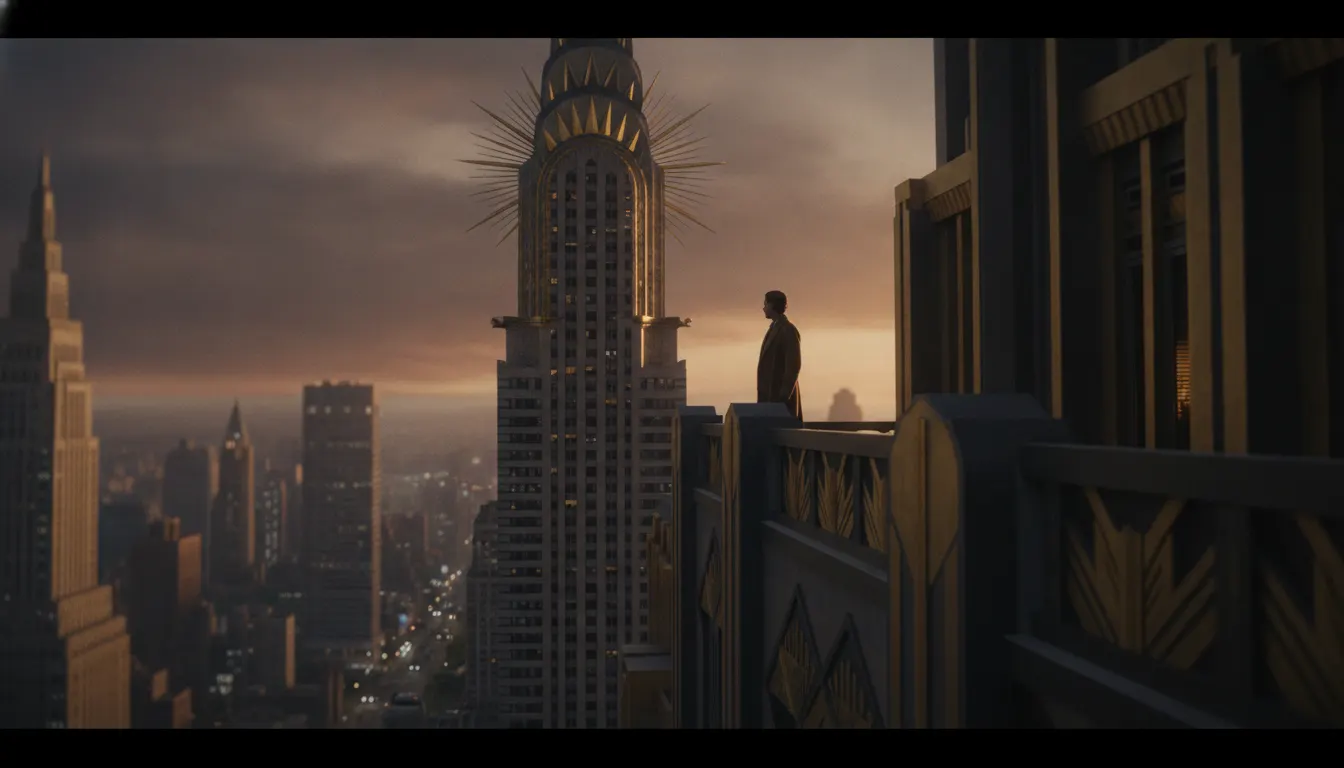
Roaring 20s Art Deco. Chrysler Building sunburst, ziggurat motifs, gold-and-black geometric ornament, Chrysler-era luxury.
The moves a human crew would use to get here. Cue applies them for you, and knowing their names is how you ask for a change.
mirror-image compositions, radial balance, bilateral axes
gold, chrome, black, ivory with jewel-tone accents
strong serifs or geometric sans-serifs with generous letter-spacing
minimal gradient, no painterly softness
Art Deco emerged in Paris in the 1910s, reached its zenith at the 1925 Exposition Internationale des Arts Décoratifs et Industriels Modernes (from which the style takes its name), and dominated Western visual culture through the 1930s before the austerity of World War II curtailed its excesses. It was simultaneously a fine art movement, a design philosophy, a fashion sensibility, and an architectural program.
Art Deco synthesized influences that seem contradictory: the streamlined forms of the Machine Age, the geometric abstraction of Cubism, the ornamental richness of ancient Egypt and Mesoamerica (reinvigorated by the 1922 discovery of Tutankhamun's tomb), and the luxurious materials of pre-war French decorative arts. The result was a style that was simultaneously modern and opulent - the future rendered in gold.
Key characteristics include: strict geometric symmetry and repeating patterns; stylized natural forms (sunbursts, chevrons, stepped pyramids, frozen fountains); a palette of gold, black, ivory, chrome, and jewel tones (deep teal, coral, jade green); and an emphasis on craftsmanship in expensive materials (lacquer, ebony, ivory, chrome-plated steel, Bakelite).
The Chrysler Building (William Van Alen, 1928-1930, New York) and the Empire State Building (Shreve, Lamb & Harmon, 1930-1931) are the movement's most famous architectural monuments. The Chrysler Building's steel eagle gargoyles and sunburst crown are pure Art Deco theatrics. Radio City Music Hall (1932, New York) represents the style in interior design. In Miami, the South Beach Art Deco Historic District (1923-1943) preserves the largest collection of Art Deco architecture in the world.
In graphic design, A.M. Cassandre (born Adolphe Jean-Marie Mouron, 1901-1968) was the movement's preeminent poster artist. His Normandie ocean liner poster (1935) and L'Atlantique (1931) are considered among the greatest posters ever made. Erté (Romain de Tirtoff, 1892-1990) defined Art Deco fashion illustration through his Harper's Bazaar covers (1915-1936). In fashion, designers like Paul Poiret and Elsa Schiaparelli translated geometric boldness into clothing.
Art Deco in motion graphics and illustration: bold geometric symmetry, sunburst and fan motifs, stepped forms and chevrons, metallic gold and silver, strong vertical emphasis, stylized human figures with elongated proportions, and lettering with strong serifs or geometric sans-serifs.
1935
Normandie ocean liner poster
1931
L'Atlantique poster
Harper's Bazaar covers (1915-1936)
1929
Autoportrait / Tamara in the Green Bugatti
A Look is not a filter. It is a set of stored decisions the pipeline reads before it makes a single frame, so two videos in the same Look actually match.