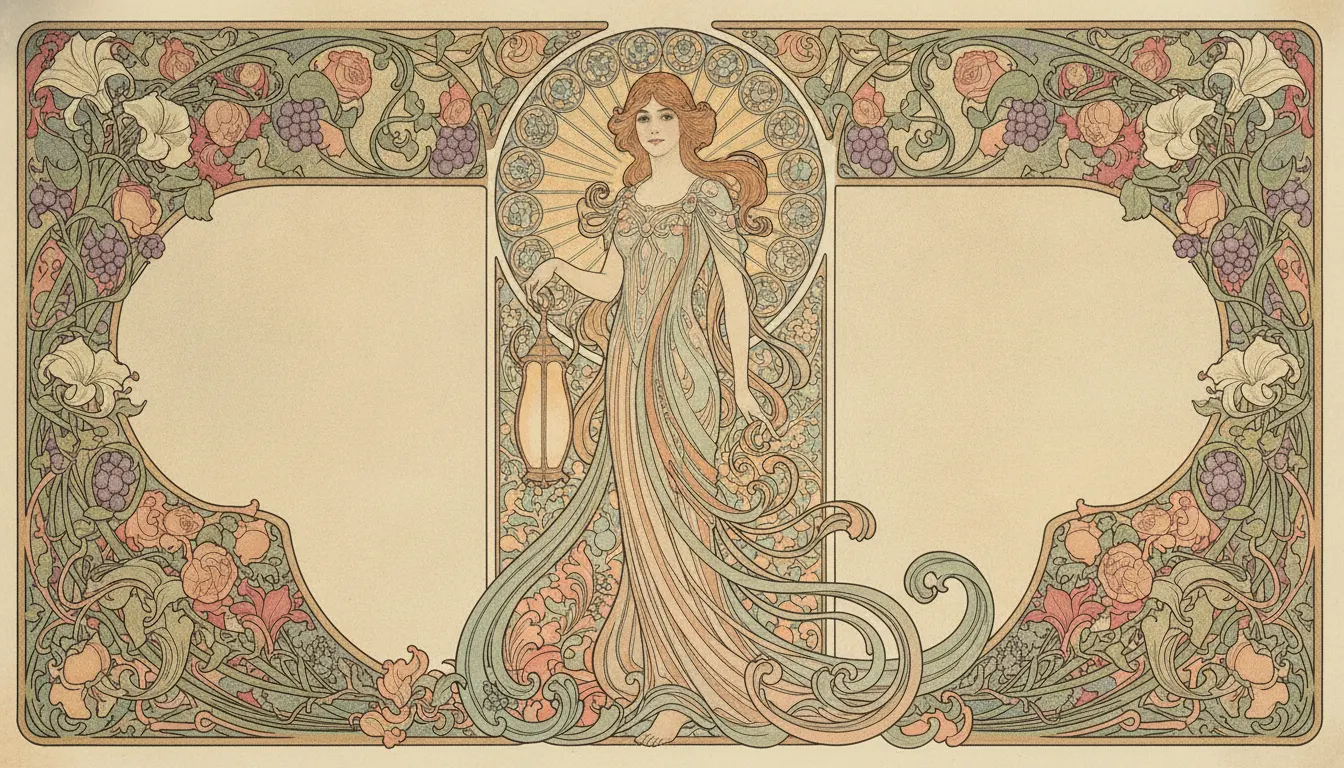
Alphonse Mucha
1895
Gismonda poster
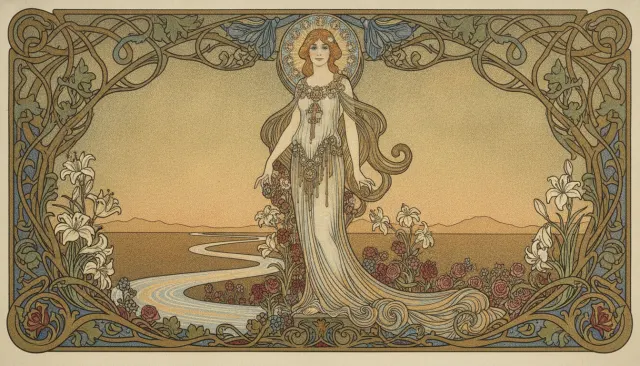
Alphonse Mucha Art Nouveau poster. Whiplash organic curves, halo-haloed maiden, floral border, pastel theatre advertising.
The moves a human crew would use to get here. Cue applies them for you, and knowing their names is how you ask for a change.
long, sinuous, asymmetric curves derived from plant tendrils and waves
the decorative frame grows from the subject
sage green, champagne gold, dusty lilac, warm ivory
lilies, peacock feathers, dragonflies, poppies, water reeds
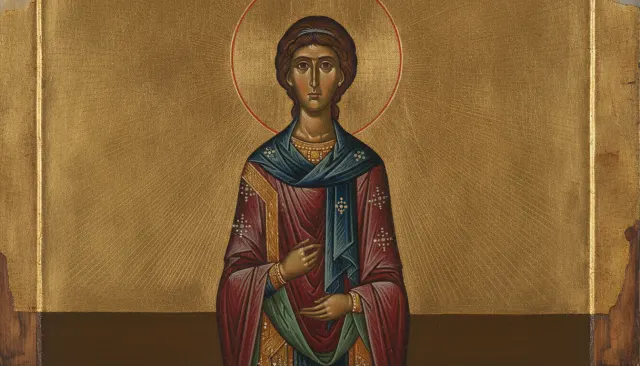
gold ground, flat pattern, decorative arabesque
Art Nouveau was a pan-European decorative arts and design movement that flourished approximately 1890-1910, representing a deliberate rejection of historicism (the Victorian habit of recycling historical styles) in favor of a new, organic visual language drawn from nature. It appeared simultaneously across Europe under different names: Jugendstil (Youth Style) in Germany and Austria, Stile Liberty in Italy, Modernisme in Catalonia, Sezessionstil in Vienna.
Art Nouveau sought to dissolve the boundary between fine art and applied art - to make everyday objects (posters, furniture, jewelry, architecture, book covers) as beautiful as paintings or sculpture. It drew on natural forms - plants, insects, water, the female body - and abstracted them into sinuous, asymmetric, endlessly curving line. The movement reacted against the geometric regularity of industrial production by embracing the organic irregularity of living things.
Alphonse Mucha (1860-1939) is Art Nouveau's most globally recognized practitioner. His 1895 poster for Sarah Bernhardt's play Gismonda launched his career and established the movement's commercial poster vocabulary: the full-length female figure, botanical halo, integrated typography, and muted champagne-and-sage palette. See the dedicated entry for Alphonse Mucha Art Nouveau Poster for full detail on his work.
Gustav Klimt (1862-1918) represented the Austrian strain of Art Nouveau. His The Kiss (1907-08, Österreichische Galerie Belvedere) and Portrait of Adele Bloch-Bauer I (1907, Neue Galerie New York) incorporate Byzantine gold-leaf mosaic, Japanese decorative flatness, and symbolist eroticism into painting. The Vienna Secession group (founded 1897) with its Ver Sacrum journal and the famous Secession Building (Josef Maria Olbrich, 1897) was the movement's institutional home in Austria.
Antoni Gaudí (1852-1926) expressed Art Nouveau principles in architecture: the Casa Batlló (1904-1906) and Sagrada Família (begun 1882) in Barcelona use undulating facades, bone-like structural elements, and mosaic surfaces derived from natural forms. Hector Guimard's cast-iron Paris Métro entrances (1900-1913) are the movement's most reproduced architectural objects.
In Britain, Aubrey Beardsley (1872-1898) developed a distinctive black-and-white Art Nouveau illustration style - spare, perverse, and highly influential - for Oscar Wilde's Salomé (1894) and The Yellow Book journal (1894-1897). In the United States, Louis Comfort Tiffany adapted Art Nouveau to stained glass and decorative objects.
1895
Gismonda poster
1896
Job cigarette papers poster
The Kiss (1907-08, Belvedere, Vienna)
Portrait of Adele Bloch-Bauer I (1907, Neue Galerie, New York)
Paris Métro entrances (1900-1913)
Casa Batlló (1904-1906, Barcelona)
1894
Salomé illustrations
Wisteria lamp (1901-1902)
A Look is not a filter. It is a set of stored decisions the pipeline reads before it makes a single frame, so two videos in the same Look actually match.