Herbert Bayer
1925
Universal typeface
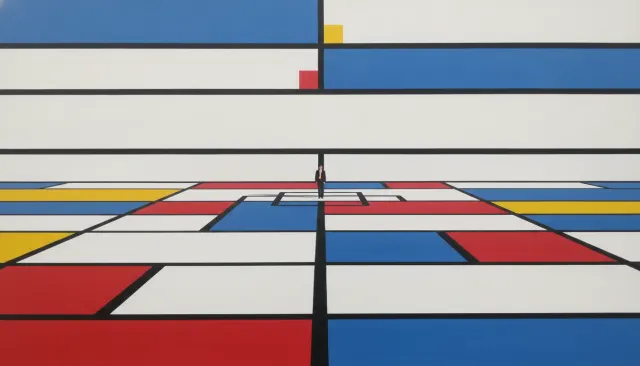
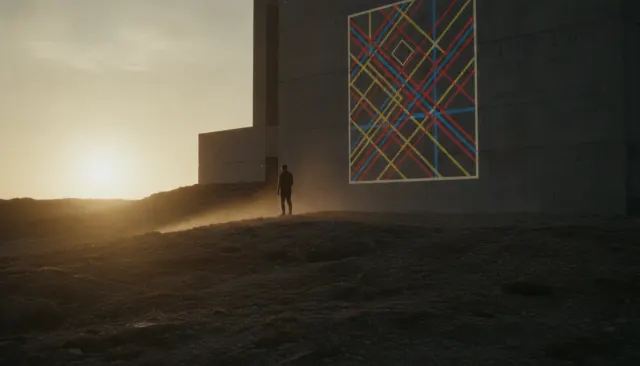
Bauhaus Dessau modernist design. Primary-color squares triangles circles, Herbert Bayer geometric sans-serif, form-follows-function rigour.
The moves a human crew would use to get here. Cue applies them for you, and knowing their names is how you ask for a change.
red, yellow, blue with black and white - no mixed or muted tones
circle, triangle, square as irreducible building blocks
based composition with strict horizontal/vertical alignment
serif typography - Futura, Universal, or Helvetica-derived letterforms
structural elements visible rather than concealed
black forms on white ground or primary color on neutral
tension between geometric elements rather than mirror symmetry
The Bauhaus (Bau = construction; Haus = house) was a German art, design, and architecture school founded in 1919 in Weimar by architect Walter Gropius (1883-1969). It operated in three cities - Weimar (1919-1925), Dessau (1925-1932), and Berlin (1932-1933) - before being closed by the Nazis in April 1933. In its fourteen years, it assembled the most influential design faculty of the 20th century and produced a visual language that underlies virtually every modern design system.
Walter Gropius (1883-1969): founding director, articulated the school's philosophy of integrating fine art with craft and industrial production. Architecture department.
Paul Klee (1879-1940): taught the preliminary course and the theory of color and form. His paintings - watercolor abstractions, musical visual notation, pictographic imagery - embody the Bauhaus synthesis of intuition and analysis.
Wassily Kandinsky (1866-1944): taught analytical drawing and the theory of form. His treatise Point and Line to Plane (1926) codified the Bauhaus approach to visual elements.
László Moholy-Nagy (1895-1946): taught the preliminary course (Vorkurs), championed industrial materials and photography, founded the New Bauhaus in Chicago (1937) after emigrating.
Josef Albers (1888-1976): taught the preliminary course and color theory; his Interaction of Color (1963) is still foundational to design education.
Herbert Bayer (1900-1985): designed the Universal typeface (1925), a geometric sans-serif with lowercase only, and was the school's graphic design voice.
Marcel Breuer (1902-1981): designed the Wassily chair (1925-1926) in bent tubular steel, the Cesca chair, and went on to major architectural work.
Mies van der Rohe (1886-1969): final director (1930-1933), brought the school's architectural ideas to their most austere expression; later designed the Seagram Building (1958, New York).
The Bauhaus rejected ornament as dishonest and pursued the integration of form and function - beauty as a byproduct of fitness for purpose. The visual language that emerged is: primary colors (red, yellow, blue) plus black and white; geometric forms (circle, triangle, square) as elemental building blocks; grid-based composition; sans-serif typography; and the honest expression of materials.
Kandinsky's famous correspondence between shapes and colors - the triangle is yellow/aggressive, the circle is blue/spiritual, the square is red/grounded - became foundational pedagogy.
The Nazis' closure scattered the faculty across the United States and Europe, spreading Bauhaus principles globally. The Swiss International Style (Helvetica, grid typography), post-war American corporate graphic design, IKEA's design philosophy, and Apple's interface design all trace lineage to Bauhaus.
1925
Universal typeface
Wassily Chair (1925-26)
Light-Space Modulator kinetic sculpture (1922-30)
1925
Pedagogical Sketchbook and Hammamet with Its Mosque (1914)
Composition VIII (1923, Solomon R. Guggenheim Museum)
Homage to the Square series (1950-1976)
Bauhaus Dessau building (1925-26, Dessau)
1923
Bauhaus Ausstellung poster
A Look is not a filter. It is a set of stored decisions the pipeline reads before it makes a single frame, so two videos in the same Look actually match.