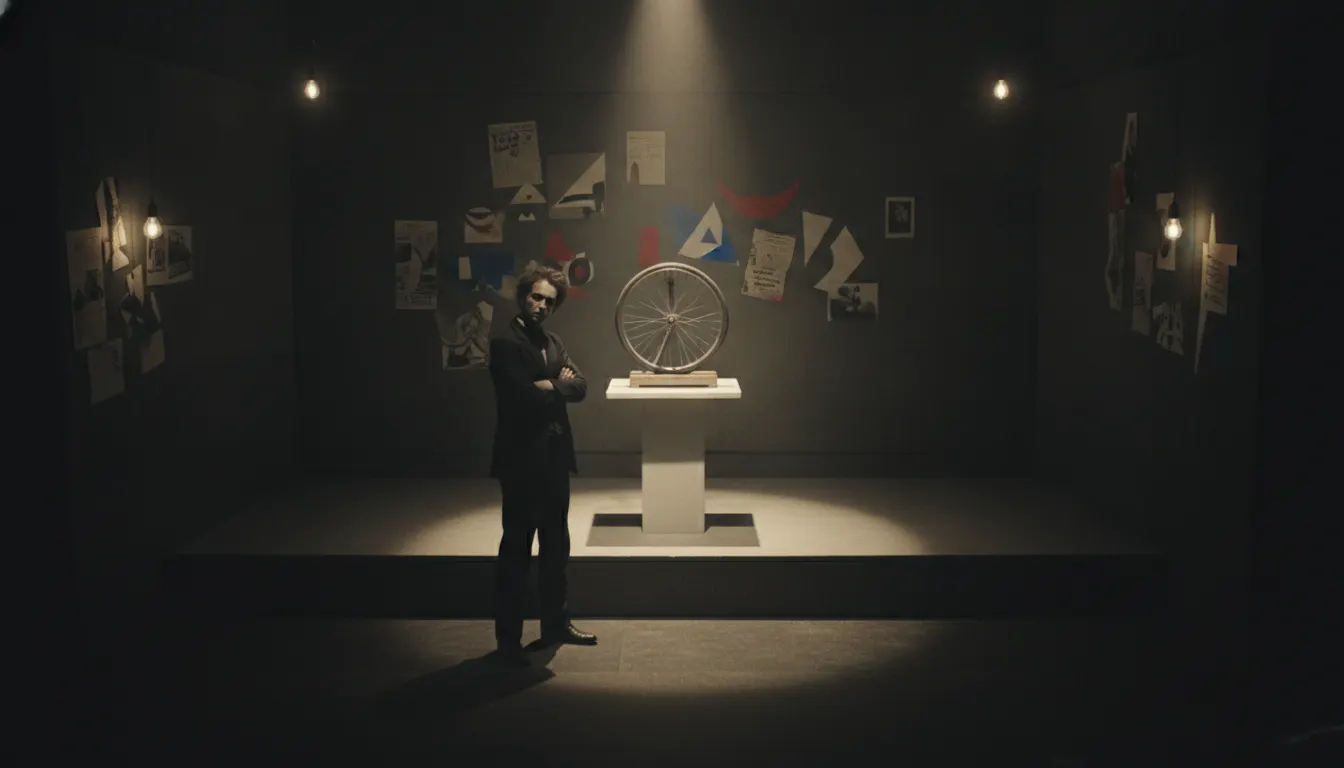
Marcel Duchamp
Fountain (1917/1964 replica; Tate Modern, London and others)
Marcel Duchamp Dada anti-art. Readymade urinal Fountain, ironic gallery placement, found-object collage, Cabaret Voltaire absurdism.
The moves a human crew would use to get here. Cue applies them for you, and knowing their names is how you ask for a change.
newspaper, magazine clippings, commercial imagery combined without logical connection
photographs cut and recombined to create impossible or satirical images
typographic elements used graphically rather than for information
random selection, automatic writing, random typography
existing objects recontextualized as art without alteration
incompatible elements placed together to produce cognitive disruption
Dada was an international avant-garde movement founded in Zurich in 1916, during World War I, as a deliberate assault on Western rationalism, bourgeois culture, and the aesthetic values that - in its practitioners' view - had produced the industrial slaughter of the war. Its founding gesture was nihilistic: if civilized European culture had led to the trenches and poison gas, then that culture's art, logic, and values deserved not critique but ridicule and destruction.
The movement was founded at the Cabaret Voltaire in Zurich in February 1916 by Hugo Ball (1886-1927), Emmy Hennings (1885-1948), and swiftly joined by Tristan Tzara (1896-1963), Jean (Hans) Arp (1886-1966), Richard Huelsenbeck (1892-1974), and Sophie Taeuber-Arp (1889-1943). The Cabaret hosted performances of sound poetry - phonetic verse with no semantic content (Karawane, Hugo Ball, 1916), simultaneous multilingual readings, and anti-concerts. The name Dada was allegedly found by inserting a knife at random into a French dictionary (dada is French children's language for a hobby horse).
Marcel Duchamp (1887-1968) was working in New York from 1915 and is the movement's most consequential philosophical artist, though he maintained an ironic distance from all group affiliations. His readymades - commercially produced objects selected and nominated as art without modification - are Dada's most enduring legacy:
Berlin Dada (1918-1920), led by John Heartfield (born Helmut Herzfeld, 1891-1968), Hannah Höch (1889-1978), George Grosz (1893-1959), and Raoul Hausmann (1886-1971), developed photomontage as a political weapon. Hannah Höch's Cut with the Kitchen Knife Dada through the Last Weimar Beer-Belly Cultural Epoch of Germany (1919-20, Nationalgalerie, Berlin) is a 90 x 144 cm collage of newspaper and magazine images creating a scathing critique of the Weimar Republic's male-dominated culture.
John Heartfield pioneered photomontage as anti-Nazi propaganda in the 1930s for the Arbeiter-Illustrierte-Zeitung magazine, producing images like Adolf, the Superman: Swallows Gold and Spouts Junk (1932).
Dada directly preceded and influenced Surrealism (André Breton's 1924 Surrealist Manifesto drew heavily on Dada tactics). Its influence on conceptual art (the readymade as the ancestor of all conceptual work from the 1960s onward), performance art, collage, graphic design, punk music, and contemporary internet culture is incalculable.
Fountain (1917/1964 replica; Tate Modern, London and others)
1919
L.H.O.O.Q.
Bicycle Wheel (1913/1951 replica)
Cut with the Kitchen Knife Dada... (1919-20, Nationalgalerie, Berlin)
1932
Adolf, the Superman: Swallows Gold and Spouts Junk
1916
Collage with Squares Arranged According to the Laws of Chance (1917, MoMA)
A Look is not a filter. It is a set of stored decisions the pipeline reads before it makes a single frame, so two videos in the same Look actually match.