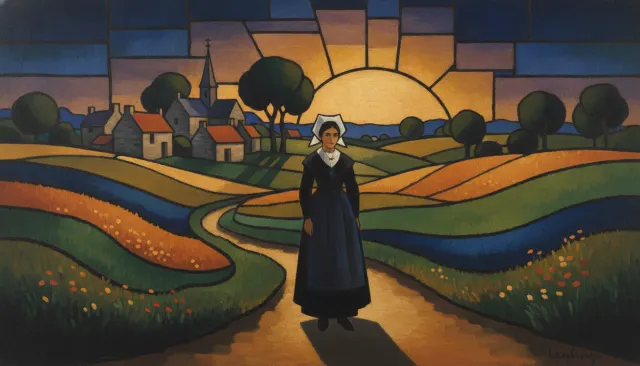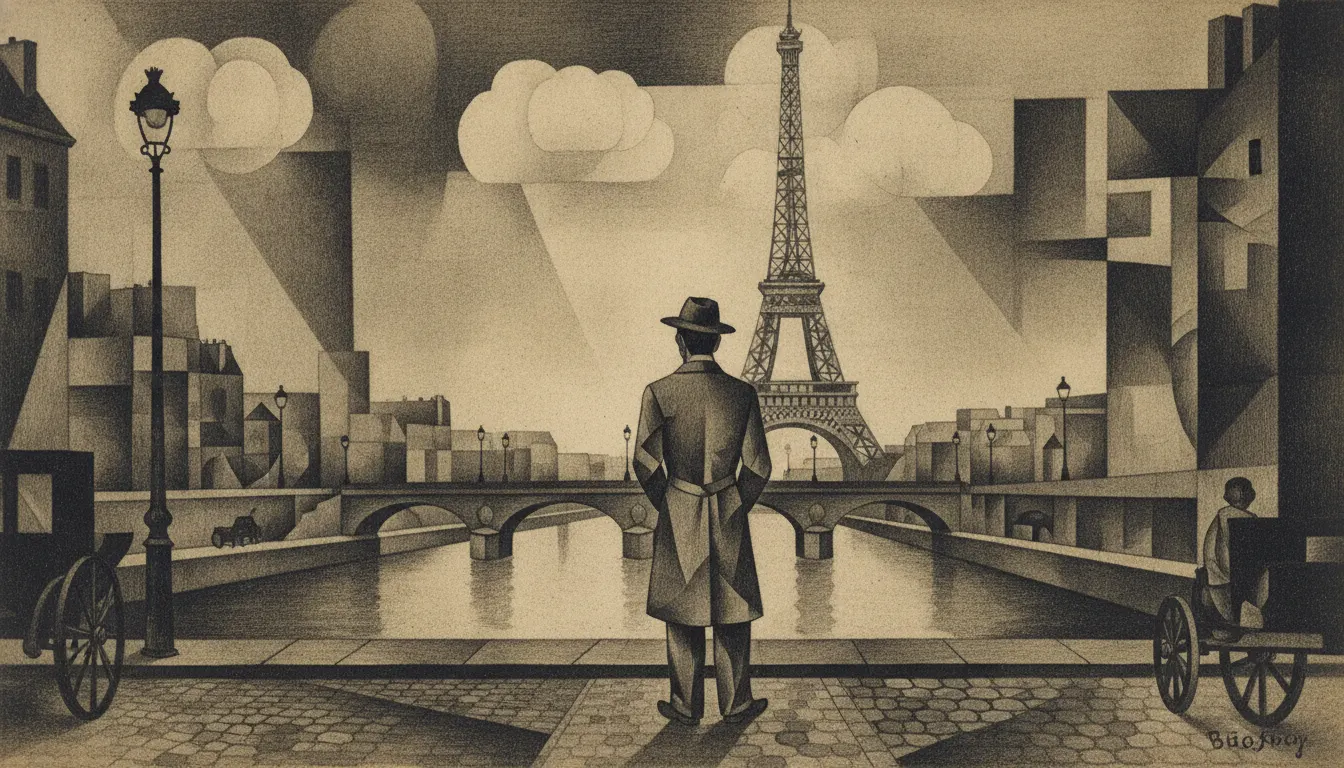
Pablo Picasso
Les Demoiselles d'Avignon (1907, MoMA, New York)
Analytical Cubism in the Picasso Braque manner. Fragmented faceted planes, simultaneous multiple viewpoints, monochrome ochre.
The moves a human crew would use to get here. Cue applies them for you, and knowing their names is how you ask for a change.
subject shown from front, side, and above simultaneously
objects decomposed into interlocking facets rather than continuous surfaces
narrow range of ochre, grey, brown, tan, cream in the 1908-1912 phase
post-1912, strong reds, greens, yellows alongside the analytic neutrals
real newspaper, wallpaper, sheet music incorporated into painted surface
all planes crowded close to the picture surface, no deep recession
newspaper mastheads, musical notation, partial words embedded in composition
Cubism, developed jointly by Pablo Picasso (1881-1973) and Georges Braque (1882-1963) in Paris between 1907 and 1914, is the most radical and consequential art movement of the 20th century. It destroyed the 500-year-old Renaissance convention of single-viewpoint perspective - the assumption that a painting shows a scene as seen from one position at one moment in time - and replaced it with a fragmented representation showing multiple simultaneous viewpoints, planes, and temporal moments.
Analytic Cubism (roughly 1908-1912) reduced the visual world to interlocking faceted planes in a narrow palette of ochre, grey, brown, and cream. Picasso's Ma Jolie (1911-12, MoMA) and Braque's Violin and Candlestick (1910, SFMOMA) are characteristic: the subject (a figure, a still life, a musical instrument) is simultaneously shown from front, side, and above, with the planes overlapping and interpenetrating until the object is almost unreadable from any single conventional viewpoint. The palette is intentionally self-effacing - color would distract from the formal analysis.
Synthetic Cubism (from about 1912) was more colorful and introduced the technique of collage - Braque and Picasso began incorporating actual newspaper clippings, sheet music, wallpaper, and other found materials into the painted surface. Picasso's Still Life with Chair Caning (1912, Musée Picasso, Paris) is the first Cubist collage. The palette opened up to include strong greens, reds, and yellows alongside the now-iconic tan and black. The synthesis of real material and painted surface was itself a philosophical statement about representation and reality.
The movement's two acknowledged sources are: Paul Cézanne (1839-1906), whose late paintings of Mont Sainte-Victoire and his geometric still lifes decomposed rounded natural forms into planes and tilted the conventional viewpoint, providing the intellectual foundation; and African and Oceanic art in the collections of the Trocadéro ethnographic museum in Paris, which Picasso encountered in 1907 and described as a revelation - mask forms that showed face and profile simultaneously, that abstracted the human head into angular essentials.
Picasso's Les Demoiselles d'Avignon (1907, MoMA) is the movement's founding work - five nude figures whose faces shift between Iberian sculpture (left figures) and African mask forms (right figures), with the spatial illusionism of the background entirely fractured. It was shocking when Picasso showed it privately to his circle, including Braque, and was not publicly exhibited until 1916.
Cubism spread immediately. Juan Gris (1887-1927) developed a more rigorous, logical Synthetic Cubism. Fernand Léger (1881-1955) extended it toward machine forms (Tubism). The movement influenced virtually every subsequent abstract art movement - Futurism (Italian Cubism in motion), Constructivism, De Stijl, and Expressionism all bear Cubism's structural DNA.
Les Demoiselles d'Avignon (1907, MoMA, New York)
Houses at l'Estaque (1908, Kunstmuseum Bern)
Ma Jolie (1911-12, MoMA, New York)
Violin and Candlestick (1910, SFMOMA)
Still Life with Chair Caning (1912, Musée Picasso, Paris) - first Cubist collage
Portrait of Pablo Picasso (1912, Art Institute of Chicago)
Contrast of Forms (1913, MoMA, New York)
A Look is not a filter. It is a set of stored decisions the pipeline reads before it makes a single frame, so two videos in the same Look actually match.