Composition with Red, Blue and Yellow
1930
Piet Mondrian
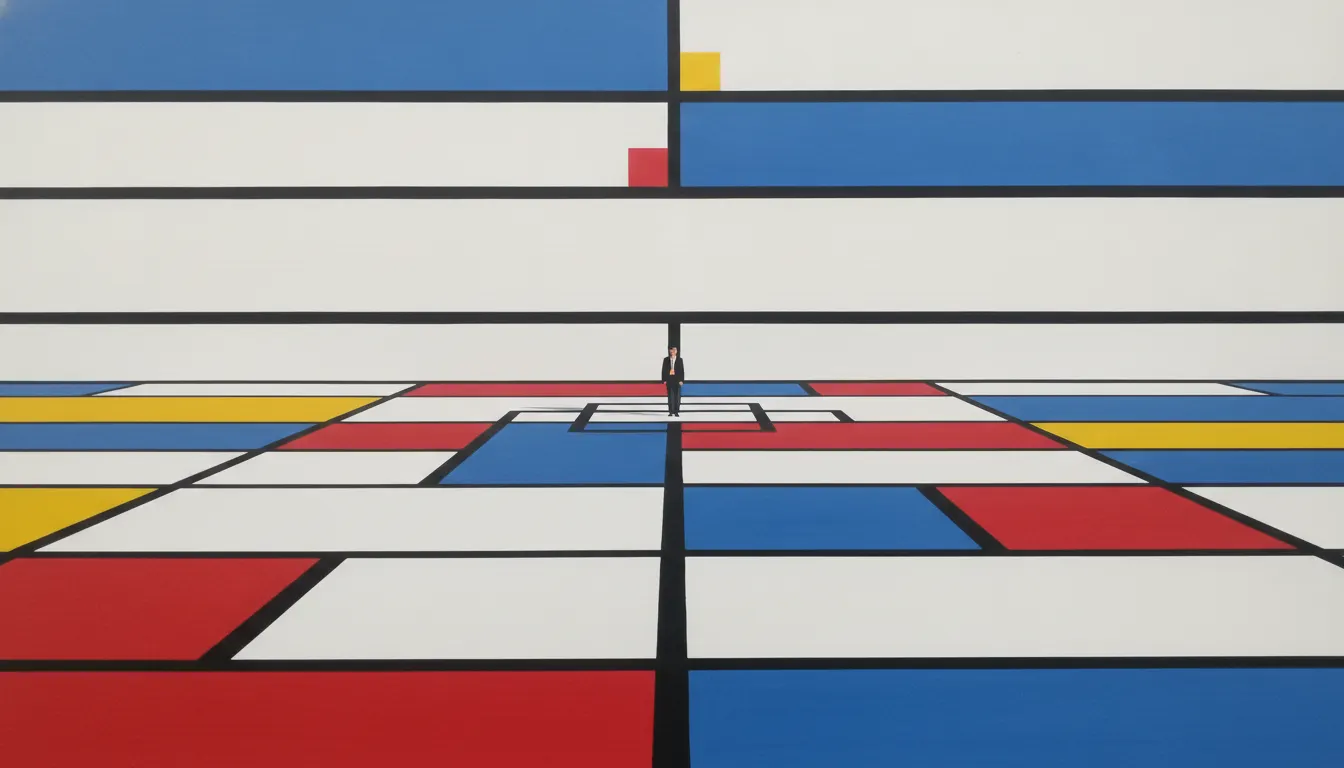
De Stijl Mondrian compositional grid. Black orthogonal lines, primary red yellow blue panels on white, neoplasticism, Rietveld discipline.
The moves a human crew would use to get here. Cue applies them for you, and knowing their names is how you ask for a change.
no diagonals, no curves
color and proportion weighted to create tension without chaos
serif set inside grid cells
pure hue at full saturation
De Stijl (Dutch: 'The Style') was founded in 1917 by Theo van Doesburg in Leiden. The movement, whose members included Piet Mondrian, Gerrit Rietveld, and Bart van der Leck, proposed that all art and design should reduce to universal elements: horizontal and vertical lines, primary colors (red, yellow, blue), and the non-colors (black, white, gray). They called this philosophy neoplasticism - a new kind of plastic art liberated from nature's particulars.
Piet Mondrian is the figure most associated with the visual language of De Stijl, though his relationship with van Doesburg was eventually fractious - they split in 1924 when van Doesburg introduced diagonal lines, which Mondrian considered a fundamental violation of neoplastic principles. Mondrian's mature paintings from the early 1920s - Tableau I (1921), Composition with Red, Blue and Yellow (1930) - are the canonical images: irregular grids of black lines dividing the canvas into rectangles, most of which are white or light gray, with a few colored with primary red, yellow, or blue.
The geometry looks deceptively simple. Mondrian spent months adjusting line positions, varying grid weights, and balancing color areas to achieve what he described as 'dynamic equilibrium' - a state where no element dominates, where the composition holds in perfect tension. The process involved physically taping colored strips to his canvases to test arrangements.
Gerrit Rietveld's Red Blue Chair (1917-1923) translated the De Stijl visual vocabulary into three dimensions: the same primary color palette, the same orthogonal structure, the same refusal of ornament. His Rietveld Schröder House in Utrecht (1924) extended it to architecture - the only building designed in complete accordance with De Stijl principles.
De Stijl's graphic influence runs through Bauhaus (van Doesburg gave an unofficial course at the school in Weimar in 1921-1922), into Swiss modernism, and then into the entire tradition of grid-based design. Mondrian's grid is cited in corporate identity work, fashion design (Yves Saint Laurent's Mondrian Dress collection, 1965), and digital interface design (the four-color Windows logo).
1930
Piet Mondrian
1921
Piet Mondrian
Gerrit Rietveld (1917-1923)
1924
Gerrit Rietveld, Utrecht
Theo van Doesburg (1917-1928)
1965
Yves Saint Laurent
four-color quadrant grid drawing on De Stijl tradition (1992-present)
A Look is not a filter. It is a set of stored decisions the pipeline reads before it makes a single frame, so two videos in the same Look actually match.