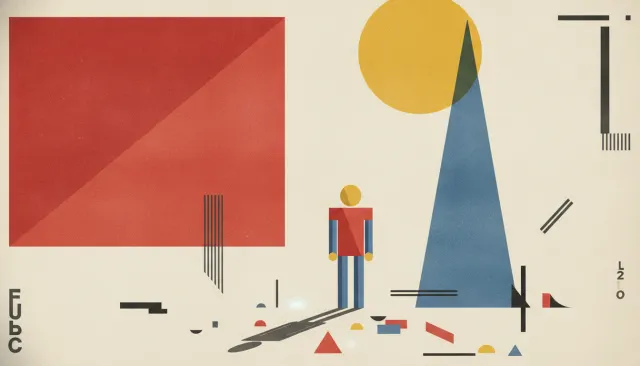
Otto Neurath and Gerd Arntz
ISOTYPE system, Vienna (1925-1934)
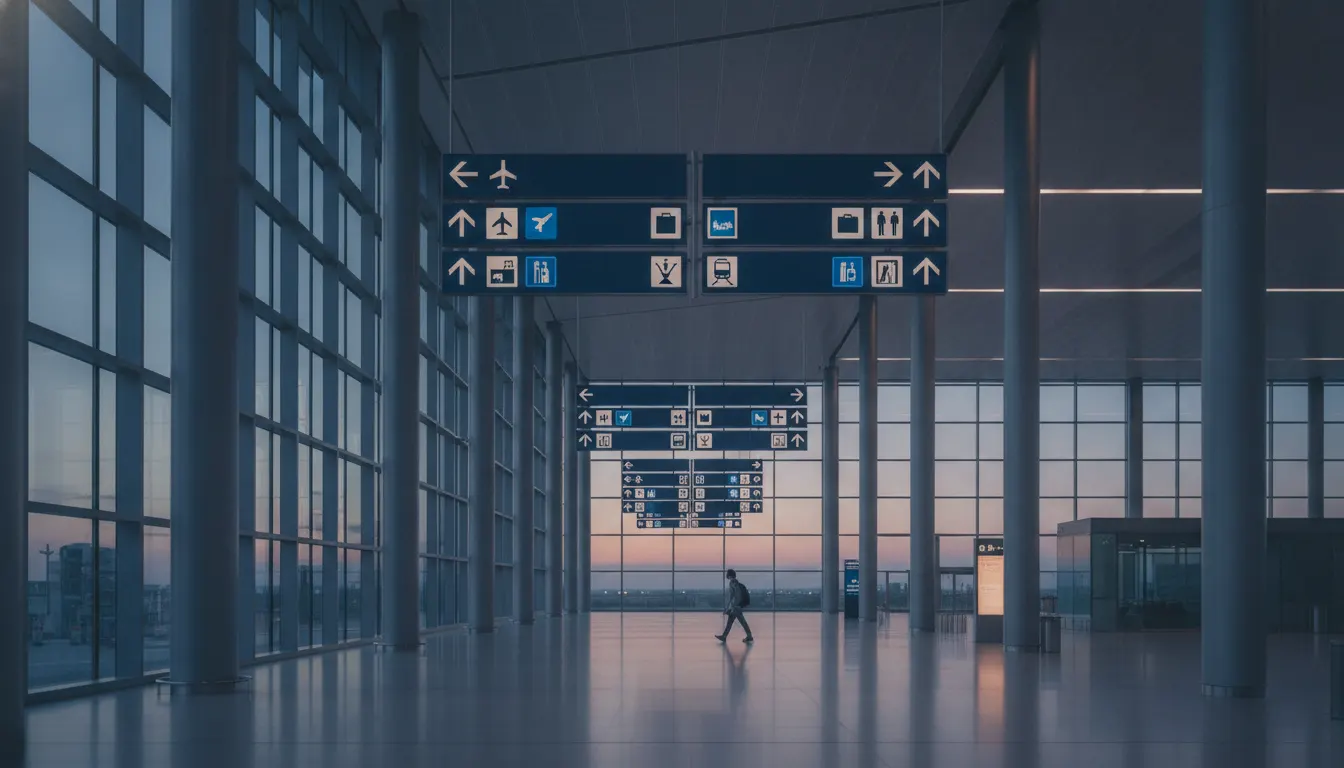
Airport wayfinding system. AIGA-DOT pictograms, Frutiger typeface, hierarchical sign hangs, arrow-direction grid, calm air-travel polish.
The moves a human crew would use to get here. Cue applies them for you, and knowing their names is how you ask for a change.
based pictograms on single-color fields with no gradients
contrast color blocking: white on blue, green, or red
caps with generous tracking
every form built on the same proportional unit
The airport wayfinding aesthetic draws from one of graphic design's most utilitarian traditions: the universal pictogram. Its roots reach back to Otto Neurath's ISOTYPE (International System of Typographic Picture Education), developed in Vienna between 1925 and 1934 with artist Gerd Arntz. Neurath's goal was radical: a visual language so clear it could communicate across literacy barriers and national boundaries. Arntz hand-cut over 4,000 individual symbols that became the template for every toilet door, emergency exit, and departure board that followed.
The modern airport wayfinding canon was codified in 1974 when the American Institute of Graphic Arts (AIGA) commissioned a set of 34 passenger/pedestrian symbols for the U.S. Department of Transportation. Designers including Cook and Shanosky Associates produced icons that are still in airports worldwide today - the running figure, the fork and knife, the airplane silhouette tilted at 45 degrees.
The system depends on radical reduction. Each symbol strips away everything non-essential until only the recognizable silhouette remains. Forms are geometric, symmetrical where possible, and designed to read at 30 meters on a backlit panel. Color follows strict convention: white pictogram on blue background for amenities, white on green for emergency egress, white on red for prohibition.
Typography in wayfinding systems is typically a grotesque sans-serif. Frutiger, designed by Adrian Frutiger specifically for Charles de Gaulle Airport (1975), became the canonical wayfinding typeface - its open apertures and generous x-height were engineered to read at speed and angle. Helvetica and its derivatives dominate North American airports.
The isotype aesthetic has been absorbed into interface design (iOS system icons, Material Design's icon grid), data visualization (isotype charts showing comparative quantities), and brand identity for companies needing universal legibility. Designers like Otl Aicher, who created the Munich 1972 Olympic pictograms, extended the vocabulary into full visual systems where every human figure follows a precise modular grid.
ISOTYPE system, Vienna (1925-1934)
1974
Cook and Shanosky Associates
1975
Adrian Frutiger for Charles de Gaulle Airport
Otl Aicher
1916
Edward Johnston typeface , modernized system
Masaru Katzumie and Yoshiro Yamashita
Lance Wyman
Paul Mijksenaar wayfinding (1990s)
A Look is not a filter. It is a set of stored decisions the pipeline reads before it makes a single frame, so two videos in the same Look actually match.