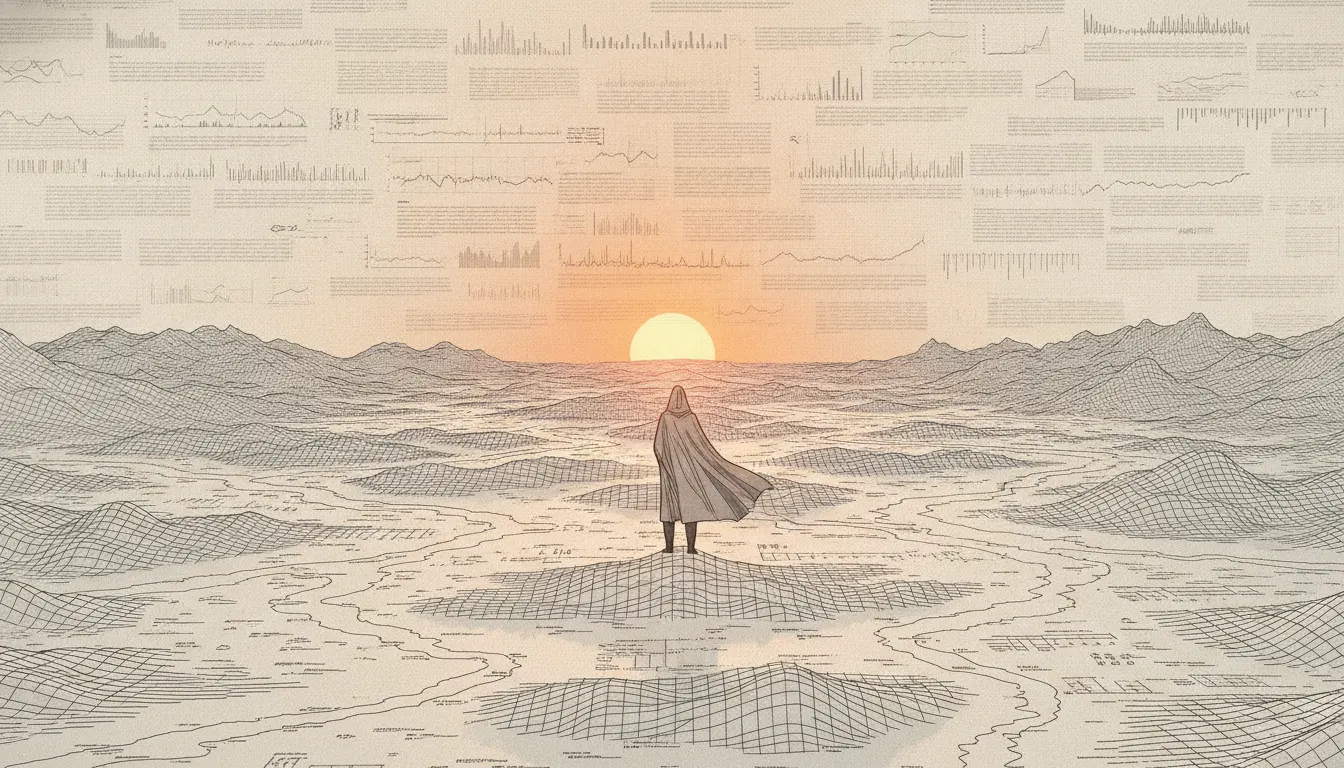
The Visual Display of Quantitative Information
1983
Edward Tufte
Edward Tufte clean data visualization. High data-to-ink ratio, sparklines, small multiples, restrained labels, no chartjunk, serif body, scientific.
The moves a human crew would use to get here. Cue applies them for you, and knowing their names is how you ask for a change.
ink ratio: every visual element carries information, decorative elements removed
many identical-format charts enabling comparison
word-sized data graphics embedded in text context
serif typography in small sizes for data labels
gridlines at near-invisible gray, data at high contrast, labels at medium contrast
Edward Tufte is the most influential theorist of statistical graphics in the 20th century. His four main books - The Visual Display of Quantitative Information (1983), Envisioning Information (1990), Visual Explanations (1997), and Beautiful Evidence (2006) - established a framework for thinking about data presentation that remains the reference standard for anyone designing charts, maps, tables, or information systems.
Tufte self-published this book after finding mainstream publishers unwilling to meet his standards for color reproduction and typographic quality. The book introduced several concepts that have since become foundational vocabulary: the 'data-ink ratio' (the proportion of ink on a page devoted to non-redundant data information - maximize it), 'chartjunk' (decorative elements that add no information - eliminate them), and 'lie factor' (the size of an effect as shown in a graphic divided by the size of the effect in the data - keep it as close to 1 as possible).
Tufte's analysis of historical charts - John Snow's 1854 cholera map identifying the Broad Street pump, Charles Joseph Minard's 1869 map of Napoleon's Russian campaign (which Tufte calls 'the best statistical graphic ever drawn'), Florence Nightingale's rose diagrams of mortality causes - established that the greatest information visualizations are those that reveal truth with minimum means.
Tufte coined the term 'sparkline' in Beautiful Evidence (2006) to describe data-intense, design-simple, word-sized graphics: small, high-density line charts that can be embedded inline with text. The concept influenced the development of data-dense dashboard design and led directly to their implementation in Bloomberg Terminal, Excel, and hundreds of data products.
The 'small multiples' principle - repeating the same graphic format across different data slices to enable comparison - was a central Tufte principle from Envisioning Information. Rather than animating a change over time, show all states simultaneously. Rather than a single complex chart, show many simple charts in a grid. The principle influenced the design of analytics dashboards, scientific publications, and news graphics.
Tufte's aesthetic is not minimalism for its own sake. It is minimalism in service of maximum information density - the opposite of empty white space. Every chart element must justify its presence by contributing to data communication. The result is graphics that use fine rules, small type, and dense point clouds rather than thick bars, large fonts, and decorative backgrounds.
1983
Edward Tufte
1990
Edward Tufte
1869
analyzed and republished by Tufte
analyzed by Tufte as exemplary data display
2006
Edward Tufte, introducing sparklines
influenced by Tufte's high-density principles
leading newspaper data visualization, Tufte-influenced
A Look is not a filter. It is a set of stored decisions the pipeline reads before it makes a single frame, so two videos in the same Look actually match.