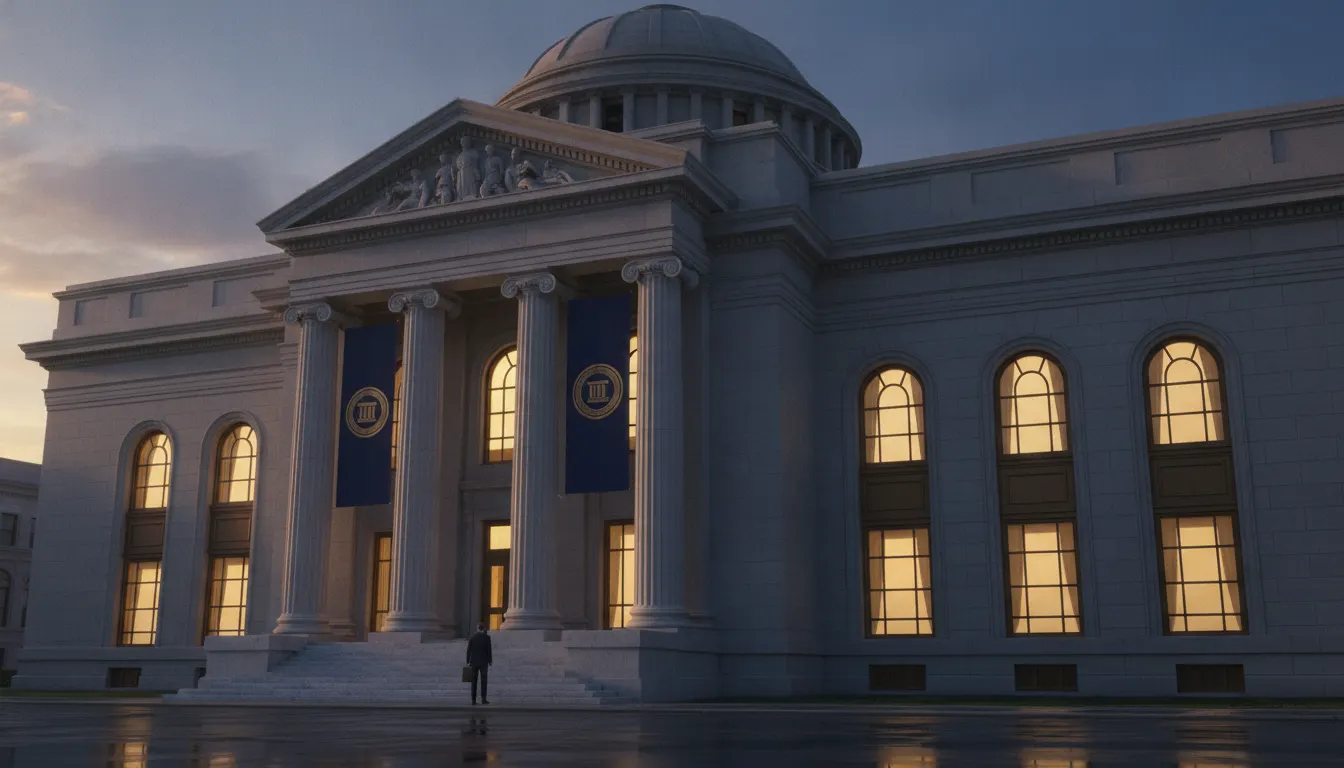
Bank of England architectural identity
John Soane facade (1788-1833)
Old-school banking brand. Deep navy, serif wordmark, gold seal medallion, classical column iconography, conservative trust signals.
The moves a human crew would use to get here. Cue applies them for you, and knowing their names is how you ask for a change.
eagles, shields, laurel wreaths, columns
The old-school banking aesthetic is a deliberate visual argument for permanence and safety. It emerged in the 19th century when banks needed to communicate stability to a public with every reason to be skeptical - bank runs were routine, and trust had to be built through architecture, signage, and eventually print materials that radiated institutional solidity.
The color at the center of this language is a specific navy or royal blue - not the cheerful cobalt of tech startups, but a deep Prussian blue associated with naval uniforms, government seals, and conservative authority. It appears in the logos of JPMorgan Chase, Barclays, Deutsche Bank, and hundreds of regional institutions worldwide. Gold and silver accents signal wealth without ostentation. The palette communicates: we are serious, we have been here a long time, and we will be here when you return.
Serif typefaces dominate - Garamond, Caslon, Times New Roman variants, or custom serif faces that echo 18th and 19th century letterpress printing. The choice signals tradition and literacy. Wide tracking on uppercase lettering is common, a typographic shorthand for gravitas borrowed from stone-cut inscriptions on public buildings.
The architectural influence is direct. Neoclassical bank buildings - the Bank of England (rebuilt by John Soane, 1788-1833), the New York Stock Exchange facade (1903), local Carnegie-era bank branches with their marble columns and vaulted ceilings - set a visual template. Marble textures, engraved ornamental borders, heraldic shields, and eagle motifs all carry forward this architectural language into print and digital materials.
Fintech brands since 2015 have largely abandoned this aesthetic in favor of clean consumer-tech simplicity, which has created a countertrend: some legacy institutions have leaned harder into traditional signals as a deliberate differentiation from app-first competitors. Goldman Sachs's identity and J.P. Morgan Private Bank materials maintain the old-school vocabulary precisely because it communicates exclusivity and longevity that a gradient-heavy app cannot replicate.
John Soane facade (1788-1833)
navy blue wordmark and heritage system
continuous heraldic iconography since 1736
Bureau of Engraving and Printing
institutional serif conservative system
1903
royal warrant heritage branding
A Look is not a filter. It is a set of stored decisions the pipeline reads before it makes a single frame, so two videos in the same Look actually match.