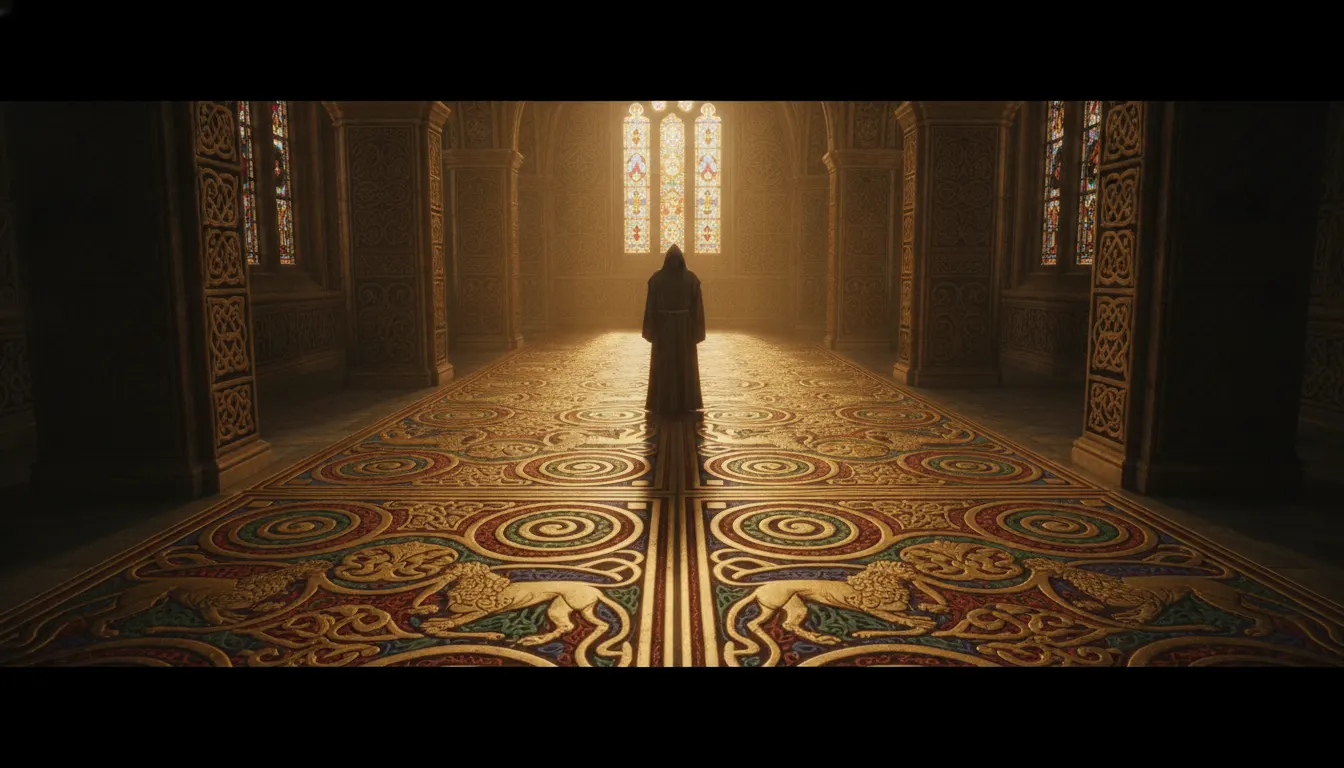
HISTORICAL ILLUMINATED EXTENDED · 800S · IRELAND
Book of Kells Celtic Illuminated
Book of Kells Celtic illuminated manuscript. Interlaced knotwork carpet page, gold leaf, zoomorphic spirals, Insular Hiberno-Saxon monastic gospel.
book-of-kellscelticilluminatedinsular
LUT book-of-kells-celtic
WHEN TO USE
- Content celebrating Irish, Scottish, or Celtic heritage and culture
- Religious or spiritual content, particularly Christian or pagan/Celtic faith traditions
- Fantasy world-building that draws on medieval or Celtic mythology
- Book, manuscript, or literary content requiring a sense of ancient sacred craft
- Museum, cultural institution, or heritage organization content
- Decorative borders, title cards, or frame elements for historically themed content
WHEN NOT TO USE
- Contemporary, digital-native, or minimalist aesthetics
- Content that needs visual speed and legibility over ornamental richness
- Brand content for technology, finance, or other contexts where historical reference is off-brand
- Horror or dark content where the sacred/spiritual origin creates tonal mismatch
- Content requiring photographic realism or modern design sensibilities
SIGNATURE TECHNIQUES
How the look is made.
The moves a human crew would use to get here. Cue applies them for you, and knowing their names is how you ask for a change.
- 01Interlace knotwork
continuous ribbons of line that weave over and under without end
- 02Zoomorphic interlace
the ribbons are animal bodies - serpents, birds, quadrupeds - that bite and twine
- 03Spiral and trumpet motifs derived from Celtic La Tène metalwork (200 BCE - 400 CE)
- 04Rich mineral pigments
lapis blue, orpiment orange-yellow, verdigris green, red lead, chalk white
- 05Hierarchical composition
the sacred text or symbol placed within concentric frames of ornament
- 06Frontally hieratic figure poses derived from Byzantine icon tradition
- 07Micro
scale precision: pattern at a level of detail invisible to the naked eye
HISTORY & CONTEXT
Where it comes from.
The Book of Kells: Insular Illumination at Its Peak
The Book of Kells (Trinity College Library, Dublin, MS 58) is an illuminated manuscript Gospel book containing the four Latin Gospels of the New Testament, produced by Celtic monks in the Columban monastic tradition. It was created approximately c. 800 CE, most likely at the monastery of Iona (a Scottish island) before being moved to the Abbey of Kells in County Meath, Ireland, possibly to protect it from Viking raids - though scholarly debate about its origins and multiple hands continues.
The manuscript consists of 340 vellum leaves (folios) and contains the complete text of the four Gospels accompanied by prefatory material, Canon Tables, and decorated pages that represent the highest achievement of the Insular (Irish-Northumbrian) school of manuscript illumination.
Key Illuminated Pages
The book contains several categories of highly decorated pages:
- Chi-Rho page (folio 34r): the initial letters XPI (Chi-Rho-Iota) of the word Christi, rendered as a whole-page decorative composition with zoomorphic interlace, angel figures, moths, cats chasing mice, and an otter holding a fish - all within spiraling knotwork. It is the most elaborately decorated single page in the manuscript and arguably in all medieval art.
- Carpet pages: pure ornamental pages with no text, consisting entirely of interlaced geometric and zoomorphic pattern
- Evangelist portraits: images of the four Gospel authors (Matthew, Mark, Luke, John) in frontal hieratic pose
- Initial pages: the decorated opening letters of each Gospel section
Visual Language and Technique
Insular illumination synthesizes several traditions: Celtic La Tène metalwork (the spiral, trumpet, and triskele patterns of pre-Christian Celtic art); Germanic and Anglo-Saxon animal interlace (zoomorphic knotwork derived from Migration Period animal ornament); and Mediterranean Late Antique Christian iconography (the evangelist symbols, the frontal hieratic portrait tradition).
The visual elements include:
- Knotwork and interlace: continuous ribbon patterns, often composed of animal bodies (serpents, birds, quadrupeds) whose limbs and tails interweave without beginning or end
- Spiral and trumpet motifs: derived from La Tène metalwork, creating hypnotic rotational energy
- Zoomorphic ornament: animals and humans whose bodies transform into or interweave with abstract pattern
- Mineral pigments: the vivid palette was made from materials including lapis lazuli (blue), orpiment (yellow-orange), verdigris (green), red lead, chalk (white), and locally sourced carbon black
The level of precision is astonishing - some areas of knotwork reveal, under magnification, patterns that require a grid of millimeter-scale accuracy to construct, and were invisible to the naked eye of a contemporary viewer.
NOTABLE WORKS
Where you have seen it.
Book of Kells, full manuscript (340 folios, Trinity College Library, Dublin, MS 58)
Lindisfarne Gospels (c. 715-720 CE, British Library, London)
Book of Durrow (c. 680 CE, Trinity College Library, Dublin)
Echternach Gospels (c. 690 CE, Bibliothèque nationale de France)
St. Gall Gospels (c. 750-800 CE, Stiftsbibliothek St. Gallen)
THE RECIPE
The exact knobs
the renderer turns.
A Look is not a filter. It is a set of stored decisions the pipeline reads before it makes a single frame, so two videos in the same Look actually match.
SettingValue
GradeColour LUT applied to every frame
book-of-kells-celticTransitionHow one shot becomes the next
hard cuts · 160ms · linearKen BurnsCamera move applied to stills
Slow push · 0.02 · centerTypographyDisplay / body / mono pairing
Cinzel · Lora · JetBrains MonoMusic moodWhat the bed under the voice sounds like
celtic-harp-sacred · gregorian-chantPrompt suffixAppended to every shot prompt in this Look
Book of Kells Celtic illuminated manuscript carpet page, interlaced knotwork, gold leaf, zoomorphic spiral, Insular Hiberno Saxon monastic gospel 800ADPALETTE
Primary
#D4AF37
Secondary
#7A1010
Accent
#1A3A8E
Text/Light
#1A0F08
Text/Dark
#F5E6B8
BG 900
#1A140A
BG 800
#2A2010
RELATED LOOKS
Next to it on the shelf.
Your first cut
is on us.
+ New videoFree plan · no card · 1080p export