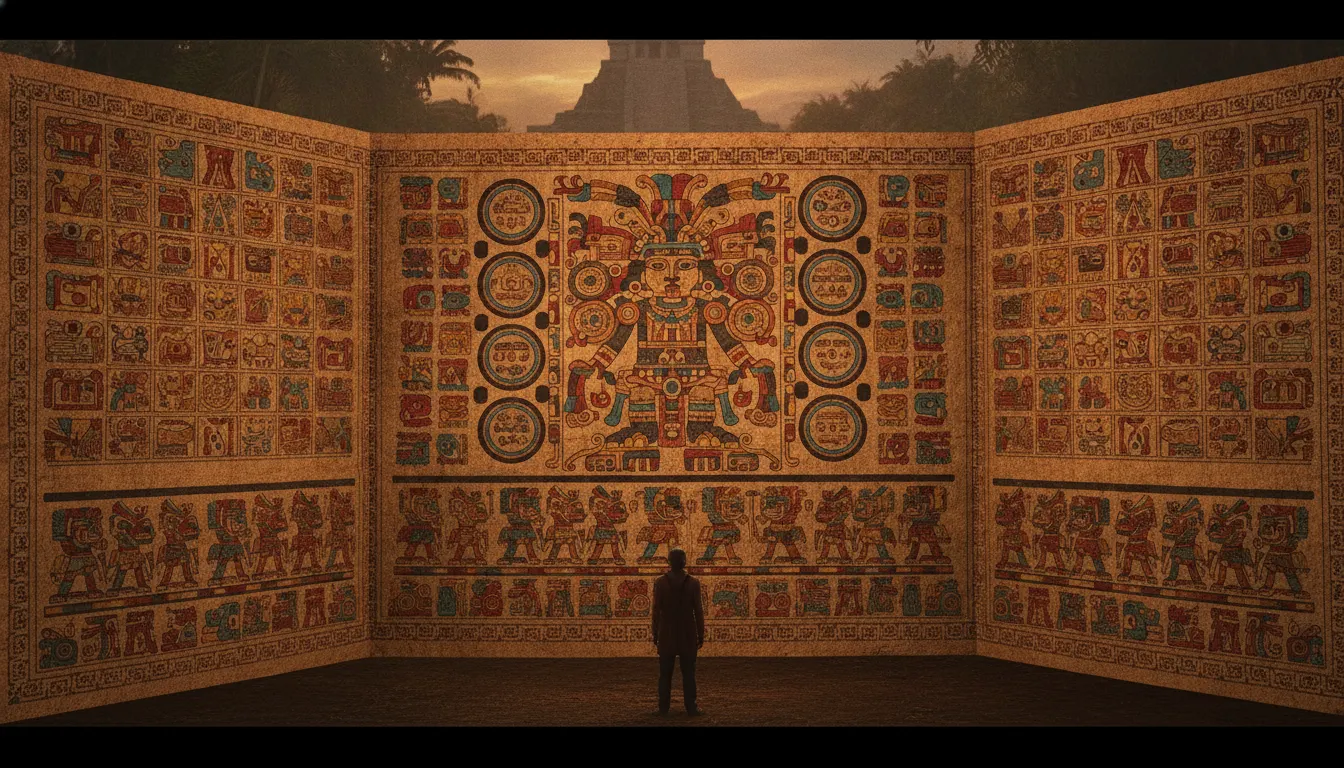
HISTORICAL ILLUMINATED EXTENDED · 1400S · MEXICO
Aztec Mesoamerican Codex Symbol
Aztec Mexica Mesoamerican codex page. Black outlined glyph figures, flat earth-pigment colour, deity calendar register, pre-Columbian amate-paper folding screen.
aztecmesoamericancodexglyph
LUT aztec-codex-earth
WHEN TO USE
- Content celebrating Mexican, Indigenous Mesoamerican, or Latin American cultural heritage
- Historical or anthropological documentaries covering pre-Columbian civilizations
- Brand content for food, beverage, or lifestyle brands rooted in Mexican culture
- Title graphics for Day of the Dead content or related cultural celebrations
- Music videos or cultural content incorporating indigenous symbolism respectfully
- Educational content about Aztec, Maya, or Mesoamerican history
WHEN NOT TO USE
- Generic 'world culture' content that uses the style superficially without cultural grounding
- Commercial content that would reduce the symbolic system to mere decoration without context
- European historical content where the visual reference is anachronistic
- Minimalist or contemporary brand aesthetics
- Content that could be perceived as cultural appropriation without authentic connection to the tradition
SIGNATURE TECHNIQUES
How the look is made.
The moves a human crew would use to get here. Cue applies them for you, and knowing their names is how you ask for a change.
- 01Profile
view figures with frontal eye and shoulder - the schematic convention shared with Egyptian art
- 02Flat color fills bounded by crisp black outline, no shading or illusionistic depth
- 03Symbolic pictography
animals, deities, and objects rendered as recognizable icons
- 04Mineral and earthy palette
terracotta, maize yellow, turquoise, jungle green, bone, black
- 05Geometric grid structures derived from the 260
day tonalpohualli ritual calendar
- 06Repeated motifs
feathered serpent, eagle, jaguar, sun disc, stepped pyramid
- 07Border decoration using repeating geometric or scrollwork units
HISTORY & CONTEXT
Where it comes from.
Aztec and Mesoamerican Codex Symbolism
The visual language of the Aztec Empire (1300-1521 CE) and earlier Mesoamerican cultures - the Maya (200-900 CE Classic period), Zapotec, Mixtec, and Teotihuacán - constitutes one of the world's richest pre-modern symbolic systems. It survived in the form of codices (screenfold books made from bark paper or deer hide), monumental stone carvings, ceramic decoration, and manuscript painting, and was violently disrupted by the Spanish conquest beginning in 1519.
The Codices
Mesoamerican codices are pictographic and logographic manuscripts that record calendrical, religious, historical, and genealogical information. Most surviving pre-Columbian codices are Aztec or Mixtec; the majority of Maya codices were destroyed by Spanish missionaries, particularly Bishop Diego de Landa in 1562. Key surviving examples include:
- Codex Mendoza (c. 1541, post-conquest, Bodleian Library, Oxford): an Aztec manuscript recording tribute, imperial history, and daily life, compiled under Spanish direction
- Codex Borgia (pre-conquest, c. 1400-1500, Vatican Apostolic Library): a Nahuatl religious manuscript depicting ritual calendars, deities, and cosmological diagrams
- Dresden Codex (Maya, c. 900-1200 CE, Sächsische Landesbibliothek): the oldest known book of the Americas, containing astronomical tables
- Mixtec Codex Nuttall (pre-conquest, c. 1300-1521, British Museum)
Visual Language
Codex illustration is fundamentally symbolic and schematic rather than illusionistic. Figures are rendered in profile with frontal eye and shoulder (Egyptian convention). Color is flat, bounded by black outline. Spatial relationships are indicated by relative size and stacking rather than perspective. The visual vocabulary includes: the Aztec sun stone and calendar wheel, the feathered serpent Quetzalcóatl, the eagle, the jaguar, the hummingbird deity Huitzilopochtli, the rain god Tlaloc with goggle eyes, and the skeletal death god Mictlantecuhtli.
The palette is earthy and mineral: terracotta red, maize yellow, turquoise blue, jungle green, bone white, and charcoal black - derived from naturally available pigments including cochineal, indigo, and mineral ochres.
20th-Century Revival
Mexican muralists Diego Rivera (1886-1957), José Clemente Orozco (1883-1949), and David Alfaro Siqueiros (1896-1974) drew heavily on pre-Columbian visual traditions in their monumental public works of the 1920s-1940s, particularly Rivera's murals at the National Palace of Mexico City and the Detroit Institute of Arts. Contemporary Chicano art movements continue this lineage.
NOTABLE WORKS
Where you have seen it.
Codex Mendoza (post-conquest Aztec, c. 1541, Bodleian Library, Oxford)
Dresden Codex (Maya, c. 900-1200 CE, Sächsische Landesbibliothek)
Aztec Sun Stone / Calendar Stone (c. 1502-1520, Museo Nacional de Antropología, Mexico City)
Diego Rivera
History of Mexico murals (1929-1935, National Palace, Mexico City)
Mixtec Codex Nuttall (pre-conquest, c. 1300-1521, British Museum)
THE RECIPE
The exact knobs
the renderer turns.
A Look is not a filter. It is a set of stored decisions the pipeline reads before it makes a single frame, so two videos in the same Look actually match.
SettingValue
GradeColour LUT applied to every frame
aztec-codex-earthTransitionHow one shot becomes the next
hard cuts · 160ms · linearKen BurnsCamera move applied to stills
Slow push · 0.02 · centerTypographyDisplay / body / mono pairing
Cinzel · Lora · JetBrains MonoMusic moodWhat the bed under the voice sounds like
mesoamerican-flute · ritual-drumPrompt suffixAppended to every shot prompt in this Look
Aztec Mexica Mesoamerican codex page, black outlined glyph figures, flat earth pigment colour, deity calendar register, pre Columbian amate paper folding screenPALETTE
Primary
#C84A2E
Secondary
#F5C144
Accent
#1A3A8E
Text/Light
#1F0808
Text/Dark
#FFE8C0
BG 900
#1F0F08
BG 800
#2A1810
RELATED LOOKS
Next to it on the shelf.



Your first cut
is on us.
+ New videoFree plan · no card · 1080p export