Mao Zedong propaganda portraits
Shen Yaoyi and collective artists (1966-1976)
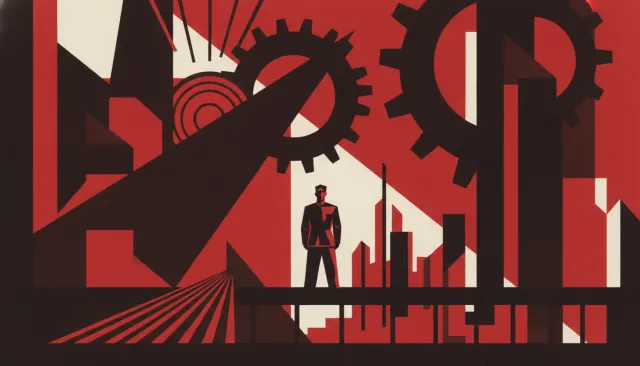
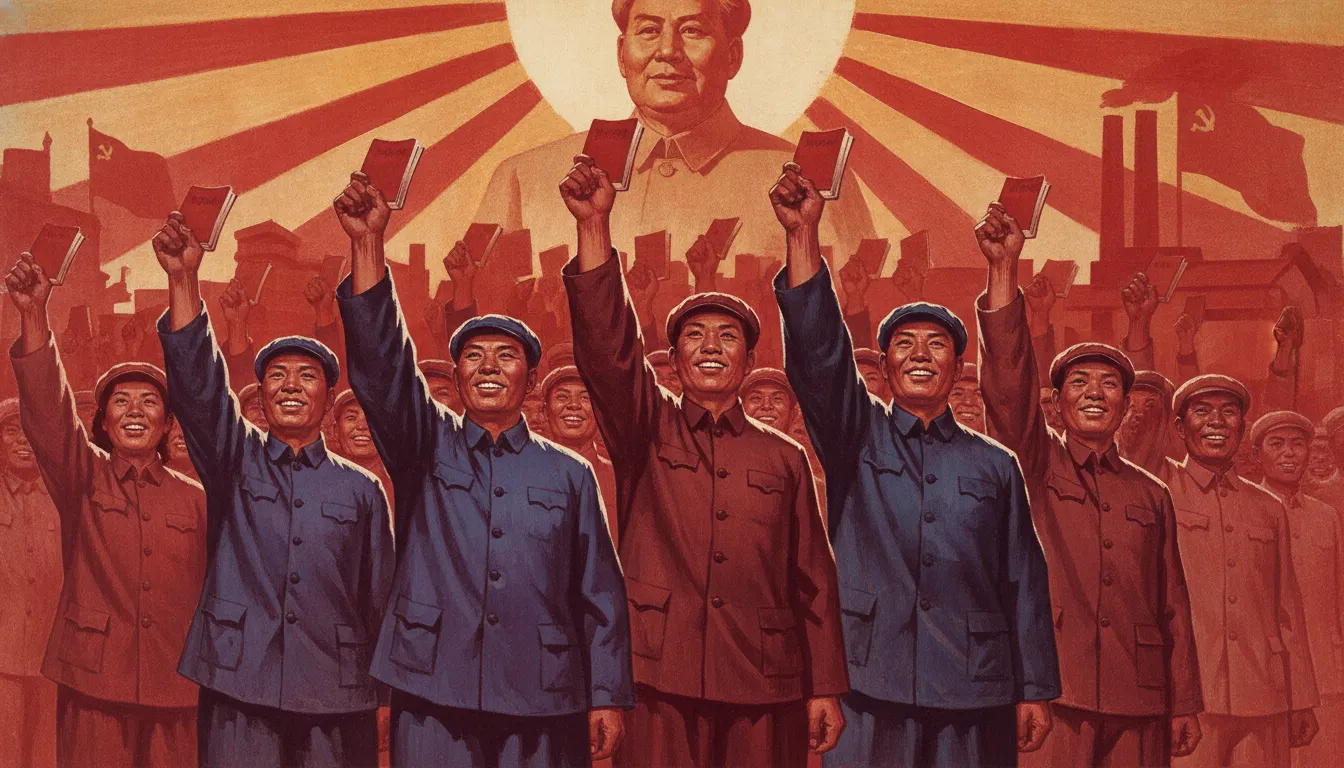
Chinese Cultural Revolution poster. Painterly socialist realism, smiling workers raising Little Red Book, vermilion red, golden sunburst behind Mao.
The moves a human crew would use to get here. Cue applies them for you, and knowing their names is how you ask for a change.
gazing figure compositions with figures occupying the lower two-thirds of frame
key, even lighting on figures with idealized skin tones in warm amber
print Chinese characters as slogan typography
moving group compositions
Between 1966 and 1976, the People's Republic of China produced tens of millions of propaganda posters under the direction of the Cultural Revolution - Mao Zedong's campaign to reassert ideological control, eliminate 'bourgeois' cultural influences, and mobilize youth in service of revolutionary transformation. The visual language developed during this decade is among the most recognizable and formally distinctive bodies of mass political art in history.
The Cultural Revolution poster aesthetic built on the Soviet Socialist Realist tradition established in the 1930s but developed distinctly Chinese characteristics. Figures were depicted as idealized types - the worker, the peasant, the People's Liberation Army soldier - rather than individuals. Their bodies were heroic: straight-backed, forward-leaning, with faces turned upward toward a luminous horizon. The 'Three Prominences' doctrine (三突出, sān tūchū), formalized by Jiang Qing after 1968, mandated that heroic characters be prominent within compositions, positive characters prominent among all figures, and the principal hero most prominent of all.
Mao Zedong's Little Red Book, issued from 1964 and ubiquitous during the Revolution, appeared in posters held aloft by figures radiating light. Mao himself was depicted in a distinctive palette: warm gold and amber skin tones against sunlit backgrounds, dressed in the gray-green PLA uniform or the Mao suit. The sun, often stylized, appeared in the upper corners of posters to represent Mao's ideological radiance.
The palette was constrained and symbolic: revolutionary red dominated backgrounds and banners, gold and yellow signified enlightenment and Mao's ideological light, white was used for text and for idealized figure highlights. Blues and greens appeared for uniforms and agricultural settings. The red/gold/white combination became the color vocabulary of revolutionary optimism.
Chinese calligraphic typography appeared in slogans set in bold, angular brushstroke letterforms. Block-printed simplified characters in red or black on white provided declaratory text. The visual relationship between image and text was rhetorical - the slogan completed the image's argument.
The aesthetic has been cited by designers, artists, and political movements globally since the 1970s. Shepard Fairey's Barack Obama 'Hope' poster (2008) drew on its formal vocabulary of upward-gazing heroic portraiture and high-contrast color blocking. Contemporary appropriations range from satirical to sincere.
Shen Yaoyi and collective artists (1966-1976)
Cultural Revolution era (1970-1971)
anonymous collective poster production
1967
standardized series
2008
Shepard Fairey, drawing on this tradition
University of Westminster collection
A Look is not a filter. It is a set of stored decisions the pipeline reads before it makes a single frame, so two videos in the same Look actually match.