Calvin and Hobbes daily strip (November 18, 1985
December 31, 1995)
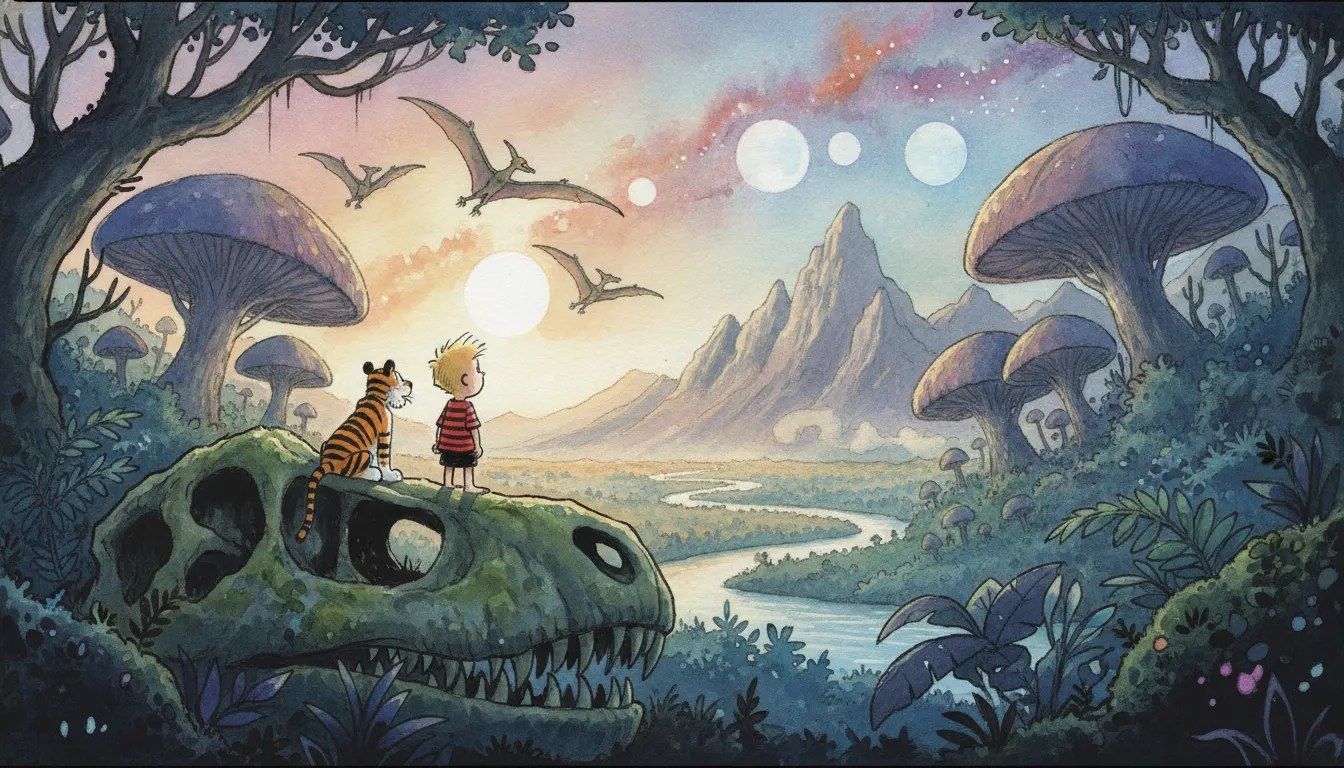
Bill Watterson Calvin and Hobbes Sunday strip painted watercolour. Imaginative kid in dinosaur fantasy, lush brushed colour, tiger toy companion.
The moves a human crew would use to get here. Cue applies them for you, and knowing their names is how you ask for a change.
wash backgrounds with loose, gestural brush strokes in imagination sequences
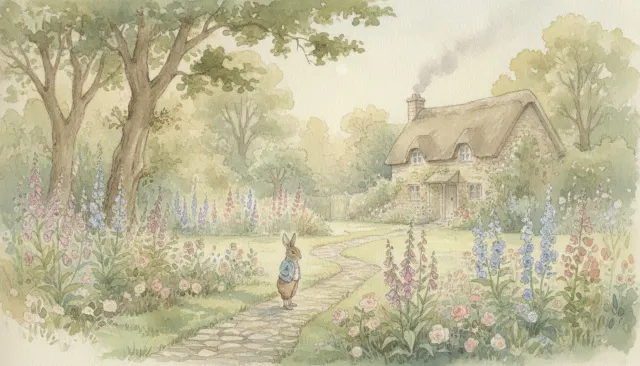
small figures in vast natural landscapes
autumn leaf color, snowfield light, summer firefly glow
page Sunday layouts without fixed grid - panels breathe and vary in size dramatically
burnt orange, deep sky blue, winter white and grey
Calvin and Hobbes, created by Bill Watterson (born 1958, Washington DC), ran from November 18, 1985 to December 31, 1995 - a run of exactly ten years and 3,150 strips, all produced by Watterson alone. It is widely considered the greatest American newspaper comic strip and one of the most sophisticated works of sequential art ever created for a mass audience.
The Sunday strip - larger format, in full color - was where Watterson most fully realized his painterly ambitions. He famously fought with his syndicate, Universal Press Syndicate, for creative control over the Sunday layout. Most syndicates required a locked format allowing editors to rearrange or remove panels; Watterson refused and, after the strip's enormous commercial success enabled him to negotiate from strength, won the right to an open Sunday format in 1991. The resulting strips are among the most visually inventive works in newspaper comics history.
The Sunday strips fall into two visual registers:
1. Imagination sequences: when Calvin imagines himself as Spaceman Spiff (interplanetary explorer), Tracer Bullet (hard-boiled detective), a dinosaur, or a participant in Hobbes's philosophical thought experiments, the panels shift into a different visual register - loose, gestural, and painterly. Watterson used a large brush loaded with watercolor to capture movement and atmosphere in ways that dry pen line cannot.
2. Nature sequences: Calvin and Hobbes explore the woods behind Calvin's house, build snow sculptures, toboggan down hills, observe autumn leaves, catch fireflies. These strips are landscapes - horizontal, panoramic, with the two small figures dwarfed by the enormity of sky and field. Watterson cites the influence of George Herriman (Krazy Kat, 1913-1944) and Windsor McCay (Little Nemo in Slumberland, 1905-1914) on his use of the Sunday page as a visual environment rather than a sequence of talking-head panels.
Watterson cited Charles Schulz as a foundational influence on the strip's emotional honesty and minimalist weekday style, but his Sunday visual ambitions drew from George Herriman, Windsor McCay, and N.C. Wyeth's illustration. He studied Charles Addams, Walt Kelly (Pogo), and Jeff MacNelly, and expressed deep admiration for the formal experimentation of newspaper comics in the 1910s-1920s.
The strip operates simultaneously as children's entertainment (Calvin's antics, his sentient stuffed tiger Hobbes, their friendship) and as adult philosophy (free will, mortality, the consolations of imagination, consumerism, environmentalism, the compromises of adulthood). Watterson's refusal to license characters - he rejected hundreds of millions of dollars in merchandising offers - is itself a statement about the integrity of the work.
December 31, 1995)
1995
Watterson's extended commentary on the strip
Calvin and Hobbes on fresh snow: 'It's a magical world, Hobbes, ol' buddy... Let's go exploring!'
A Look is not a filter. It is a set of stored decisions the pipeline reads before it makes a single frame, so two videos in the same Look actually match.