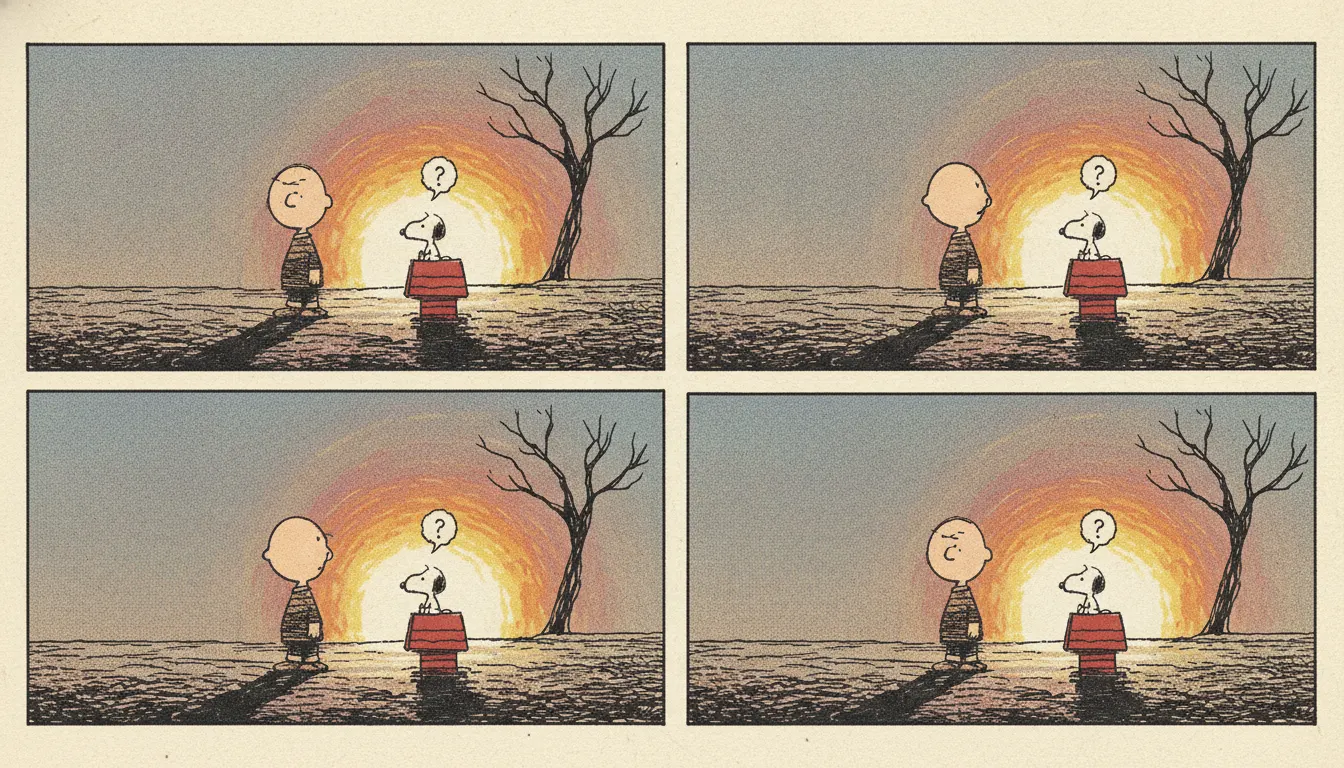
Peanuts daily strip (October 2, 1950
February 13, 2000, United Feature Syndicate)
Charles Schulz Peanuts daily strip. Wobbly trembling line, big-round-head kids, melancholic dry humour, Charlie Brown Snoopy four-panel.
The moves a human crew would use to get here. Cue applies them for you, and knowing their names is how you ask for a change.
thin variation
the face is the subject
characters exist in emotional rather than geographic space
no detail otherwise needed
Peanuts, created and drawn entirely by Charles Monroe Schulz (1922-2000), debuted on October 2, 1950 and ran continuously until February 13, 2000 - one day after Schulz died of colon cancer at 77, having drawn the final daily strip the previous December. Over fifty years it produced approximately 17,897 strips, was syndicated at its peak to 2,600 newspapers in 75 countries, and reached an estimated 355 million readers daily. No other comic strip in history has achieved this scale with total creative control maintained by a single person.
Schulz's line is deceptively simple. His characters - Charlie Brown, Snoopy, Lucy, Linus, Schroeder, Peppermint Patty, Franklin - are rendered in rounded, consistent line weights with minimal anatomical detail. Heads are enormous relative to bodies (Charlie Brown's head is essentially a large circle). Eyes in the daily strips are small dots; the characters' emotional states are communicated almost entirely through eyebrow position, mouth shape, and body posture.
The background is frequently nothing - a white void. Characters sit on a brick wall, stand at a mailbox, or lean against a tree, all floating in uncommitted space. This minimalism, which readers of the 1950s initially found sparse and modern compared to the more elaborate cartooning of the era (Li'l Abner, Dick Tracy), turned out to be a perfect vehicle for the strip's emotional register: universal and unlocated, like a feeling rather than a place.
Schulz designed everything himself - lettering, panel borders, color specifications for Sunday strips - and refused all assistants. He drew with a felt-tip pen directly from imagination, without preliminary pencil sketching in his mature period.
The strip is often described as melancholy, and it is - but it is also genuinely funny and philosophically serious. Charlie Brown's persistent failure (his baseball team loses every game, the Little Red-Haired Girl never notices him, he can never kick the football) is explicitly a meditation on inadequacy and persistence. Linus's security blanket and his belief in the Great Pumpkin address faith and vulnerability. Snoopy's fantasy life as a World War I flying ace represents the imagination's consolation for an ordinary existence.
The animated specials - A Charlie Brown Christmas (1965, dir. Bill Melendez) and It's the Great Pumpkin, Charlie Brown (1966) - extended the visual language to television with the original jazz score by Vince Guaraldi (1928-1976).
Schulz's minimalism directly influenced a generation of alternative and literary cartoonists including Charles Burns, Daniel Clowes, Lynda Barry, and Adrian Tomine, all of whom acknowledge the emotional directness his simple line made possible.
February 13, 2000, United Feature Syndicate)
A Look is not a filter. It is a set of stored decisions the pipeline reads before it makes a single frame, so two videos in the same Look actually match.