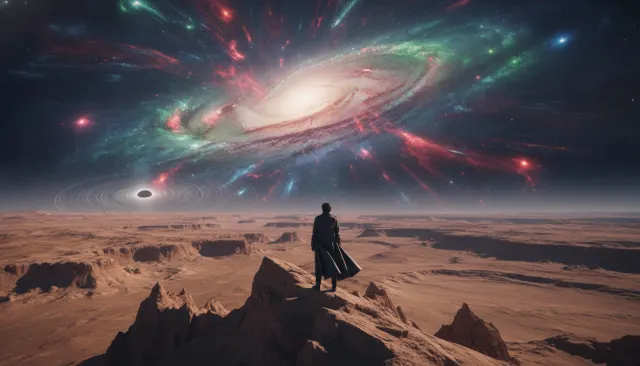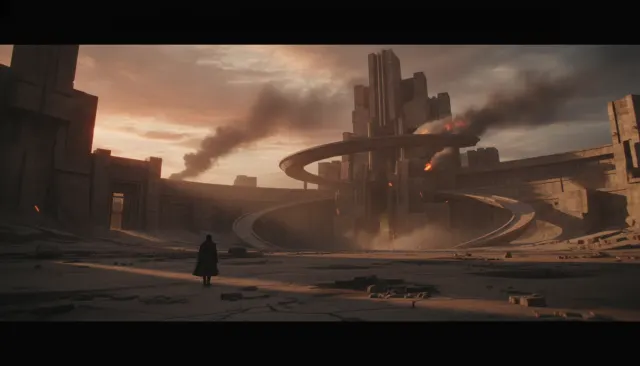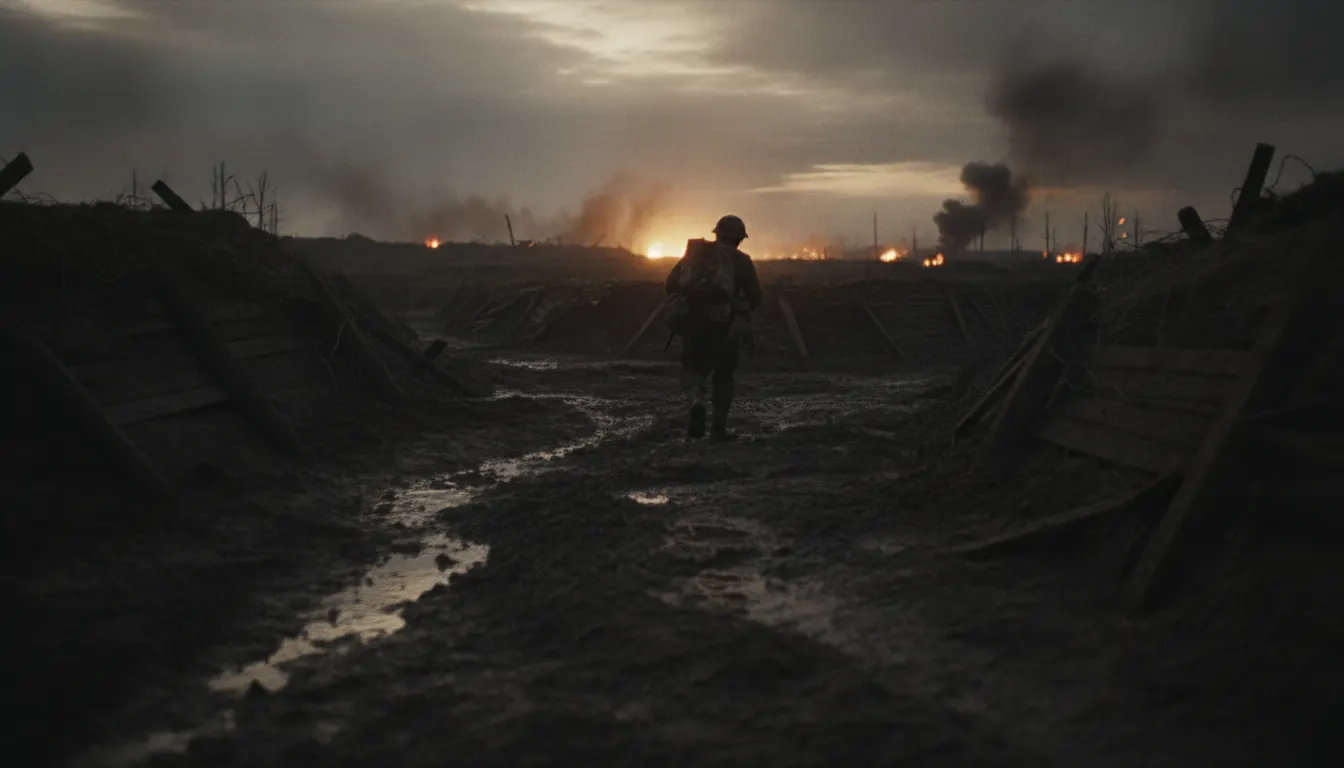
1917
Sam Mendes · 2019
Roger Deakins's second Academy Award; continuous-movement war film as unprecedented achievement in motivated lighting design
Roger Deakins 1917 single-take war film. Trench mud, golden flare-lit night, immersive walk-with-camera blocking.
The moves a human crew would use to get here. Cue applies them for you, and knowing their names is how you ask for a change.
All light sourced from practical or period-motivated sources visible within or implied by the frame, designed to function as camera moves 360 degrees.
Overhead grid of timed lights simulating descending flares over a sequence, creating orange pulsing illumination through ruins or open terrain.
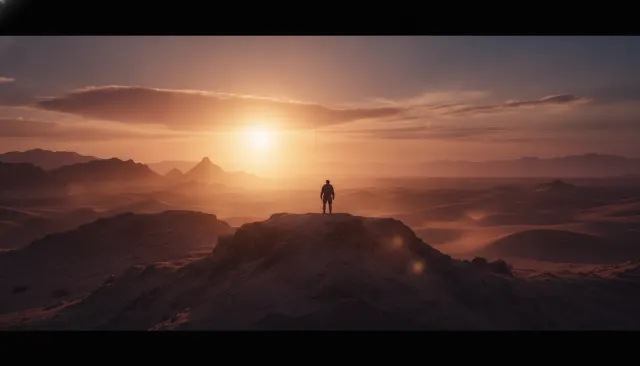
Subject held in frame center as camera moves laterally or tracks forward, landscape scrolling behind them, creating sustained real-time journey feel.
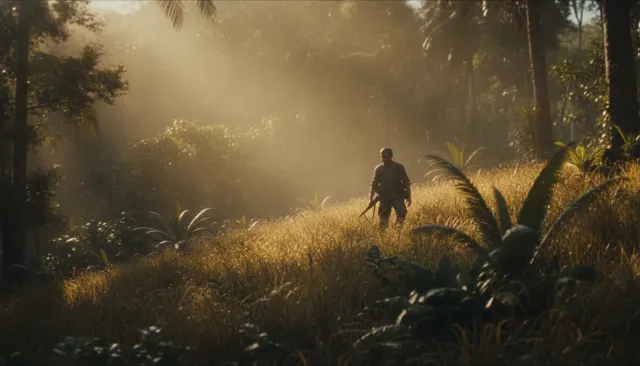
Preference for overcast conditions that eliminate hard shadows and allow continuous movement without chasing sun position.
Cuts hidden in camera swings through darkness, under objects, or at motion blur moments, creating the illusion of a single unbroken take.
Exposure calibrated to motivated practical sources - faces held bright, shadows recoverable - creating a documentary brightness strategy.
Sam Mendes's 1917 (2019), shot by Roger Deakins, is one of the most technically ambitious war films ever produced. Designed to appear as a single, unbroken take following two British soldiers across the Western Front in April 1917, it required Deakins to solve problems that no previous cinematographer had faced at this scale: how to light continuously moving action across both day and night, interior and exterior, constructed sets and real landscape, while maintaining a visual coherence that would support the illusion of real time.
The film is not literally one take - it was shot in multiple takes stitched together via invisible cuts concealed in transitions through darkness, under objects, or at camera-spin moments. But it was designed to appear uncut, which imposed extraordinary constraints on production. Every set was built to be lit continuously through 360 degrees. Every lighting setup had to function for both approach and departure. Roger Deakins's lighting was primarily motivated by practical sources - the sun, fire, flares, searchlights - and he worked with gaffer Chris Blatchley to design elaborate systems of naturalistic-appearing motivated illumination that could sustain continuous camera movement.
The daylight trench sequences open the film in flat overcast light that eliminates hard shadows and allows the camera to move freely without chasing a sun position. The Ecoust ruined village sequence - among the most extraordinary in contemporary cinema - takes place in a semi-destroyed town illuminated only by falling flares. Deakins pre-lit the set with a grid of lights above the frame line, timed to flicker as the flares descend, creating an orange pulsing quality that transforms rubble and ruins into something hallucinatory and beautiful. Schofield (George MacKay) moves through this sequence nearly alone, and the combination of physical movement and shifting light creates a dreamlike momentum.
The No Man's Land sequences were shot at Salisbury Plain, UK, with practical mist and overcast conditions supplemented by light haze machines. The visual grammar of these sequences - wide, tracking shots that keep the subject in the center of the frame while the landscape scrolls - creates the sense of crossing a vast hostile terrain in real time. Deakins maintained a consistent exposure strategy: faces held at the bright end of the meter, with detail in shadow recoverable, to maintain a slight documentary brightness.
Deakins won the Academy Award for Best Cinematography for 1917, his second Oscar win (his first was for Blade Runner 2049 in 2017). The cinematography community recognized the film as an unprecedented achievement in continuous lighting design. The film was shot on Arri Alexa Mini LF with Sigma Art lenses, with Deakins preferring longer focal lengths than Villeneuve films - a 40mm equivalent as the workhorse - to avoid GoPro-style distortion while maintaining field of view for the moving camera.
Sam Mendes · 2019
Roger Deakins's second Academy Award; continuous-movement war film as unprecedented achievement in motivated lighting design
Stanley Kubrick · 1957
Black-and-white WWI trench cinematography that established the spatial grammar of trench warfare on screen
Christopher Nolan · 2017
Hoyte van Hoytema; IMAX beach and sea war grammar that preceded and influenced 1917's large-format approach
Steven Spielberg · 1998
Janusz Kaminski; desaturated handheld D-Day grammar that defined the modern war film visual before 1917
Mel Gibson · 2016
Simon Duggan; Pacific combat with continuous movement and motivated practical lighting in heavy battle sequences
Elem Klimov · 1985
Alexei Rodionov; Soviet WWII film with continuous-movement immersive grammar that anticipates the 1917 approach
A Look is not a filter. It is a set of stored decisions the pipeline reads before it makes a single frame, so two videos in the same Look actually match.