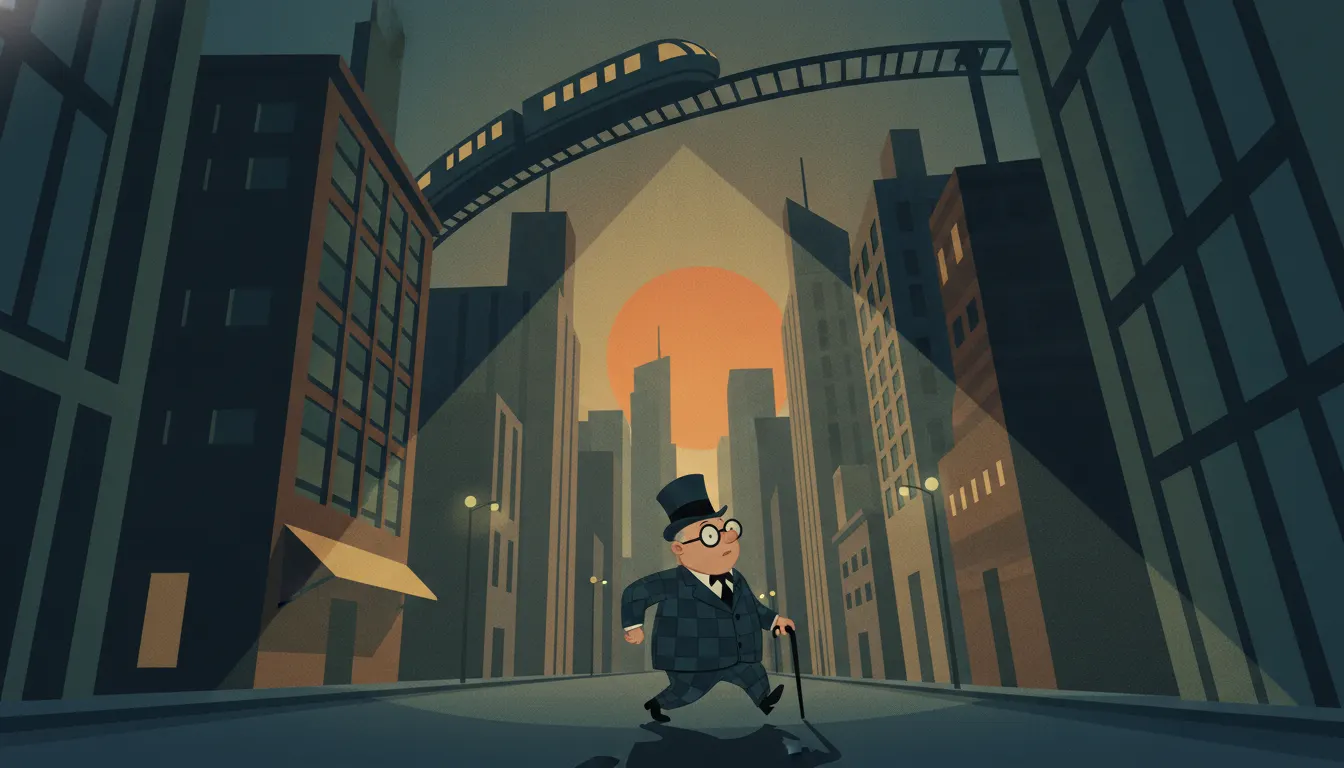
Gerald McBoing-Boing
Robert Cannon / UPA (story by Dr. Seuss) · 1950
Academy Award winner - the canonical UPA modernist short establishing the geometric flat-color philosophy
United Productions of America 1950s modernist flat-geometric style. Mr Magoo, Gerald McBoing-Boing, jazz-age design-conscious animation.
The moves a human crew would use to get here. Cue applies them for you, and knowing their names is how you ask for a change.
Characters built from pure geometric shapes - circles, rectangles, triangles - with minimal anatomical detail, achieving personality through shape combination
Environments rendered as large, flat color areas without perspective detail - Matisse-influenced color field backgrounds rather than illustrated spaces
Movement achieved through held pose-cuts and minimal in-betweens rather than full animation - the aesthetic celebrates stillness as graphic design
Colors drawn from mid-century graphic design: salmon pinks, olive greens, cool blues, warm yellows in the muted ranges of 1950s print reproduction
Large areas of empty color plane used deliberately as compositional positive elements - negative space as active design choice rather than absent detail
Emotional states reflected in color temperature and abstraction degree - John Hubley's work using jazz-synced color changes to visualize musical and psychological states
United Productions of America (UPA) was founded in 1941-1943 by a group of former Disney animators - John Hubley, Zachary Schwartz, David Hilberman, and others - who had participated in the 1941 Disney animators' strike and sought a fundamentally different approach to animation. UPA produced theatrical shorts for Columbia Pictures starting in 1948 and reached its commercial and artistic peak in the early-to-mid 1950s.
UPA's founding aesthetic premise was a direct rejection of Disney's naturalistic philosophy - the illusion of weight, volume, and physics that required full animation with every frame carefully rendered. UPA animators argued that this approach was expensive, slow, and aesthetically conservative. Their alternative drew from European modernist visual movements: Cubism, Bauhaus design, Matisse's cut-paper, Saul Steinberg's line work, Paul Klee's abstraction.
The result was 'limited animation' as artistic choice rather than budget compromise: characters built from geometric shapes with minimal detail, backgrounds rendered as flat color planes with minimal perspective, movement achieved through pose-to-pose cuts with held frames rather than full in-between animation. The 1953 short Gerald McBoing-Boing (1950, directed by Robert Cannon) and the Mr. Magoo series (beginning 1949) are the canonical examples.
Gerald McBoing-Boing (1950, directed by Robert Cannon, story by Theodore Geisel / Dr. Seuss) won the Academy Award for Best Animated Short Film in 1951. The visual approach uses pastel color fields, geometric abstraction, and minimal line work that deliberately evokes children's book illustration and European graphic art rather than the naturalistic Disney tradition.
John Hubley is the most important UPA director: his Rooty Toot Toot (1952) and A Lonely Night use jazz-influenced abstraction and expressionistic color that influenced a generation of graphic designers. After leaving UPA in 1952 following McCarthy-era political investigations, Hubley founded Storyboard Productions and continued developing the modernist animation approach.
UPA's aesthetic became the foundation for mid-century American graphic design broadly: the flat color, geometric simplicity, and bold negative space visible in Bauhaus-influenced corporate identity work, Paul Rand's IBM and ABC logos, and the visual language of mass-market American design from 1955-1975 all connect to UPA's popularization of modernist principles.
The animated TV commercial tradition of the 1950s-60s draws almost entirely from UPA's vocabulary: the Piels Beer commercials (animated by Hubley), the Bert and Harry animated spots, and mid-century cereal commercial characters all use UPA-derived flat-geometric design.
Every subsequent 'limited animation' tradition - Hanna-Barbera TV animation, Genndy Tartakovsky's flat-graphic approach, Craig McCracken's CN era, the entire UPA modernist thread in contemporary animation - traces back to the 1950s UPA model.
Robert Cannon / UPA (story by Dr. Seuss) · 1950
Academy Award winner - the canonical UPA modernist short establishing the geometric flat-color philosophy
John Hubley / UPA · 1952
Hubley's masterpiece - jazz-synchronized abstract expressionist color and modernist figure design
William T. Hurtz / UPA · 1953
James Thurber adaptation - gentle domestic modernism in the UPA suburban setting
Ted Parmelee / UPA · 1953
Poe adaptation using expressionistic color and abstraction - UPA's darkest work
John Hubley + Robert Cannon / UPA · 1949
The commercial hit that funded UPA's artistic work - nearsighted character using limited animation for character comedy
Chuck Jones / MGM · 1965
Post-UPA short by Chuck Jones directly applying UPA geometric abstraction principles
Saul Steinberg · 1940s
Primary graphic influence on UPA animators - line work and abstraction they explicitly studied and cited
A Look is not a filter. It is a set of stored decisions the pipeline reads before it makes a single frame, so two videos in the same Look actually match.
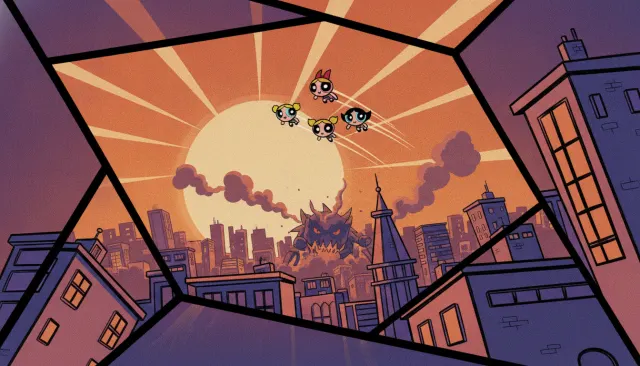 Cn 90S RevivalPowerpuff Girls CN 90s
 Cn 90S RevivalSamurai Jack Bold Action
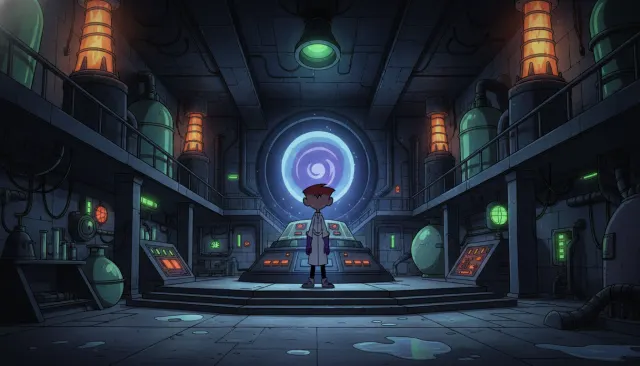 Cn 90S RevivalDexter's Lab Tartakovsky
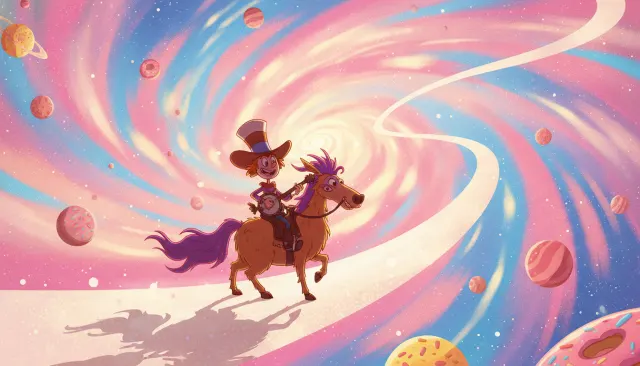 Kids Disney Channel ModernWander Over Yonder Craig McCracken
 Art Movement ModernBauhaus Modernist
 Infographic Data VizKurzgesagt Flat Vector Icon
 Concert Music PosterFestival Poster Flat Illustration