Katsushika Hokusai
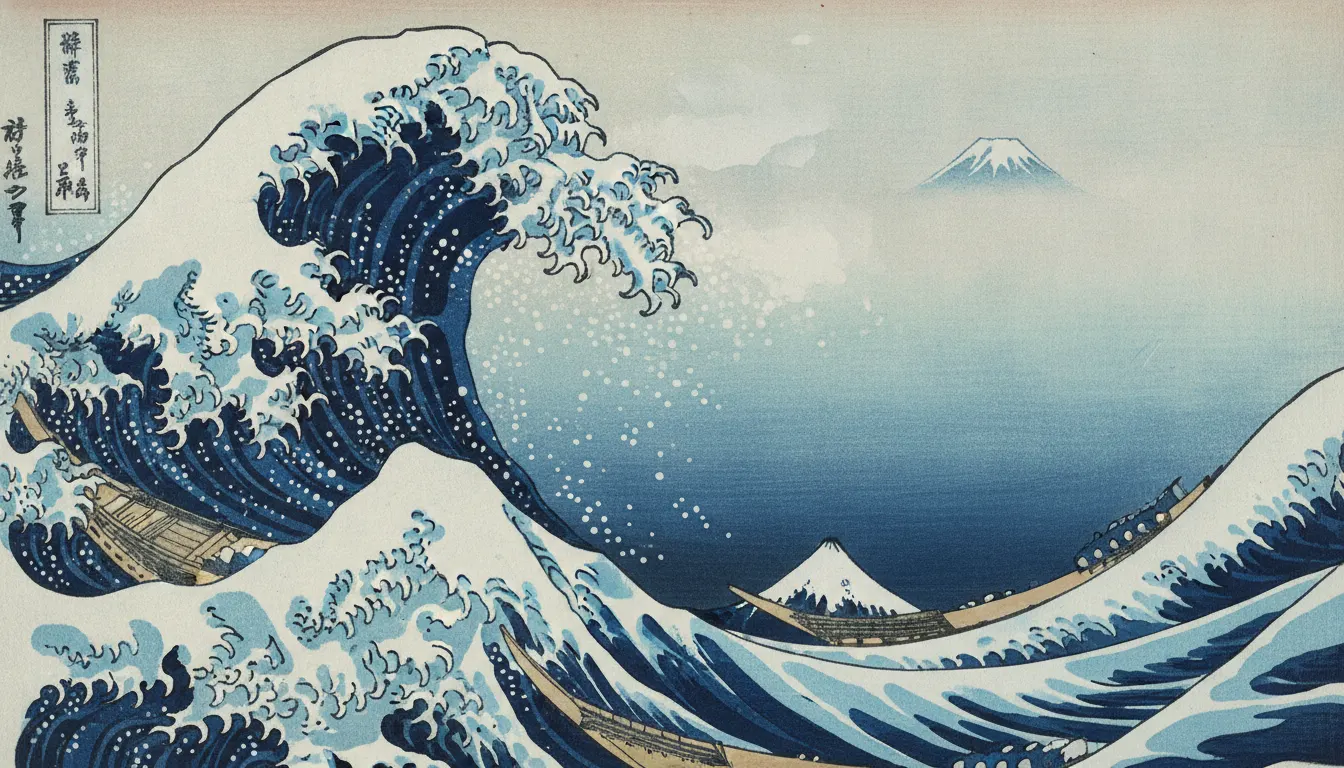
The Great Wave off Kanagawa (c. 1831, multiple collections including MMA, BM, Art Institute Chicago)
Katsushika Hokusai Great Wave ukiyo-e woodblock. Bold curling wave outline, Mount Fuji small in distance, flat indigo blue, multi-block print.
The moves a human crew would use to get here. Cue applies them for you, and knowing their names is how you ask for a change.
crisp, confident, non-wavering
Prussian blue, vermilion, ochre - no gradients inside forms
sky and water tones graded from dark to light through uneven ink application
a form that reads as detail, mid-ground force, and compositional frame simultaneously
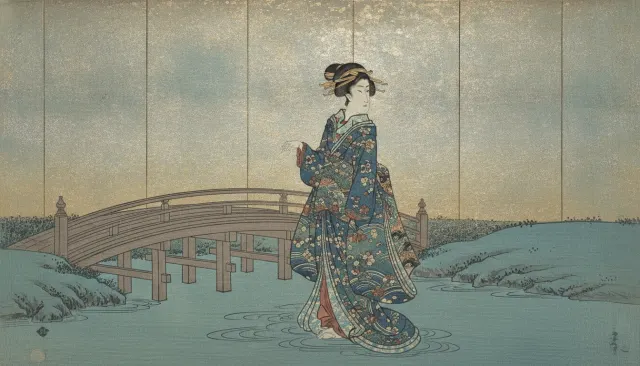
Ukiyo-e (浮世絵), literally "pictures of the floating world," was Japan's dominant commercial print art form from the 17th through 19th centuries. Originally focused on urban pleasure-quarter subjects (kabuki actors, sumo wrestlers, courtesans), the tradition was transformed by Katsushika Hokusai (1760–1849) into a vehicle for landscape art of unprecedented power and global influence.
Hokusai began the Fugaku Sanjūrokkei series in 1830, when he was 70 years old. The series was so popular that it expanded to 46 prints before completion. The Great Wave off Kanagawa (c. 1831, multiple editions) is the series' iconic opening image: a colossal foaming wave in the foreground, its claw-like crest threatening three fishing boats, with Fuji reduced to a small white cone in the distant background. The wave's curling form appears in at least three different scales simultaneously - foam as detail, crest as mid-ground force, entire wave as environmental frame for the mountain - a compositional complexity achieved through the woodblock's capacity for precise line.
Red Fuji (Fine Wind, Clear Morning) (c. 1831) renders the mountain in a single flat orange-vermilion field against a gradated blue sky at dawn - one of the simplest and most powerful compositions in print history. Rainstorm Beneath the Summit (c. 1831) divides the picture plane into diagonal bands of rain and lightning, Fuji barely visible through storm.
Ukiyo-e woodblock prints were a collaborative manufacturing process: the artist drew the design on paper, a block-cutter carved it into cherry wood planks (one per color), and a printer used water-based pigments applied with a flat brush to print each color layer in registration. Prussian blue (bero-ai or bokashi) - imported from Dutch traders - became Hokusai's signature sky and wave tone after 1829. The printing could include gradation effects (bokashi) achieved by deliberately uneven ink application.
Hokusai's One Hundred Ghost Stories (1831–32) produced the iconic The Dream of the Fisherman's Wife. His Thirty-six Views of Fuji was followed by One Hundred Views of Mount Fuji (1834–35, three volumes). His Manga sketchbooks (15 volumes, 1814–1878) functioned as a visual encyclopedia that influenced Degas, Monet, and every European artist who encountered Japonisme.
Hokusai's Great Wave is among the most reproduced images in human history. It influenced Art Nouveau's organic line, European Impressionism's compositional flatness, and continues to define the visual shorthand for Japan internationally.
The Great Wave off Kanagawa (c. 1831, multiple collections including MMA, BM, Art Institute Chicago)
Red Fuji / Fine Wind, Clear Morning (c. 1831)
Rainstorm Beneath the Summit (c. 1831)
Fuji from Kanaya on the Tōkaidō Road (c. 1831)
South Wind, Clear Sky (alternate Red Fuji version, c. 1831)
One Hundred Views of Mount Fuji (1834–35, 3 volumes)
Hokusai Manga (15 volumes, 1814–1878)
The Dream of the Fisherman's Wife (c. 1814)
A Look is not a filter. It is a set of stored decisions the pipeline reads before it makes a single frame, so two videos in the same Look actually match.