Paul Gauguin
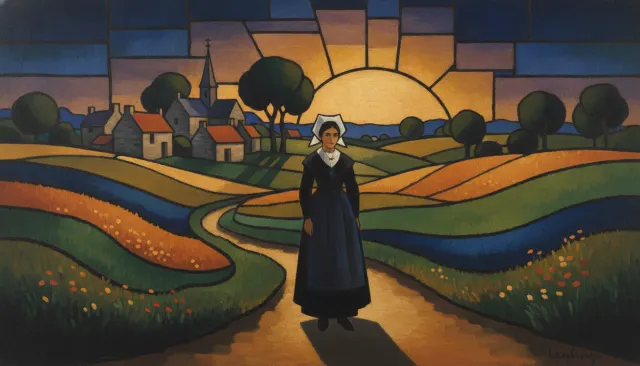
Vision After the Sermon (1888, National Gallery of Scotland)
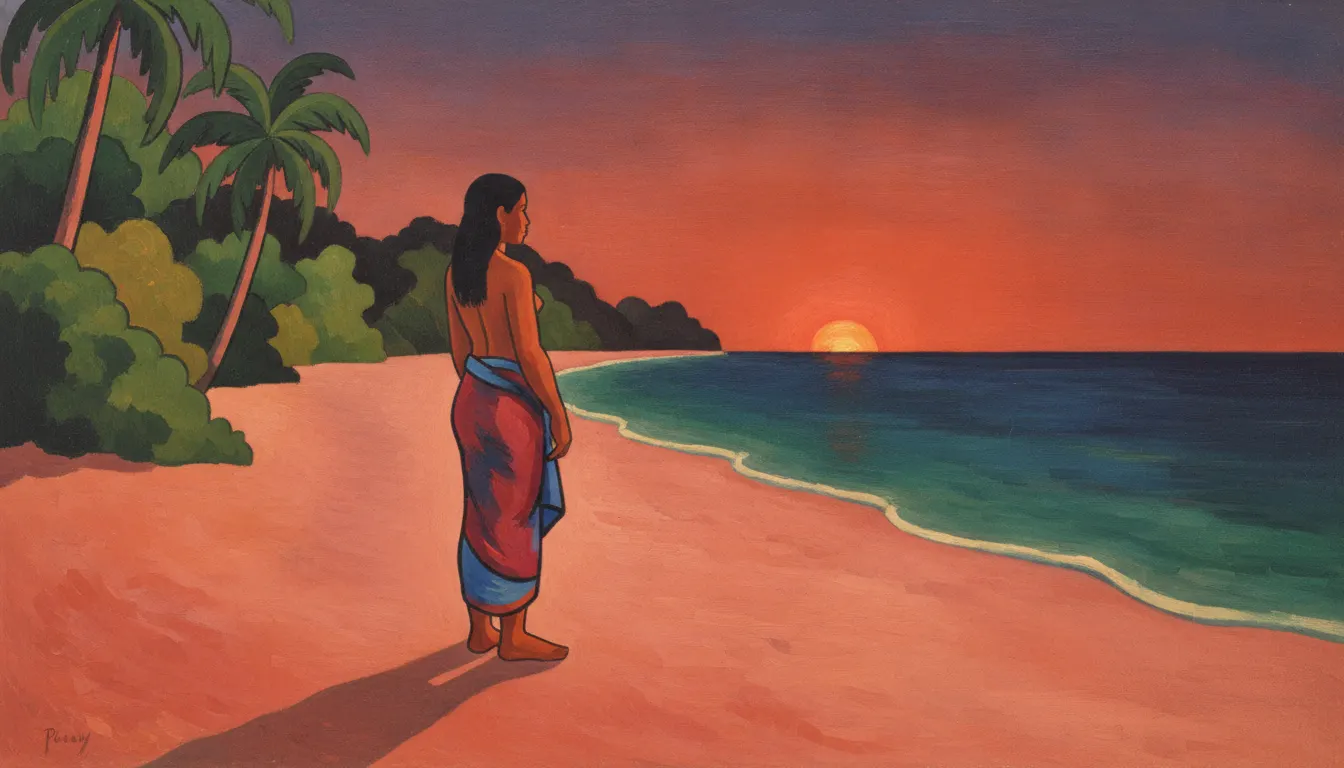
Paul Gauguin Synthetism Pont-Aven school. Flat unmodulated color planes, Tahitian figures, simplified contour, post-impressionist tropical vision.
The moves a human crew would use to get here. Cue applies them for you, and knowing their names is how you ask for a change.
borrowed from cloisonné enamel technique
naturalistic symbolic color: a red field, a yellow sky, green shadows on flesh
Synthetism was formulated in Pont-Aven, Brittany, around 1888, primarily by Paul Gauguin and the younger Émile Bernard. Their aim was to synthesize three elements: the outward form of nature, the artist's inward feeling about it, and the pure aesthetic quality of line, shape, and color. The result was a painting style that simplified forms into flat zones of bold color, bounded by dark outlines, deliberately anti-naturalistic in its palette choices.
Gauguin and Bernard competed fiercely over who originated Synthetism, but the key shared works appeared in 1888–1889. Gauguin's Vision After the Sermon (Jacob Wrestling with the Angel) (1888, National Gallery of Scotland) is the founding document: a field of pure vermilion red - a color no Breton meadow has ever been - with white-capped peasant women in the foreground and a biblical scene beyond. The red is not described light; it is felt significance. Bernard's Breton Women in the Meadow (1888) uses the same heavy-outline, flat-zone syntax.
Gauguin's first Tahitian voyage (1891–1893) amplified these tendencies to their maximum intensity. Ia Orana Maria (1891, MMA) - "I Hail You, Mary" - transplants the Annunciation to Polynesia with ochre flesh tones and exotic foliage flattened into decorative pattern. Where Do We Come From? What Are We? Where Are We Going? (1897–98, Museum of Fine Arts, Boston) is his most ambitious single canvas: a 3.7-meter frieze of Tahitian figures staged across a dream landscape, the sky an acid yellow-gold, the ground a saturated blue-green. Painted in a single month while Gauguin believed he was dying, it compresses a philosophical program into pure color and form. The White Horse (1898, Musée d'Orsay) and Nevermore (1897, Courtauld Gallery) continue this synthesis of Polynesian subject matter and European color system.
Synthetism's flat-color zones and bold outlines were a direct precursor to Art Nouveau, Fauvism, and Cubism. Matisse acknowledged Gauguin's color as a liberation. The technique also flows directly into mid-century animation backgrounds, graphic novel coloring, and contemporary brand illustration.
Synthetism reads as bold, confident, and slightly exotic - color that does not describe light but embodies emotion. It is the right look whenever naturalistic color would be timid and expressive color is the point.
Vision After the Sermon (1888, National Gallery of Scotland)
Ia Orana Maria (1891, Metropolitan Museum of Art)
Where Do We Come From? What Are We? Where Are We Going? (1897–98, MFA Boston)
Nevermore (1897, Courtauld Gallery)
The White Horse (1898, Musée d'Orsay)
Tahitian Women on the Beach (1891, Musée d'Orsay)
Breton Women in the Meadow (1888, private collection)
1887
Bathers with Red Cow
A Look is not a filter. It is a set of stored decisions the pipeline reads before it makes a single frame, so two videos in the same Look actually match.