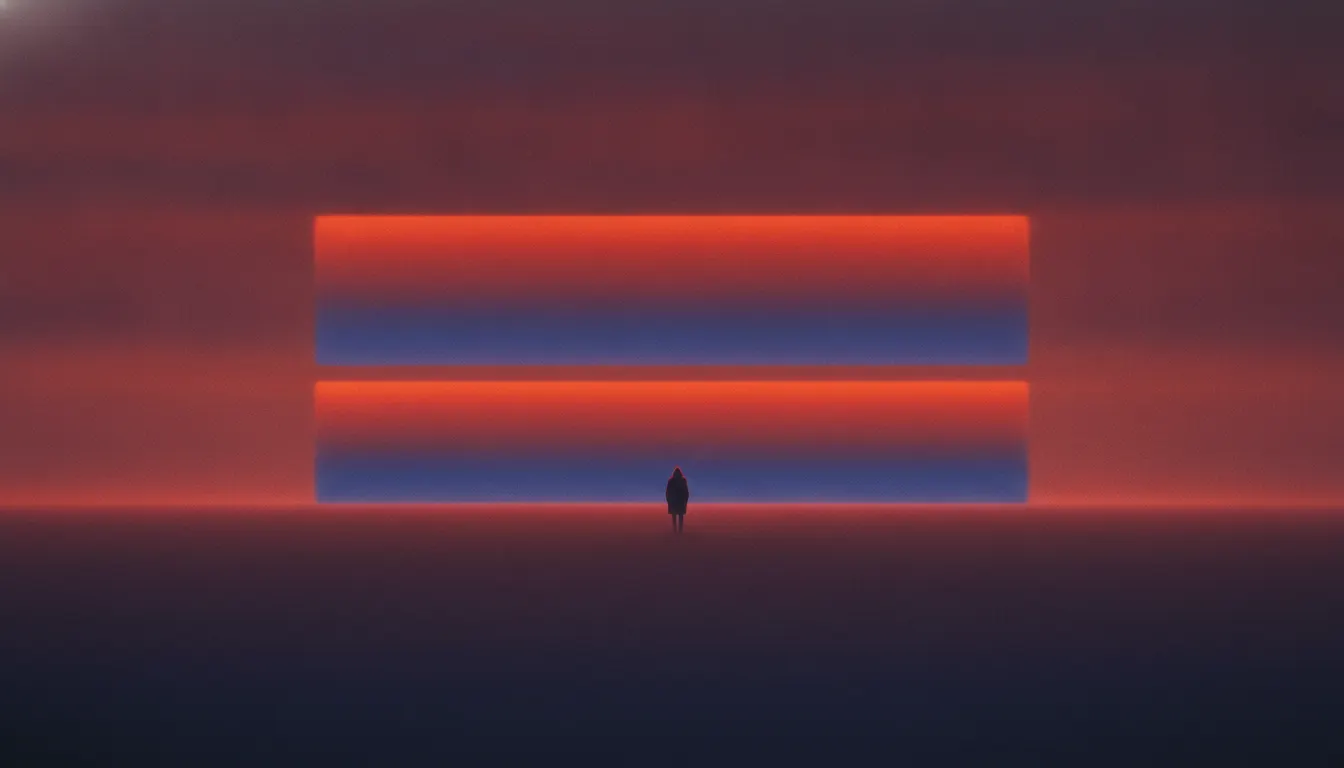
Mark Rothko
No. 61 (Rust and Blue), 1953 (MOCA, Los Angeles)
Mark Rothko color field. Two or three soft-edge horizontal rectangles glowing, transcendent saturated color, meditative scale.
The moves a human crew would use to get here. Cue applies them for you, and knowing their names is how you ask for a change.
the painting is the color
Rothko's rectangles have no hard contour, they glow into their ground
multiple thin glazes create color of optical depth
two or three horizontally stacked rectangles floating in a colored field
elimination of line, form, and traditional pictorial composition
Color Field painting is the name given to the branch of Abstract Expressionism that prioritized large areas of pure color over gestural mark-making. While the Action Painters (Pollock, de Kooning, Kline) emphasized process and physical gesture, the Color Field artists - principally Mark Rothko (1903-1970), Barnett Newman (1905-1970), and Clyfford Still (1904-1980) - sought to create immersive, meditative, emotionally overwhelming experiences through the behavior of color alone.
Marcus Rothkowitz was born in Dvinsk, Russia (now Daugavpils, Latvia) in 1903 and emigrated to the United States with his family in 1913, settling in Portland, Oregon. He studied briefly at Yale and then moved to New York, where he spent most of his career. His early work (1930s-1940s) passed through Surrealist automatism and mythological imagery before arriving, around 1949-1950, at the signature format he would maintain for the rest of his life: rectangular luminous color areas floating on a colored ground.
The paintings are large - often taller than a standing person. No. 61 (Rust and Blue) (1953) is 115 x 92 inches. Orange and Yellow (1956) is 91 x 71 inches. The scale is deliberate: Rothko insisted his paintings should not be viewed from a distance but should surround the viewer's entire field of vision, creating an intimate rather than monumental experience.
The Rothko Chapel (Houston, Texas, inaugurated 1971) is the culmination of Rothko's vision. Commissioned by John and Dominique de Menil and completed after Rothko's death by suicide in February 1970, the chapel contains fourteen large paintings in near-black plum and brown tones - the most austere of all Rothko's work - surrounding an octagonal meditation space open to all faiths. Rothko described the commission as the most important project of his life.
Barnett Newman's Vir Heroicus Sublimis (1950-51, MoMA, 242 x 513 cm) is a vast red canvas interrupted by five thin vertical bands ("zips") - Newman's signature motif, which he regarded as creating space rather than dividing it. His statement: "I'm not painting stripes. I'm painting feelings."
Clyfford Still rejected the art market and critical establishment throughout his career, stipulating in his will that his estate not be sold or broken up. The Clyfford Still Museum in Denver (opened 2011) holds approximately 94% of his life's work.
Color Field in practice: large expanses of saturated or subtly modulated color; soft, blurred edges between color areas (Rothko achieved this through thin layers of oil paint applied over rabbit-skin glue ground); deep chromatic saturation that changes with viewing distance and light; a near-elimination of line, form, and composition as traditionally understood.
No. 61 (Rust and Blue), 1953 (MOCA, Los Angeles)
Orange and Yellow, 1956 (Albright-Knox Art Gallery, Buffalo)
Four Darks in Red, 1958 (Whitney Museum of American Art)
Vir Heroicus Sublimis (1950-51, MoMA, New York)
PH-950, 1950 (Clyfford Still Museum, Denver)
Mountains and Sea (1952, National Gallery of Art) - Color Field by staining technique
A Look is not a filter. It is a set of stored decisions the pipeline reads before it makes a single frame, so two videos in the same Look actually match.