Pamela Colman Smith
The Fool (card 0, Rider-Waite deck, 1909)
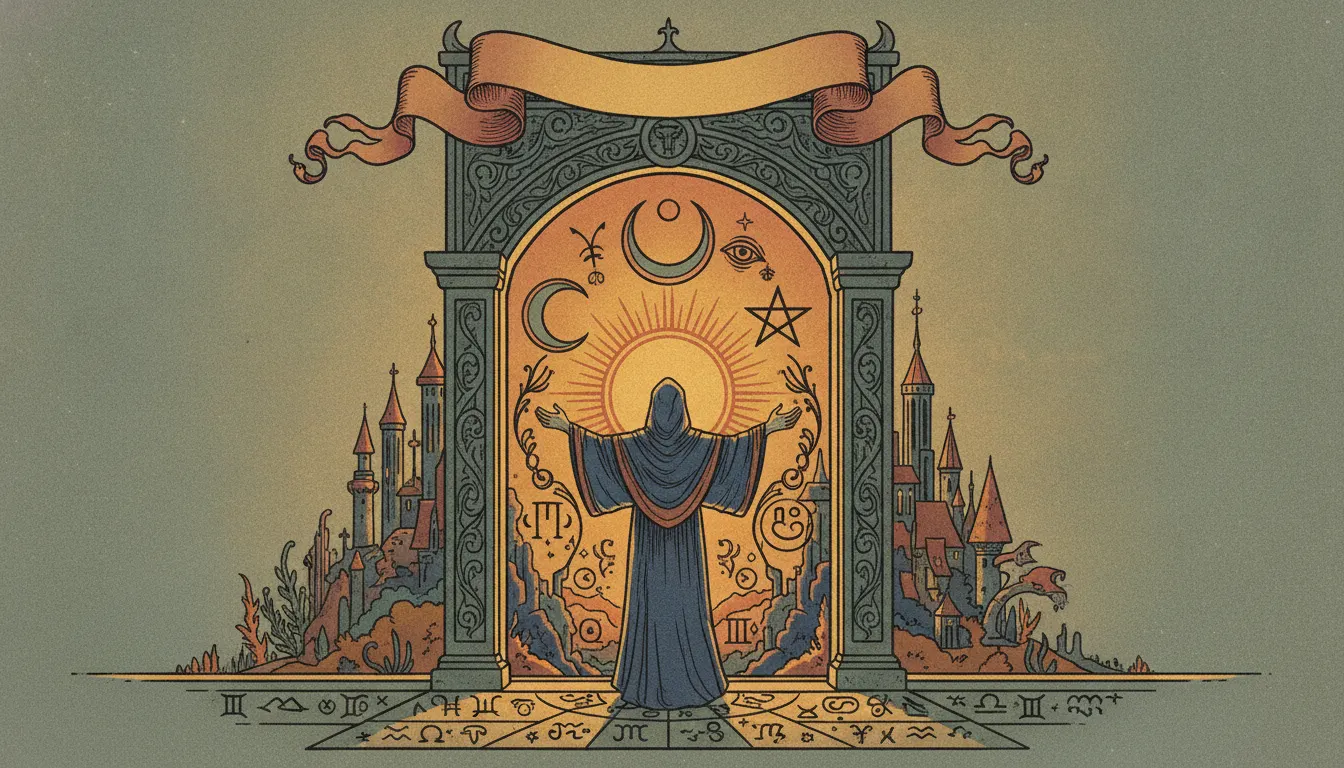
Pamela Colman Smith Rider-Waite tarot illustration. Symbolic figure in archway, banner caption, occult-Edwardian limited palette.
The moves a human crew would use to get here. Cue applies them for you, and knowing their names is how you ask for a change.
deep cobalt, solar yellow, black - with minimal internal modeling
yellow = illumination, red = passion, white = purity, blue = intuition
pillars, stars, cliffs, rivers as archetypal stage sets
like clarity: cups, wands, swords, pentacles
symbolic importance determines scale, not spatial logic
The Rider-Waite tarot deck, published in December 1909 by Rider & Company, London, was a collaboration between occultist A.E. Waite and artist Pamela Colman Smith (1878–1951). Smith - known in the Golden Dawn circle as "Pixie" - was the first illustrator to create fully pictorial scenes for all 78 cards, including the 56 minor arcana, which in previous decks had been shown as purely symbolic pip arrangements. Smith's innovation was to give every card a narrative human scene, making the deck both a mystical reference system and a coherent body of illustration.
Smith trained at the Pratt Institute in Brooklyn and was influenced by Japanese woodblock prints, Celtic revivalism, and Pre-Raphaelite illustration. Her card images use flat planes of color - bold yellows, deep blues, white - with figures in theatrical, slightly heraldic poses. The backgrounds are schematic and symbolic: a cliff, a river, a starfield. Perspective is shallow or absent. Scale is determined by symbolic importance rather than spatial logic. The Fool (card 0) skips toward a cliff edge with a white sun behind him; The High Priestess (card II) sits between twin pillars with a Torah scroll; The Tower (card XVI) shows lightning shattering a crown from a tower top as bodies fall - one of the most powerful single images in the deck.
Color in the Rider-Waite system is loaded: yellow backgrounds signal spiritual illumination; red garments indicate passion and action; white signals purity; black implies the hidden or unconscious. The wand suits glow orange; cups are associated with blue water; swords with grey sky; pentacles with green earth. This systematic color-meaning correspondence makes the deck function as a visual grammar as much as a set of illustrations.
The Rider-Waite is the template for virtually all subsequent tarot decks. Its visual vocabulary has been cited by illustrators from comic books to brand identity design. The Thoth Tarot (Aleister Crowley / Lady Frieda Harris, 1942–43) and the Visconti-Sforza (15th century) are the two alternative canonical decks, but Rider-Waite's pictorial completeness makes it the reference point. In contemporary culture, tarot imagery has migrated into fashion shoots, social media aesthetics, and brand illustrations as a shorthand for mystery, intuition, and self-exploration.
The Fool (card 0, Rider-Waite deck, 1909)
The High Priestess (card II, 1909)
The Tower (card XVI, 1909)
The World (card XXI, 1909)
The Star (card XVII, 1909)
The Moon (card XVIII, 1909)
Thoth Tarot (1942–43)
A Look is not a filter. It is a set of stored decisions the pipeline reads before it makes a single frame, so two videos in the same Look actually match.