Kazimir Malevich
Black Square (1915, Tretyakov Gallery, Moscow)
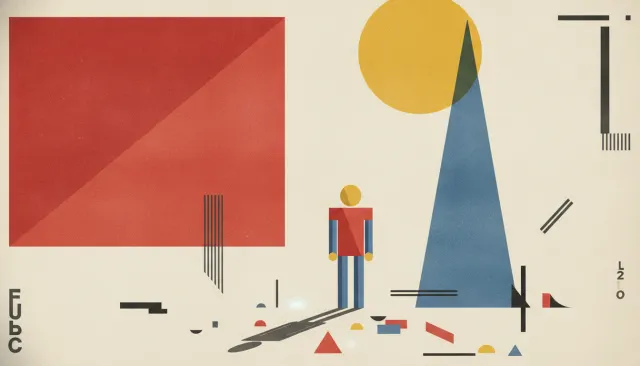
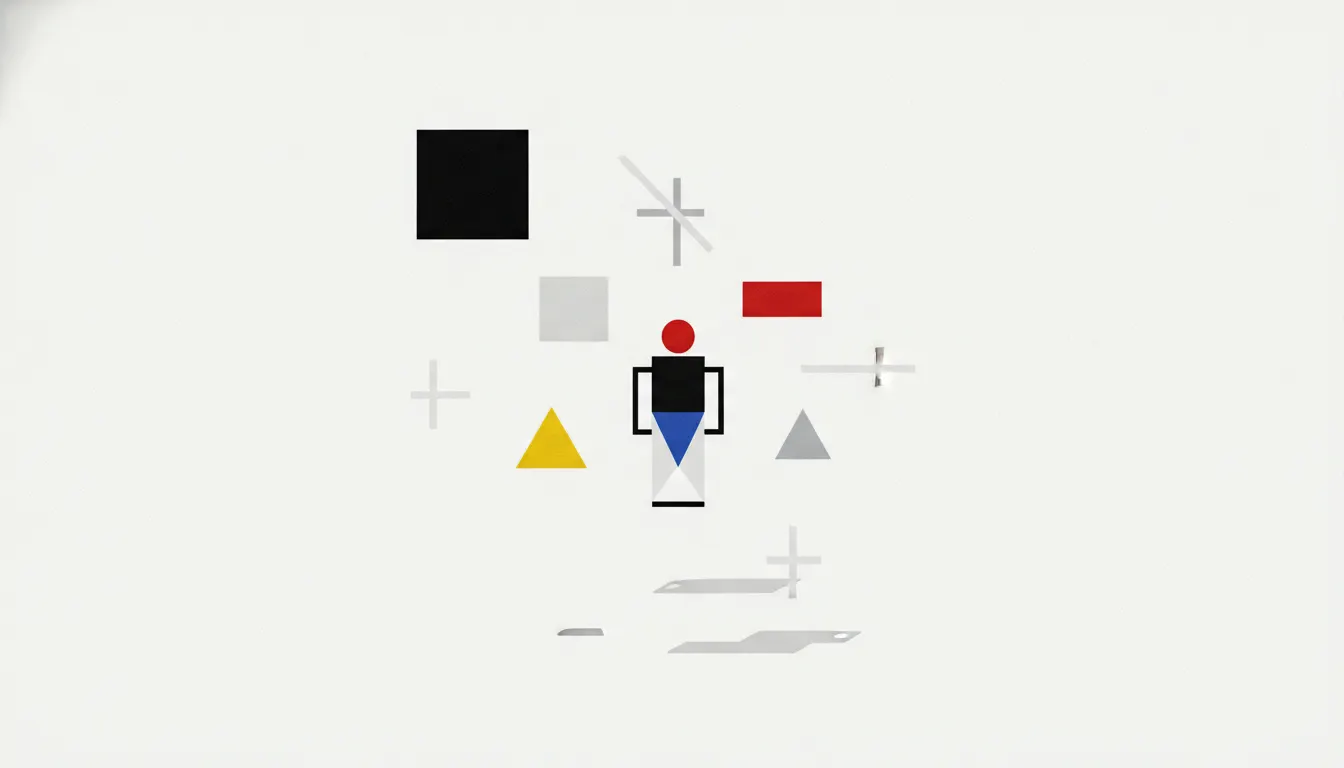
Kazimir Malevich Suprematism. Black Square, pure geometric color planes floating on white, abstract spiritual minimalism.
The moves a human crew would use to get here. Cue applies them for you, and knowing their names is how you ask for a change.
squares, circles, crosses, bars - on a pure white ground with no horizon or gravity
primary black, red, and white dominate; no gradients, no texture
center placement that creates visual tension
monochrome compositions where value contrast alone structures space
Suprematism was founded by Kazimir Malevich (1879–1935) around 1913 and unveiled to the world at the landmark "0.10" exhibition in Petrograd in December 1915. The movement's central claim, stated in Malevich's 1916 manifesto, is radical: art must free itself entirely from the world of objects and represent only "pure feeling" through geometric form. A black square is not a symbol of anything - it is the irreducible unit of sensation.
Black Square (1915, Tretyakov Gallery, Moscow) shocked contemporaries because it claimed the position in Malevich's apartment where religious icons traditionally hung. It announced the death of representation. Black Circle and Black Cross completed a trinity of primary forms that year. Suprematist Composition: Airplane Flying (1915, MoMA) introduced dynamic diagonal energy - rectangles and bars floating in implied flight across a white field. White on White (1918, MoMA) pushed the experiment to its logical extreme: a tilted white square barely distinguishable from its white ground, sensation reduced to near-zero.
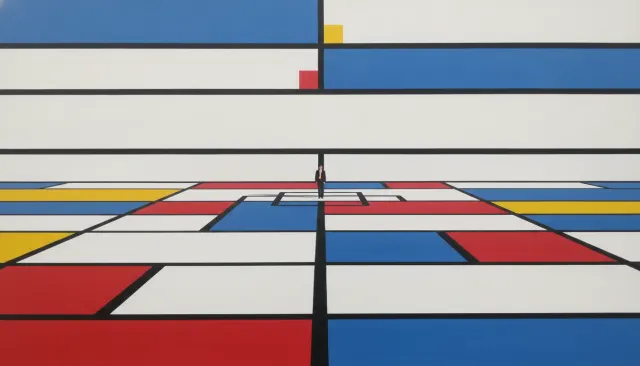
Malevich codified Suprematism as a system of expanding geometric vocabulary: squares, circles, crosses, rectangles in black, then colors, then gradients. His followers at UNOVIS ("Champions of the New Art," Vitebsk 1919–1922) - including El Lissitzky - applied Suprematist principles to architecture, typography, and industrial design, generating the visual DNA of the Bauhaus and De Stijl movements.
El Lissitzky's Proun series (1919–1923) took Suprematist geometry into three-dimensional axonometric space, bridging painting and architecture. His Beat the Whites with the Red Wedge (1919) showed how the geometric vocabulary could carry political force.
The Russian Revolution of 1917 initially embraced Suprematism as an art of the new world. Malevich was appointed head of the Vitebsk Art School in 1919, where he launched UNOVIS (Affirmers of the New Art) and recruited El Lissitzky. But by the mid-1920s, Soviet cultural policy turned toward Socialist Realism, and abstract art was condemned as bourgeois formalism. Malevich returned to representational painting in the 1930s under political pressure, though he continued to advocate Suprematist theory privately. He died in Leningrad in 1935; his body was buried in a Suprematist-designed coffin and under a black square monument.
Suprematism's geometry is embedded in modern logo design, Swiss graphic design, and every tech-company icon system. As a video look, it reads as intellectual, bold, and avant-garde - suited to design, technology, philosophy, or any content that wants to signal that ideas have been stripped to their essence.
Black Square (1915, Tretyakov Gallery, Moscow)
Black Circle (1915, Russian Museum, St. Petersburg)
Suprematist Composition: Airplane Flying (1915, MoMA)
Suprematist Composition: Eight Red Rectangles (1915, Stedelijk Museum)
White on White (1918, MoMA)
1919
Beat the Whites with the Red Wedge
Proun 19D (c. 1920–21, MoMA)
Dynamic Suprematism (1916, Tate Modern)
A Look is not a filter. It is a set of stored decisions the pipeline reads before it makes a single frame, so two videos in the same Look actually match.